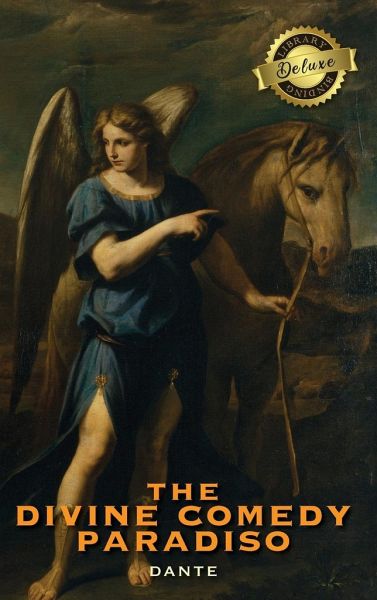
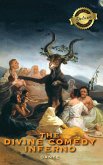
After an initial ascension, Beatrice guides Dante through the nine celestial spheres of Heaven. These are concentric and spherical, as in Aristotelian and Ptolemaic cosmology. The structure of Paradiso is based on the four cardinal virtues and the three theological virtues. In Paradiso, Dante meets and converses with several great saints of the Church, including Saint Peter, and St. John. Allegorically, the poem represents the soul's ascent to God. The Divine Comedy represents a vision of the afterlife of the medieval world-view as it had developed in the Western Church by the 14th century.…mehr
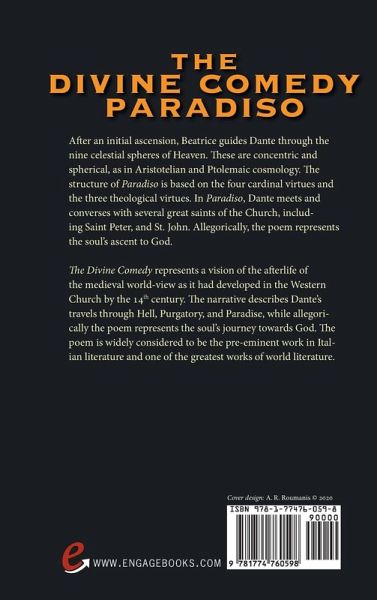
After an initial ascension, Beatrice guides Dante through the nine celestial spheres of Heaven. These are concentric and spherical, as in Aristotelian and Ptolemaic cosmology. The structure of Paradiso is based on the four cardinal virtues and the three theological virtues. In Paradiso, Dante meets and converses with several great saints of the Church, including Saint Peter, and St. John. Allegorically, the poem represents the soul's ascent to God. The Divine Comedy represents a vision of the afterlife of the medieval world-view as it had developed in the Western Church by the 14th century. The narrative describes Dante's travels through Hell, Purgatory, and Paradise, while allegorically the poem represents the soul's journey towards God. The poem is widely considered to be the pre-eminent work in Italian literature and one of the greatest works of world literature.
Dante Aligheri, commonly known simply as Dante, was an Italian poet, writer, and philosopher born in 1265 in Florence, Italy. He is best known for his monumental work, The Divine Comedy, originally titled Comed a and later called Divina by Giovanni Boccaccio. This epic poem is widely regarded as one of the greatest literary works in Western history. Dante s writing reflects his deep understanding of philosophy, theology, and human nature, influenced by great figures such as Virgil, Guido Cavalcanti, Aristotle, and Guido Guinizelli. Dante married Gemma Di Manetto Donati in 1285, and they remained married until his death in 1321. He passed away in Ravenna at the age of 56. Dante's work not only revolutionized Italian literature but also had a profound impact on European literature as a whole, shaping the course of literary history for centuries to come. His works have inspired countless scholars, poets, and thinkers, with his exploration of the afterlife, human virtue, and divine justice continuing to resonate today.
Es gelten unsere Allgemeinen Geschäftsbedingungen: www.buecher.de/agb
Impressum
www.buecher.de ist ein Internetauftritt der buecher.de internetstores GmbH
Geschäftsführung: Monica Sawhney | Roland Kölbl | Günter Hilger
Sitz der Gesellschaft: Batheyer Straße 115 - 117, 58099 Hagen
Postanschrift: Bürgermeister-Wegele-Str. 12, 86167 Augsburg
Amtsgericht Hagen HRB 13257
Steuernummer: 321/5800/1497
USt-IdNr: DE450055826