After brilliantly capturing the sense of loss and linguistic violence of the Inferno, Jason Baxter now turns to communicating the fugue-like magic of the Purgatorio. On the one hand, his translation is sensitive to the Purgatorio's new, soaring lyrical style that Dante so admired in his classical authors; on the other, it has an ear for the humble, the unexpectedly lowly-for experiences and feelings "rooted" in the body, like those found in the fervent, devotional art of the late Middle Ages. In this way, Baxter gives modern readers not just an accurate translation of Dante's Italian but an…mehr
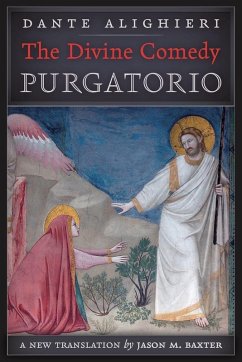
After brilliantly capturing the sense of loss and linguistic violence of the Inferno, Jason Baxter now turns to communicating the fugue-like magic of the Purgatorio. On the one hand, his translation is sensitive to the Purgatorio's new, soaring lyrical style that Dante so admired in his classical authors; on the other, it has an ear for the humble, the unexpectedly lowly-for experiences and feelings "rooted" in the body, like those found in the fervent, devotional art of the late Middle Ages. In this way, Baxter gives modern readers not just an accurate translation of Dante's Italian but an immersive experience into the feelings, intimations, and realizations Dante's original readers must have had as they made their way through the unmatched moral evocations and inner tutelage of this second panel of The Divine Comedy.
Durante degli Alighieri (1265 - 1321), was a major Italian poet of the Late Middle Ages. His Divine Comedy, originally called Comedìa and later christened Divina by Boccaccio, is widely considered the greatest literary work composed in the Italian language and a masterpiece of world literature. In the late Middle Ages, the overwhelming majority of poetry was written in Latin and therefore accessible only to affluent and educated audiences. In De vulgari eloquentia (On Eloquence in the Vernacular), however, Dante defended use of the vernacular in literature. He himself would even write in the Tuscan dialect for works such as The New Life (1295) and the aforementioned Divine Comedy; this choice, although highly unorthodox, set a hugely important precedent that later Italian writers such as Petrarch and Boccaccio would follow. As a result, Dante played an instrumental role in establishing the national language of Italy.
Es gelten unsere Allgemeinen Geschäftsbedingungen: www.buecher.de/agb
Impressum
www.buecher.de ist ein Internetauftritt der buecher.de internetstores GmbH
Geschäftsführung: Monica Sawhney | Roland Kölbl | Günter Hilger
Sitz der Gesellschaft: Batheyer Straße 115 - 117, 58099 Hagen
Postanschrift: Bürgermeister-Wegele-Str. 12, 86167 Augsburg
Amtsgericht Hagen HRB 13257
Steuernummer: 321/5800/1497
USt-IdNr: DE450055826