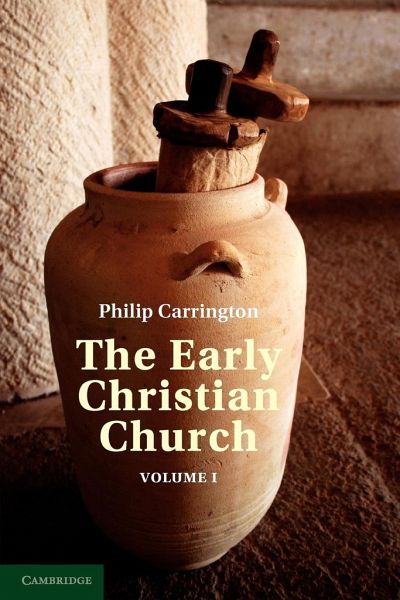
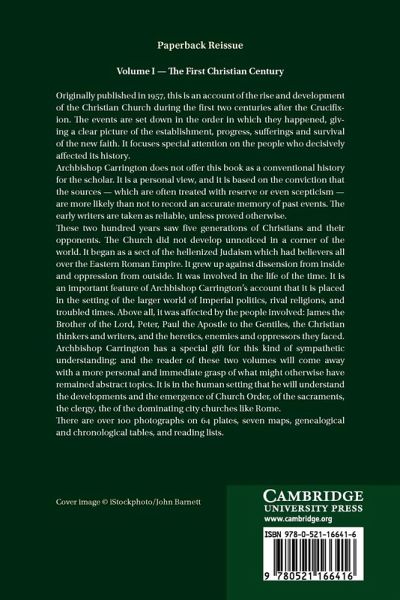
This is a 1957 account of the rise and development of the Christian Church during the first two centuries after the Crucifixion. The events are set down in the order in which they happened, giving a clear picture of the establishment, progress, sufferings and survival of the new faith. It focuses special attention on the men who decisively affected its history. Christianity began as a sect of the Hellenized Judaism which had believers all over the Eastern Roman Empire. It grew up against dissension from inside and oppression from outside. Archbishop Carrington's account of Christianity is…mehr
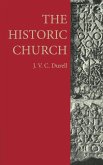
This is a 1957 account of the rise and development of the Christian Church during the first two centuries after the Crucifixion. The events are set down in the order in which they happened, giving a clear picture of the establishment, progress, sufferings and survival of the new faith. It focuses special attention on the men who decisively affected its history. Christianity began as a sect of the Hellenized Judaism which had believers all over the Eastern Roman Empire. It grew up against dissension from inside and oppression from outside. Archbishop Carrington's account of Christianity is placed in the setting of the larger world of Imperial politics, rival religions and troubled times. The author does not offer this book as a conventional history for the scholar, yet it can be read for pleasure as well as for information. There are over 100 photographs and chronological tables, and reading lists.
Philip Carrington was born July 6, 1892, in Lichfield, England, and died October 3, 1975. He was educated at Christ's College, New Zealand; Canterbury University College, New Zealand; and Selwyn College, Cambridge. His degrees included both earned (M.A.,D.D., Litt.D.) and honorary ones (S.T.D, D.C.L.). As an Anglican scholar he held various positions in New Zealand (1922), Australia (1924-27), and Canada (1927-60), including the Archbishopric of Quebec. He was the author of fourteen scholarly books on subjects as diverse as apologetics, ecclesiology, the life of Christ, church history, and the New Testament.
Inhaltsangabe
List of illustrations List of maps and tables The sources Introduction 1. The Hellenistic Period 2. Galilee and Jerusalem 3. Caesarea 4. Antioch and Galatia 5. Conference in Jerusalem 6. Macedonia and Achaia 7. Ephesus 8. Pilgrimage to Jerusalem 9. Paul in Rome 10. The martyrdoms 11. The tradition of Peter 12. The fall of Jerusalem 13. Jewish Christianity 14. The Pauline successors 15. Christian literature under Vespasian 16. The Elders in Asia Minor 17. The Syrian Gospel 18. The tyranny of Domitian 19. The Ephesian Gospel 20. Corinth and Rome 21. Hermas and his angel 22. Oriental Christianity 23. The wars of Trajan 24. Ingatius the Martyr 25. Apostolic tradition 26. Catechism and sacrament Bibliography Index.
List of illustrations List of maps and tables The sources Introduction 1. The Hellenistic Period 2. Galilee and Jerusalem 3. Caesarea 4. Antioch and Galatia 5. Conference in Jerusalem 6. Macedonia and Achaia 7. Ephesus 8. Pilgrimage to Jerusalem 9. Paul in Rome 10. The martyrdoms 11. The tradition of Peter 12. The fall of Jerusalem 13. Jewish Christianity 14. The Pauline successors 15. Christian literature under Vespasian 16. The Elders in Asia Minor 17. The Syrian Gospel 18. The tyranny of Domitian 19. The Ephesian Gospel 20. Corinth and Rome 21. Hermas and his angel 22. Oriental Christianity 23. The wars of Trajan 24. Ingatius the Martyr 25. Apostolic tradition 26. Catechism and sacrament Bibliography Index.
Es gelten unsere Allgemeinen Geschäftsbedingungen: www.buecher.de/agb
Impressum
www.buecher.de ist ein Internetauftritt der buecher.de internetstores GmbH
Geschäftsführung: Monica Sawhney | Roland Kölbl | Günter Hilger
Sitz der Gesellschaft: Batheyer Straße 115 - 117, 58099 Hagen
Postanschrift: Bürgermeister-Wegele-Str. 12, 86167 Augsburg
Amtsgericht Hagen HRB 13257
Steuernummer: 321/5800/1497
USt-IdNr: DE450055826