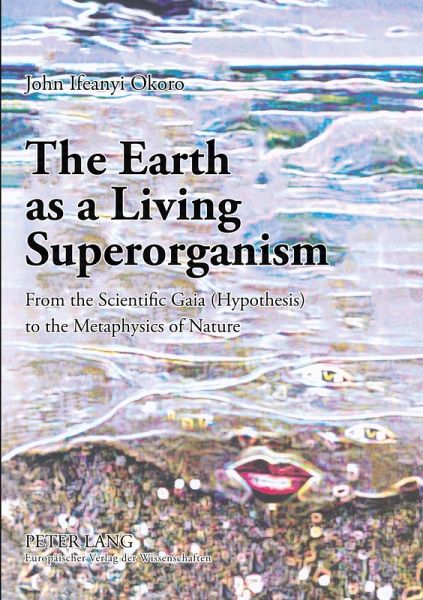
A guest from another star to our solar system could use a simple spectroscope to explore the atmospheres of the planets, and wind up that while Venus and Mars, which both have carbon dioxide atmospheres, do not have life, Earth, with its oxygen-rich atmosphere, must have, and is alive. Today, there are many different views of Gaia, ranging from the semi-religious way in which many people have latched on to the idea of the planet as a living "Mother Earth", to oppositions from some scientists who regard the whole thing as utter nonsense. Interpreting the Earth as a superorganism in this book…mehr
A guest from another star to our solar system could use a simple spectroscope to explore the atmospheres of the planets, and wind up that while Venus and Mars, which both have carbon dioxide atmospheres, do not have life, Earth, with its oxygen-rich atmosphere, must have, and is alive. Today, there are many different views of Gaia, ranging from the semi-religious way in which many people have latched on to the idea of the planet as a living "Mother Earth", to oppositions from some scientists who regard the whole thing as utter nonsense. Interpreting the Earth as a superorganism in this book represents something transcendentally new. In fact, it implies a theory, which is susceptible to being tailored and treated with rigorous metaphysical, mathematical and scientific means. It particularly calls for a new ontology, which we can qualify as an ecometaphysics, or ecoontology of an interconnection and interelatedness of all things.
The Author: John Ifeanyi Okoro, Priest, studied Philosophy, Theology, Psychology and Education, Computer Formation, French and German Languages in Nigeria (Bigard), in Cameroun (Regional Major Seminary of Douala), in Belgium and in Germany. After a Master¿s degree in Philosophy at the Université catholique de Louvain (UCL), Louvain-la-neuve (Belgium), he received another Master¿s in Psychology and Education at the VUB, Brussels, and then a Ph.D. in Philosophy and Letters at the UCL, where he continued as a Post Doctoral Researcher, and a Seminar Assistantship in Environmental Philosophy at different universities in Germany and Switzerland. Presently the author is Pfarrer Cooperator in Die Fünf Pfarreien Barweiler/Antweiler at the Bistum Trier.
Inhaltsangabe
Contents: The Idea of the Earth as a Living Superorganism - The Basis of Western Vision of Nature and the Origin of Science - The Science of Ecology and Deep Ecology - Gaia Hypothesis: Scientific and Ontological Dimensions - The Classical Pictures of the Cosmos and Gaia - Gaian Cybernetic Vision and the Logic of Modern Science - Systemic Approach and Organised Complexity - Dangers and Importance of Technology and Gaia.
Contents: The Idea of the Earth as a Living Superorganism - The Basis of Western Vision of Nature and the Origin of Science - The Science of Ecology and Deep Ecology - Gaia Hypothesis: Scientific and Ontological Dimensions - The Classical Pictures of the Cosmos and Gaia - Gaian Cybernetic Vision and the Logic of Modern Science - Systemic Approach and Organised Complexity - Dangers and Importance of Technology and Gaia.
Es gelten unsere Allgemeinen Geschäftsbedingungen: www.buecher.de/agb
Impressum
www.buecher.de ist ein Internetauftritt der buecher.de internetstores GmbH
Geschäftsführung: Monica Sawhney | Roland Kölbl | Günter Hilger
Sitz der Gesellschaft: Batheyer Straße 115 - 117, 58099 Hagen
Postanschrift: Bürgermeister-Wegele-Str. 12, 86167 Augsburg
Amtsgericht Hagen HRB 13257
Steuernummer: 321/5800/1497
USt-IdNr: DE450055826