
Thomas J. Miceli
The Economic Approach to Law, Third Edition
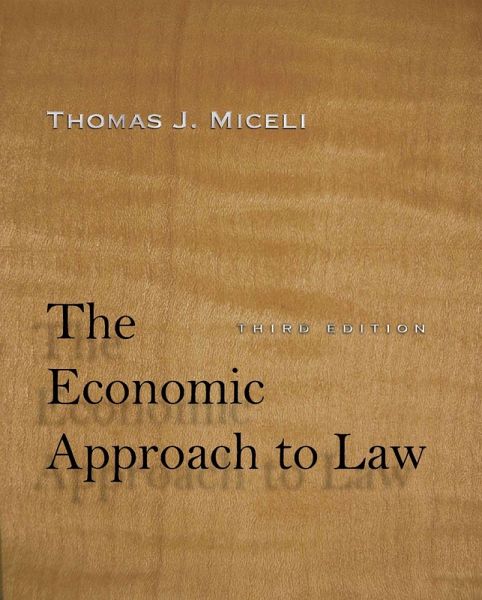
Thomas J. Miceli
The Economic Approach to Law, Third Edition
- Gebundenes Buch
- Merkliste
- Auf die Merkliste
- Bewerten Bewerten
- Teilen
- Produkt teilen
- Produkterinnerung
- Produkterinnerung
Now in its third edition, this book uses the basic tools of economic theory to depict law as a social institution, aimed at inducing socially desirable behavior. Up-to-date with discussions of recent cases and the latest research, The Economic Approach to Law is optimally organized for courses in Law and Economics.
Andere Kunden interessierten sich auch für
 Law, Surveillance and the Humanities30,99 €
 David KennyPragmatism, Law, and Literature138,99 €
 Law, Reason, and Emotion115,99 €
 Danny GittingsIntroduction to the Hong Kong Basic Law, Second Edition46,99 €
 Michael MandelstamSafeguarding Adults and the Law, Third Edition70,99 €
 John FultonThe Laws of Marriage: Containing the Hebrew Law, the Roman Law, the Law of the New Testament, and the Canon Law of the Universal Church: Con31,99 €
 Samuel GreggNatural Law, Economics and the Common Good32,99 €
-
-
-







Now in its third edition, this book uses the basic tools of economic theory to depict law as a social institution, aimed at inducing socially desirable behavior. Up-to-date with discussions of recent cases and the latest research, The Economic Approach to Law is optimally organized for courses in Law and Economics.
Produktdetails
- Produktdetails
- Verlag: Stanford University Press
- Third Edition
- Seitenzahl: 448
- Erscheinungstermin: 17. Oktober 2017
- Englisch
- Abmessung: 241mm x 194mm x 28mm
- Gewicht: 1018g
- ISBN-13: 9781503600065
- ISBN-10: 1503600068
- Artikelnr.: 54589385
- Herstellerkennzeichnung
- Libri GmbH
- Europaallee 1
- 36244 Bad Hersfeld
- gpsr@libri.de
- Verlag: Stanford University Press
- Third Edition
- Seitenzahl: 448
- Erscheinungstermin: 17. Oktober 2017
- Englisch
- Abmessung: 241mm x 194mm x 28mm
- Gewicht: 1018g
- ISBN-13: 9781503600065
- ISBN-10: 1503600068
- Artikelnr.: 54589385
- Herstellerkennzeichnung
- Libri GmbH
- Europaallee 1
- 36244 Bad Hersfeld
- gpsr@libri.de
Thomas J. Miceli is Professor of Economics at the University of Connecticut.
Contents and Abstracts
1Introductory Concepts
chapter abstract
This chapter introduces the reader to the basic concepts of law and
economics, including the distinction between positive and normative
analysis, the justification for using efficiency as a norm for evaluating
law, the specific notion of efficiency that will be used throughout the
book (namely, Kaldor Hicks efficiency), and the Coase Theorem. The chapter
also gives an overview of the legal system in the United States.
2An Economic Model of Tort Law
chapter abstract
This chapter develops the economic model of tort law, called the "model of
precaution." The model is based on the proposition that the rules of tort
law are designed to give parties engaged in risky activities an incentive
to undertake all cost-justified precautions. The analysis compares the
principal liability rules-strict liability and negligence-with respect to
this objective and argues that, as regards cost minimization, negligence is
the superior rule. The chapter then examines the famous Hand rule, the
legal test for negligence, in light of the economic analysis. Finally, the
chapter examines various extensions of the basic model, including
variations on the simple negligence rule, sequential accidents, the role of
causation rules, the function of punitive damages, the judgment proof
problem, and the impact of liability insurance, litigation costs, and legal
error on the functioning of the tort system.
3Applying the Economic Model of Tort Law
chapter abstract
This chapter applies the economic model of tort law to the following
specific areas: products liability, workplace accidents, environmental
accidents, and medical malpractice. In addition to reviewing the specific
doctrines that apply to each area, the analysis raises an important new
conceptual issue-namely, the difference between accidents involving
"strangers" and accidents involving parties already in a contractual
relationship. This distinction has important implications for the optimal
design of the law, and for the relationship between markets and legal rules
in allocating responsibility for legal wrongs. This is a theme that runs
throughout the book.
4The Economics of Contract Law I: The Elements of a Valid Contract
chapter abstract
This chapter is the first of two on the economics of contract law, which is
the legal means by which people enforce promises that they make to one
another. This chapter focuses on the question of what makes a valid
contract. From an economic perspective, the answer is based on the
objective of maximizing the gains from trade, and so the guiding principles
are the defining features of a competitive market. The specific focus is on
how the law deals with departures from those ideal features in actual
contract settings. In particular, it answers the question: when can a party
get out of his or her obligation to perform as specified in the contract?
Several justifications can be advanced: mental incapacity or incompetence,
coercion or duress, mistake about a material aspect of the contract, and
gross unfairness in the terms of the contract (unconscionability).
5The Economics of Contract Law II: Remedies for Breach
chapter abstract
This chapter examines the second fundamental question of contract law- what
should the remedy be when a party breaks an enforceable contract? The
chapter first describes the conditions under which breach of contract may
be efficient, and then shows that expectation damages achieves this
outcome. However, it also induces excessive reliance on performance by
promisees. This problem is corrected by limiting to the amount that
promisor's could have reasonably foreseen. The chapter then turns to
risk-sharing considerations in contract law, as embodied in the doctrine of
impossibility and related excuses. The discussion then considers the
specific performance remedy, which is an order by the court for the
promisor to perform the contract as written, and an argument is made for
wider use of this remedy. The last section of the chapter discusses
self-enforcement of contracts, including liquidated damage clauses, product
warranties, long term contracts, and vertical integration.
6The Economics of Property Law I: Property Rights and Consensual Exchange
chapter abstract
The first part of this chapter describes the nature and function of
property rights, how rights are defined, how they emerge, how they are
legally protected, and how they influence economic behavior. The analysis
then turns to a discussion of how the rules of property law facilitate the
consensual exchange of property, and concludes with a brief overview of the
economics of intellectual property law. The defining feature of ideas as
economic assets is that they have public good attributes, meaning that once
produced, they can be profitably used by many people without diminishing
their quantity or quality. This characteristic suggests that ideas should
be widely shared, but public ownership of ideas potentially creates a
trade-off between wide dissemination of ideas, and the need to encourage
people to discover or create them in the first place.
7The Economics of Property Law II: Involuntary Transfers and Regulation of
Property
chapter abstract
This chapter examines the role of property law in correcting market
failure, or externalities. It begins by reviewing the economic theory of
externalities and various mechanisms for internalizing them, including the
Pigovian approach and the Coasian critique of that approach. The chapter
also introduces the distinction between property rules and liability rules,
and applies the analysis to trespass and nuisance law, as well as other
responses to externalities. Other topics include various forms of
non-consensual transfer of property rights, or limitations on such
transfers. Subsequent sections turn to transactions between the government
and private property owners, including eminent domain, and the related
issue of regulatory takings. The chapter concludes with a discussion of the
General Transaction Structure, which is a general framework for
understanding the relationship between markets and the law.
8The Economics of Crime and Law Enforcement
chapter abstract
This chapter provides an introduction to the economic analysis of crime and
law enforcement. It begins by asking why there is a separate category of
harms called crimes that are treated differently from accidental harms. The
remainder of the chapter reviews the economic model of crime as it has
developed since the seminal paper by Gary Becker. The theory is based on
two principles: first, that offenders are rational calculators who take
account of the expected punishment costs when making their crime choices,
and second, that society chooses the structure of criminal penalties to
minimize the overall costs of crime. Specific topics include the choice
between fines and imprisonment, the impact of the magnitude versus the
probability of punishment, the optimal treatment of repeat offenders, the
death penalty, the ongoing controversy over the link between guns and
crime, free speech laws, and blackmail.
9The Economics of Legal Procedure
chapter abstract
This chapter undertakes an analysis of legal procedure, both civil and
criminal. The discussion of civil procedure focuses on the settlement-trial
decision, and also examines various procedural rules, including the burden
of proof, pre-trial discovery, and the allocating of trial costs. It also
examines the lawmaking function of trials. The discussion of criminal
procedure emphasizes the practice of plea bargaining, which is the criminal
counterpart to out-of-court settlements. Although many of the same
considerations apply, plea bargaining raises concerns not generally present
in the civil context, notably the question of whether it induces innocent
defendants to plead guilty. The chapter examines several other aspects of
criminal procedure, including the bail system and judicial discretion in
sentencing, and concludes with a discussion of constitutional protections
against self-incrimination and unreasonable searches and seizures.
10The Economics of Antitrust Law
chapter abstract
This chapter examines the economic justification for antitrust laws, which
constitute the body of statutes and judicial rulings whose objective is to
prevent anticompetitive business practices. The competitive market paradigm
provides the benchmark for efficient markets, but the conditions for
perfect competition are rarely if ever met in practice. When significant
departures arise, whether through the efforts of a single firm or a group
of firms acting in concert, the resulting misallocation of resources may
justify government intervention. The chapter offers an overview of some of
the key issues related to antitrust law, beginning with the Sherman Act.
The discussion focuses on the manner of enforcement and available remedies.
The chapter concludes by examining the "new" economics of antitrust, which
interprets many business practice once thought to be anti-competitive as
possibly being responses some form of market failure.
1Introductory Concepts
chapter abstract
This chapter introduces the reader to the basic concepts of law and
economics, including the distinction between positive and normative
analysis, the justification for using efficiency as a norm for evaluating
law, the specific notion of efficiency that will be used throughout the
book (namely, Kaldor Hicks efficiency), and the Coase Theorem. The chapter
also gives an overview of the legal system in the United States.
2An Economic Model of Tort Law
chapter abstract
This chapter develops the economic model of tort law, called the "model of
precaution." The model is based on the proposition that the rules of tort
law are designed to give parties engaged in risky activities an incentive
to undertake all cost-justified precautions. The analysis compares the
principal liability rules-strict liability and negligence-with respect to
this objective and argues that, as regards cost minimization, negligence is
the superior rule. The chapter then examines the famous Hand rule, the
legal test for negligence, in light of the economic analysis. Finally, the
chapter examines various extensions of the basic model, including
variations on the simple negligence rule, sequential accidents, the role of
causation rules, the function of punitive damages, the judgment proof
problem, and the impact of liability insurance, litigation costs, and legal
error on the functioning of the tort system.
3Applying the Economic Model of Tort Law
chapter abstract
This chapter applies the economic model of tort law to the following
specific areas: products liability, workplace accidents, environmental
accidents, and medical malpractice. In addition to reviewing the specific
doctrines that apply to each area, the analysis raises an important new
conceptual issue-namely, the difference between accidents involving
"strangers" and accidents involving parties already in a contractual
relationship. This distinction has important implications for the optimal
design of the law, and for the relationship between markets and legal rules
in allocating responsibility for legal wrongs. This is a theme that runs
throughout the book.
4The Economics of Contract Law I: The Elements of a Valid Contract
chapter abstract
This chapter is the first of two on the economics of contract law, which is
the legal means by which people enforce promises that they make to one
another. This chapter focuses on the question of what makes a valid
contract. From an economic perspective, the answer is based on the
objective of maximizing the gains from trade, and so the guiding principles
are the defining features of a competitive market. The specific focus is on
how the law deals with departures from those ideal features in actual
contract settings. In particular, it answers the question: when can a party
get out of his or her obligation to perform as specified in the contract?
Several justifications can be advanced: mental incapacity or incompetence,
coercion or duress, mistake about a material aspect of the contract, and
gross unfairness in the terms of the contract (unconscionability).
5The Economics of Contract Law II: Remedies for Breach
chapter abstract
This chapter examines the second fundamental question of contract law- what
should the remedy be when a party breaks an enforceable contract? The
chapter first describes the conditions under which breach of contract may
be efficient, and then shows that expectation damages achieves this
outcome. However, it also induces excessive reliance on performance by
promisees. This problem is corrected by limiting to the amount that
promisor's could have reasonably foreseen. The chapter then turns to
risk-sharing considerations in contract law, as embodied in the doctrine of
impossibility and related excuses. The discussion then considers the
specific performance remedy, which is an order by the court for the
promisor to perform the contract as written, and an argument is made for
wider use of this remedy. The last section of the chapter discusses
self-enforcement of contracts, including liquidated damage clauses, product
warranties, long term contracts, and vertical integration.
6The Economics of Property Law I: Property Rights and Consensual Exchange
chapter abstract
The first part of this chapter describes the nature and function of
property rights, how rights are defined, how they emerge, how they are
legally protected, and how they influence economic behavior. The analysis
then turns to a discussion of how the rules of property law facilitate the
consensual exchange of property, and concludes with a brief overview of the
economics of intellectual property law. The defining feature of ideas as
economic assets is that they have public good attributes, meaning that once
produced, they can be profitably used by many people without diminishing
their quantity or quality. This characteristic suggests that ideas should
be widely shared, but public ownership of ideas potentially creates a
trade-off between wide dissemination of ideas, and the need to encourage
people to discover or create them in the first place.
7The Economics of Property Law II: Involuntary Transfers and Regulation of
Property
chapter abstract
This chapter examines the role of property law in correcting market
failure, or externalities. It begins by reviewing the economic theory of
externalities and various mechanisms for internalizing them, including the
Pigovian approach and the Coasian critique of that approach. The chapter
also introduces the distinction between property rules and liability rules,
and applies the analysis to trespass and nuisance law, as well as other
responses to externalities. Other topics include various forms of
non-consensual transfer of property rights, or limitations on such
transfers. Subsequent sections turn to transactions between the government
and private property owners, including eminent domain, and the related
issue of regulatory takings. The chapter concludes with a discussion of the
General Transaction Structure, which is a general framework for
understanding the relationship between markets and the law.
8The Economics of Crime and Law Enforcement
chapter abstract
This chapter provides an introduction to the economic analysis of crime and
law enforcement. It begins by asking why there is a separate category of
harms called crimes that are treated differently from accidental harms. The
remainder of the chapter reviews the economic model of crime as it has
developed since the seminal paper by Gary Becker. The theory is based on
two principles: first, that offenders are rational calculators who take
account of the expected punishment costs when making their crime choices,
and second, that society chooses the structure of criminal penalties to
minimize the overall costs of crime. Specific topics include the choice
between fines and imprisonment, the impact of the magnitude versus the
probability of punishment, the optimal treatment of repeat offenders, the
death penalty, the ongoing controversy over the link between guns and
crime, free speech laws, and blackmail.
9The Economics of Legal Procedure
chapter abstract
This chapter undertakes an analysis of legal procedure, both civil and
criminal. The discussion of civil procedure focuses on the settlement-trial
decision, and also examines various procedural rules, including the burden
of proof, pre-trial discovery, and the allocating of trial costs. It also
examines the lawmaking function of trials. The discussion of criminal
procedure emphasizes the practice of plea bargaining, which is the criminal
counterpart to out-of-court settlements. Although many of the same
considerations apply, plea bargaining raises concerns not generally present
in the civil context, notably the question of whether it induces innocent
defendants to plead guilty. The chapter examines several other aspects of
criminal procedure, including the bail system and judicial discretion in
sentencing, and concludes with a discussion of constitutional protections
against self-incrimination and unreasonable searches and seizures.
10The Economics of Antitrust Law
chapter abstract
This chapter examines the economic justification for antitrust laws, which
constitute the body of statutes and judicial rulings whose objective is to
prevent anticompetitive business practices. The competitive market paradigm
provides the benchmark for efficient markets, but the conditions for
perfect competition are rarely if ever met in practice. When significant
departures arise, whether through the efforts of a single firm or a group
of firms acting in concert, the resulting misallocation of resources may
justify government intervention. The chapter offers an overview of some of
the key issues related to antitrust law, beginning with the Sherman Act.
The discussion focuses on the manner of enforcement and available remedies.
The chapter concludes by examining the "new" economics of antitrust, which
interprets many business practice once thought to be anti-competitive as
possibly being responses some form of market failure.
Contents and Abstracts
1Introductory Concepts
chapter abstract
This chapter introduces the reader to the basic concepts of law and
economics, including the distinction between positive and normative
analysis, the justification for using efficiency as a norm for evaluating
law, the specific notion of efficiency that will be used throughout the
book (namely, Kaldor Hicks efficiency), and the Coase Theorem. The chapter
also gives an overview of the legal system in the United States.
2An Economic Model of Tort Law
chapter abstract
This chapter develops the economic model of tort law, called the "model of
precaution." The model is based on the proposition that the rules of tort
law are designed to give parties engaged in risky activities an incentive
to undertake all cost-justified precautions. The analysis compares the
principal liability rules-strict liability and negligence-with respect to
this objective and argues that, as regards cost minimization, negligence is
the superior rule. The chapter then examines the famous Hand rule, the
legal test for negligence, in light of the economic analysis. Finally, the
chapter examines various extensions of the basic model, including
variations on the simple negligence rule, sequential accidents, the role of
causation rules, the function of punitive damages, the judgment proof
problem, and the impact of liability insurance, litigation costs, and legal
error on the functioning of the tort system.
3Applying the Economic Model of Tort Law
chapter abstract
This chapter applies the economic model of tort law to the following
specific areas: products liability, workplace accidents, environmental
accidents, and medical malpractice. In addition to reviewing the specific
doctrines that apply to each area, the analysis raises an important new
conceptual issue-namely, the difference between accidents involving
"strangers" and accidents involving parties already in a contractual
relationship. This distinction has important implications for the optimal
design of the law, and for the relationship between markets and legal rules
in allocating responsibility for legal wrongs. This is a theme that runs
throughout the book.
4The Economics of Contract Law I: The Elements of a Valid Contract
chapter abstract
This chapter is the first of two on the economics of contract law, which is
the legal means by which people enforce promises that they make to one
another. This chapter focuses on the question of what makes a valid
contract. From an economic perspective, the answer is based on the
objective of maximizing the gains from trade, and so the guiding principles
are the defining features of a competitive market. The specific focus is on
how the law deals with departures from those ideal features in actual
contract settings. In particular, it answers the question: when can a party
get out of his or her obligation to perform as specified in the contract?
Several justifications can be advanced: mental incapacity or incompetence,
coercion or duress, mistake about a material aspect of the contract, and
gross unfairness in the terms of the contract (unconscionability).
5The Economics of Contract Law II: Remedies for Breach
chapter abstract
This chapter examines the second fundamental question of contract law- what
should the remedy be when a party breaks an enforceable contract? The
chapter first describes the conditions under which breach of contract may
be efficient, and then shows that expectation damages achieves this
outcome. However, it also induces excessive reliance on performance by
promisees. This problem is corrected by limiting to the amount that
promisor's could have reasonably foreseen. The chapter then turns to
risk-sharing considerations in contract law, as embodied in the doctrine of
impossibility and related excuses. The discussion then considers the
specific performance remedy, which is an order by the court for the
promisor to perform the contract as written, and an argument is made for
wider use of this remedy. The last section of the chapter discusses
self-enforcement of contracts, including liquidated damage clauses, product
warranties, long term contracts, and vertical integration.
6The Economics of Property Law I: Property Rights and Consensual Exchange
chapter abstract
The first part of this chapter describes the nature and function of
property rights, how rights are defined, how they emerge, how they are
legally protected, and how they influence economic behavior. The analysis
then turns to a discussion of how the rules of property law facilitate the
consensual exchange of property, and concludes with a brief overview of the
economics of intellectual property law. The defining feature of ideas as
economic assets is that they have public good attributes, meaning that once
produced, they can be profitably used by many people without diminishing
their quantity or quality. This characteristic suggests that ideas should
be widely shared, but public ownership of ideas potentially creates a
trade-off between wide dissemination of ideas, and the need to encourage
people to discover or create them in the first place.
7The Economics of Property Law II: Involuntary Transfers and Regulation of
Property
chapter abstract
This chapter examines the role of property law in correcting market
failure, or externalities. It begins by reviewing the economic theory of
externalities and various mechanisms for internalizing them, including the
Pigovian approach and the Coasian critique of that approach. The chapter
also introduces the distinction between property rules and liability rules,
and applies the analysis to trespass and nuisance law, as well as other
responses to externalities. Other topics include various forms of
non-consensual transfer of property rights, or limitations on such
transfers. Subsequent sections turn to transactions between the government
and private property owners, including eminent domain, and the related
issue of regulatory takings. The chapter concludes with a discussion of the
General Transaction Structure, which is a general framework for
understanding the relationship between markets and the law.
8The Economics of Crime and Law Enforcement
chapter abstract
This chapter provides an introduction to the economic analysis of crime and
law enforcement. It begins by asking why there is a separate category of
harms called crimes that are treated differently from accidental harms. The
remainder of the chapter reviews the economic model of crime as it has
developed since the seminal paper by Gary Becker. The theory is based on
two principles: first, that offenders are rational calculators who take
account of the expected punishment costs when making their crime choices,
and second, that society chooses the structure of criminal penalties to
minimize the overall costs of crime. Specific topics include the choice
between fines and imprisonment, the impact of the magnitude versus the
probability of punishment, the optimal treatment of repeat offenders, the
death penalty, the ongoing controversy over the link between guns and
crime, free speech laws, and blackmail.
9The Economics of Legal Procedure
chapter abstract
This chapter undertakes an analysis of legal procedure, both civil and
criminal. The discussion of civil procedure focuses on the settlement-trial
decision, and also examines various procedural rules, including the burden
of proof, pre-trial discovery, and the allocating of trial costs. It also
examines the lawmaking function of trials. The discussion of criminal
procedure emphasizes the practice of plea bargaining, which is the criminal
counterpart to out-of-court settlements. Although many of the same
considerations apply, plea bargaining raises concerns not generally present
in the civil context, notably the question of whether it induces innocent
defendants to plead guilty. The chapter examines several other aspects of
criminal procedure, including the bail system and judicial discretion in
sentencing, and concludes with a discussion of constitutional protections
against self-incrimination and unreasonable searches and seizures.
10The Economics of Antitrust Law
chapter abstract
This chapter examines the economic justification for antitrust laws, which
constitute the body of statutes and judicial rulings whose objective is to
prevent anticompetitive business practices. The competitive market paradigm
provides the benchmark for efficient markets, but the conditions for
perfect competition are rarely if ever met in practice. When significant
departures arise, whether through the efforts of a single firm or a group
of firms acting in concert, the resulting misallocation of resources may
justify government intervention. The chapter offers an overview of some of
the key issues related to antitrust law, beginning with the Sherman Act.
The discussion focuses on the manner of enforcement and available remedies.
The chapter concludes by examining the "new" economics of antitrust, which
interprets many business practice once thought to be anti-competitive as
possibly being responses some form of market failure.
1Introductory Concepts
chapter abstract
This chapter introduces the reader to the basic concepts of law and
economics, including the distinction between positive and normative
analysis, the justification for using efficiency as a norm for evaluating
law, the specific notion of efficiency that will be used throughout the
book (namely, Kaldor Hicks efficiency), and the Coase Theorem. The chapter
also gives an overview of the legal system in the United States.
2An Economic Model of Tort Law
chapter abstract
This chapter develops the economic model of tort law, called the "model of
precaution." The model is based on the proposition that the rules of tort
law are designed to give parties engaged in risky activities an incentive
to undertake all cost-justified precautions. The analysis compares the
principal liability rules-strict liability and negligence-with respect to
this objective and argues that, as regards cost minimization, negligence is
the superior rule. The chapter then examines the famous Hand rule, the
legal test for negligence, in light of the economic analysis. Finally, the
chapter examines various extensions of the basic model, including
variations on the simple negligence rule, sequential accidents, the role of
causation rules, the function of punitive damages, the judgment proof
problem, and the impact of liability insurance, litigation costs, and legal
error on the functioning of the tort system.
3Applying the Economic Model of Tort Law
chapter abstract
This chapter applies the economic model of tort law to the following
specific areas: products liability, workplace accidents, environmental
accidents, and medical malpractice. In addition to reviewing the specific
doctrines that apply to each area, the analysis raises an important new
conceptual issue-namely, the difference between accidents involving
"strangers" and accidents involving parties already in a contractual
relationship. This distinction has important implications for the optimal
design of the law, and for the relationship between markets and legal rules
in allocating responsibility for legal wrongs. This is a theme that runs
throughout the book.
4The Economics of Contract Law I: The Elements of a Valid Contract
chapter abstract
This chapter is the first of two on the economics of contract law, which is
the legal means by which people enforce promises that they make to one
another. This chapter focuses on the question of what makes a valid
contract. From an economic perspective, the answer is based on the
objective of maximizing the gains from trade, and so the guiding principles
are the defining features of a competitive market. The specific focus is on
how the law deals with departures from those ideal features in actual
contract settings. In particular, it answers the question: when can a party
get out of his or her obligation to perform as specified in the contract?
Several justifications can be advanced: mental incapacity or incompetence,
coercion or duress, mistake about a material aspect of the contract, and
gross unfairness in the terms of the contract (unconscionability).
5The Economics of Contract Law II: Remedies for Breach
chapter abstract
This chapter examines the second fundamental question of contract law- what
should the remedy be when a party breaks an enforceable contract? The
chapter first describes the conditions under which breach of contract may
be efficient, and then shows that expectation damages achieves this
outcome. However, it also induces excessive reliance on performance by
promisees. This problem is corrected by limiting to the amount that
promisor's could have reasonably foreseen. The chapter then turns to
risk-sharing considerations in contract law, as embodied in the doctrine of
impossibility and related excuses. The discussion then considers the
specific performance remedy, which is an order by the court for the
promisor to perform the contract as written, and an argument is made for
wider use of this remedy. The last section of the chapter discusses
self-enforcement of contracts, including liquidated damage clauses, product
warranties, long term contracts, and vertical integration.
6The Economics of Property Law I: Property Rights and Consensual Exchange
chapter abstract
The first part of this chapter describes the nature and function of
property rights, how rights are defined, how they emerge, how they are
legally protected, and how they influence economic behavior. The analysis
then turns to a discussion of how the rules of property law facilitate the
consensual exchange of property, and concludes with a brief overview of the
economics of intellectual property law. The defining feature of ideas as
economic assets is that they have public good attributes, meaning that once
produced, they can be profitably used by many people without diminishing
their quantity or quality. This characteristic suggests that ideas should
be widely shared, but public ownership of ideas potentially creates a
trade-off between wide dissemination of ideas, and the need to encourage
people to discover or create them in the first place.
7The Economics of Property Law II: Involuntary Transfers and Regulation of
Property
chapter abstract
This chapter examines the role of property law in correcting market
failure, or externalities. It begins by reviewing the economic theory of
externalities and various mechanisms for internalizing them, including the
Pigovian approach and the Coasian critique of that approach. The chapter
also introduces the distinction between property rules and liability rules,
and applies the analysis to trespass and nuisance law, as well as other
responses to externalities. Other topics include various forms of
non-consensual transfer of property rights, or limitations on such
transfers. Subsequent sections turn to transactions between the government
and private property owners, including eminent domain, and the related
issue of regulatory takings. The chapter concludes with a discussion of the
General Transaction Structure, which is a general framework for
understanding the relationship between markets and the law.
8The Economics of Crime and Law Enforcement
chapter abstract
This chapter provides an introduction to the economic analysis of crime and
law enforcement. It begins by asking why there is a separate category of
harms called crimes that are treated differently from accidental harms. The
remainder of the chapter reviews the economic model of crime as it has
developed since the seminal paper by Gary Becker. The theory is based on
two principles: first, that offenders are rational calculators who take
account of the expected punishment costs when making their crime choices,
and second, that society chooses the structure of criminal penalties to
minimize the overall costs of crime. Specific topics include the choice
between fines and imprisonment, the impact of the magnitude versus the
probability of punishment, the optimal treatment of repeat offenders, the
death penalty, the ongoing controversy over the link between guns and
crime, free speech laws, and blackmail.
9The Economics of Legal Procedure
chapter abstract
This chapter undertakes an analysis of legal procedure, both civil and
criminal. The discussion of civil procedure focuses on the settlement-trial
decision, and also examines various procedural rules, including the burden
of proof, pre-trial discovery, and the allocating of trial costs. It also
examines the lawmaking function of trials. The discussion of criminal
procedure emphasizes the practice of plea bargaining, which is the criminal
counterpart to out-of-court settlements. Although many of the same
considerations apply, plea bargaining raises concerns not generally present
in the civil context, notably the question of whether it induces innocent
defendants to plead guilty. The chapter examines several other aspects of
criminal procedure, including the bail system and judicial discretion in
sentencing, and concludes with a discussion of constitutional protections
against self-incrimination and unreasonable searches and seizures.
10The Economics of Antitrust Law
chapter abstract
This chapter examines the economic justification for antitrust laws, which
constitute the body of statutes and judicial rulings whose objective is to
prevent anticompetitive business practices. The competitive market paradigm
provides the benchmark for efficient markets, but the conditions for
perfect competition are rarely if ever met in practice. When significant
departures arise, whether through the efforts of a single firm or a group
of firms acting in concert, the resulting misallocation of resources may
justify government intervention. The chapter offers an overview of some of
the key issues related to antitrust law, beginning with the Sherman Act.
The discussion focuses on the manner of enforcement and available remedies.
The chapter concludes by examining the "new" economics of antitrust, which
interprets many business practice once thought to be anti-competitive as
possibly being responses some form of market failure.