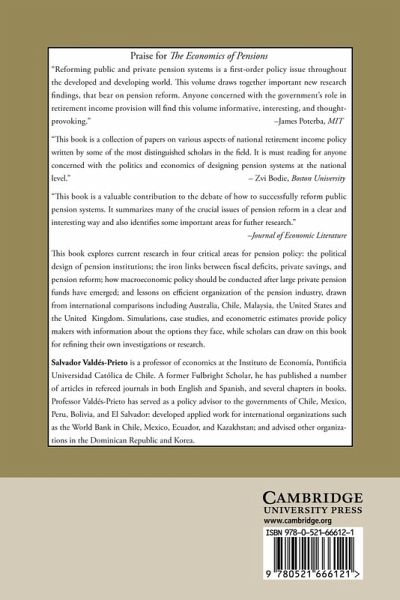
The significant store of knowledge about publicly regulated pensions for old age has grown even more rapidly in the last decade. This book, first published in 1997, explores current research in four critical areas for pension policy: the political design of pension institutions; the iron links between fiscal deficits, private savings, and pension reform; how macroeconomic policy should be conducted after large private pension funds have emerged; and lessons on efficient organization of the pension industry, drawn from international comparisons including Australia, Chile, Malaysia, and the…mehr
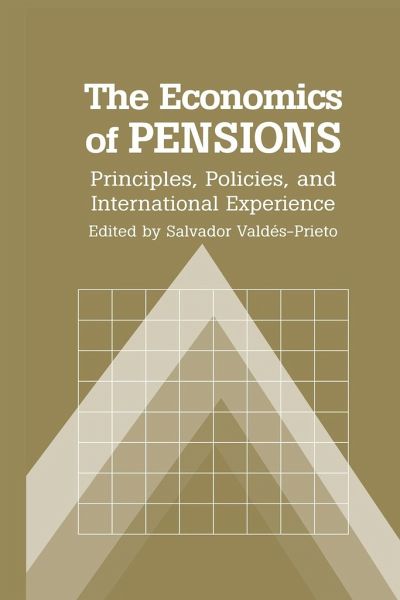
The significant store of knowledge about publicly regulated pensions for old age has grown even more rapidly in the last decade. This book, first published in 1997, explores current research in four critical areas for pension policy: the political design of pension institutions; the iron links between fiscal deficits, private savings, and pension reform; how macroeconomic policy should be conducted after large private pension funds have emerged; and lessons on efficient organization of the pension industry, drawn from international comparisons including Australia, Chile, Malaysia, and the United Kingdom. The collection combines original theoretical analysis with empirical evidence. Simulations, case studies, and econometric estimates provide policy makers with information about the options they face, while scholars can draw on this book for refining their own investigations or research.
1. Introduction and overview Salvador Valdés-Prieto; Part I. The Politics of Mandatory Pensions: 2. Insulation of pensions from political risk Peter Diamond; 3. Democracy and pensions in Chile: experience with two systems Oscar Godoy and Salvador Valdés-Prieto; 4. Public pension governance and performance Olivia Mitchell and Ping-Lung Hsin; Part II. Fiscal Deficits and Private Saving in Pension Reform: 5. Pension reform and growth Gian Carlo Corsetti and Klaus Schmidt-Hebbel; 6. Pension reforms in the presence of credit constraints Rodrigo Cifuentes and Salvador Valdés-Prieto; 7. Financing a pension reform towards private funded pensions Salvador Valdés-Prieto; Part III. Macroeconomic Policy and Private Pensions: 8. Pension funds, capital controls, and macroeconomic stability Helmut Reisen and John Williamson; 9. Are there (good) macroeconomic reasons for limiting external investments by pension funds? The Chilean experience Juan Andrés Fontaine; Part IV. Regulation of Privately-Managed Pension Systems: 10. Pension choice and pensions policy in the United Kingdom David Blake; 11. Mandatory retirement saving: Australia and Malaysia compared Hazel Bateman and John Piggott; 12. Conclusion: public pension plans in international perspective: problems, reforms and research issues Estelle James.
Es gelten unsere Allgemeinen Geschäftsbedingungen: www.buecher.de/agb
Impressum
www.buecher.de ist ein Internetauftritt der buecher.de internetstores GmbH
Geschäftsführung: Monica Sawhney | Roland Kölbl | Günter Hilger
Sitz der Gesellschaft: Batheyer Straße 115 - 117, 58099 Hagen
Postanschrift: Bürgermeister-Wegele-Str. 12, 86167 Augsburg
Amtsgericht Hagen HRB 13257
Steuernummer: 321/5800/1497
USt-IdNr: DE450055826