
Andere Kunden interessierten sich auch für
 Analysis of Fracture Toughness Mechanism in Ultra-fine-grained Steels38,99 €
 Investigation of Ultra-High Strength Fe/4Cr/0.4C Martensitic Steels for Improved Toughness28,99 €
 STUDY OF CORROSION PHENOMENA RELATED TO THE DETERIORATION OF STEELS27,99 €
 Fracture Toughness and Wear Properties of Aluminium Alloy Based MMC27,99 €
 Study of the Machinability of Steels Based on Metallurgical Aspects27,99 €
 Structural Quality Control17,99 €
 Analysis of the protection of steels by hot-dip galvanizing29,99 €



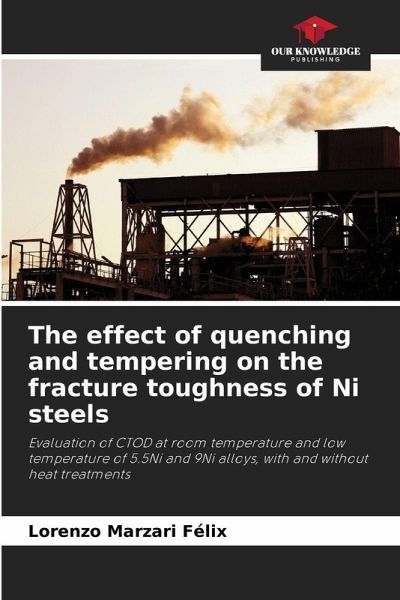
The oil and gas industry is aware of the benefits of adding nickel to improve the mechanical properties of steels when exposed to low temperatures. Low-carbon steels with 3 to 9% nickel by weight are widely used in the construction of structures for transporting and storing petroleum fluids and liquefied gases. Gains in toughness can be obtained for these steels through heat treatments, such as quenching followed by tempering, among others. Knowledge of the behavior of the material at low temperatures is of fundamental importance to the industry mentioned above. In this paper, the reader can observe the results of the evaluation of the effect of quenching and tempering on the fracture toughness of 5.5Ni and 9Ni steels, with tests performed at room temperature and -100 °C, since these materials can be used at low temperatures.