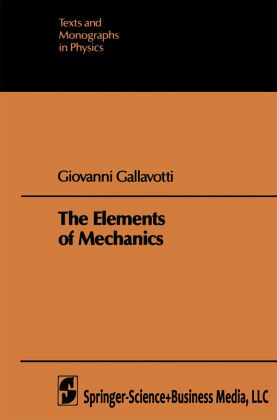
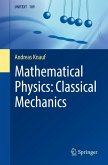
The word "elements" in the title of this book does not convey the implica tion that its contents are "elementary" in the sense of "easy": it mainly means that no prerequisites are required, with the exception of some basic background in classical physics and calculus. It also signifies "devoted to the foundations". In fact, the arguments chosen are all very classical, and the formal or technical developments of this century are absent, as well as a detailed treatment of such problems as the theory of the planetary motions and other very concrete mechanical problems. This second meaning,…mehr
The word "elements" in the title of this book does not convey the implica tion that its contents are "elementary" in the sense of "easy": it mainly means that no prerequisites are required, with the exception of some basic background in classical physics and calculus. It also signifies "devoted to the foundations". In fact, the arguments chosen are all very classical, and the formal or technical developments of this century are absent, as well as a detailed treatment of such problems as the theory of the planetary motions and other very concrete mechanical problems. This second meaning, however, is the result of the necessity of finishing this work in a reasonable amount of time rather than an a priori choice. Therefore a detailed review of the "few" results of ergodic theory, of the "many" results of statistical mechanics, of the classical theory of fields (elasticity and waves), and of quantum mechanics are also totally absent; they could constitute the subject of two additional volumes on mechanics. This book grew out of several courses on meccanica razionaie, i.e., essentially, theoretical mechanics, which I gave at the University of Rome during the years 1975-1978.
Giovanni Gallavotti, emeritus, has been fellow at IHES (Paris, 1966-1968) with David Ruelle and post doc at Rockefeller University (New York, 1968-1970) with Mark Kac. He has been, since 1972, full professor in various universities (Napoli, Roma2 and Roma1). He has been long term visitor at IHES, IAS, Nijmegen, Princeton and Rutgers University. His primary research focused subsequently on theoretical and historical aspects of Equilibrium Statistical Mechanics, Quantum field theory, Low temperature Fermi systems, Nonequilibrium and, currently, concentrates on mathematical problems on Fluid mechanics. Recipient of several awards and prizes (Presidente della Repubblica prize, Boltzmann medal, Henri Poincare' prize).
Inhaltsangabe
1 Phenomenic Reality and Models.- 2 Qualitative Aspects of the One-Dimensional Motion.- 3 Systems with Many Degrees of Freedom. Theory of the Constraints. Analytical Mechanics.- 4 Special Mechanical Systems.- 5 Stability Properties for Dissipative and Conservative Systems.- Appendices.- A. The Cauchy-Schwartz Inequality.- B. The Lagrange-Taylor Expansion.- D. Principle of the Vanishing Integrals.- E. Matrix Notations. Eigenvalues and Eigenvectors. A List of Some Basic Results in Algebra.- F. Positive-Definite Matrices. Eigenvalues and Eigenvectors. A List of the Basic Properties.- G. Implicit Function Theorems.- H. The Ascoli-Arzelà Convergence Criterion.- L. Proof of Eq. (5.6.20).- M. Proof of Eq. (5.6.63).- N. The Analytic Implicit Function Theorem.- O. A Simple Algorithm for the Solutions of the Differential Equations. The Finite Difference Method.- P. Some Astronomical Data.- Definition and Symbols.- References.
1 Phenomenic Reality and Models.- 2 Qualitative Aspects of the One-Dimensional Motion.- 3 Systems with Many Degrees of Freedom. Theory of the Constraints. Analytical Mechanics.- 4 Special Mechanical Systems.- 5 Stability Properties for Dissipative and Conservative Systems.- Appendices.- A. The Cauchy-Schwartz Inequality.- B. The Lagrange-Taylor Expansion.- D. Principle of the Vanishing Integrals.- E. Matrix Notations. Eigenvalues and Eigenvectors. A List of Some Basic Results in Algebra.- F. Positive-Definite Matrices. Eigenvalues and Eigenvectors. A List of the Basic Properties.- G. Implicit Function Theorems.- H. The Ascoli-Arzelà Convergence Criterion.- L. Proof of Eq. (5.6.20).- M. Proof of Eq. (5.6.63).- N. The Analytic Implicit Function Theorem.- O. A Simple Algorithm for the Solutions of the Differential Equations. The Finite Difference Method.- P. Some Astronomical Data.- Definition and Symbols.- References.
Es gelten unsere Allgemeinen Geschäftsbedingungen: www.buecher.de/agb
Impressum
www.buecher.de ist ein Internetauftritt der buecher.de internetstores GmbH
Geschäftsführung: Monica Sawhney | Roland Kölbl | Günter Hilger
Sitz der Gesellschaft: Batheyer Straße 115 - 117, 58099 Hagen
Postanschrift: Bürgermeister-Wegele-Str. 12, 86167 Augsburg
Amtsgericht Hagen HRB 13257
Steuernummer: 321/5800/1497
USt-IdNr: DE450055826