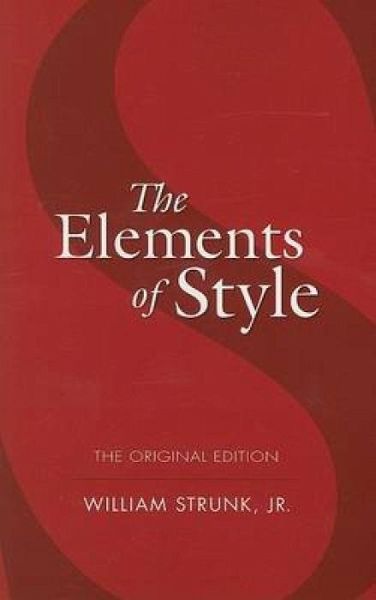
This is the book that generations of writers have relied upon for timeless advice on grammar, diction, syntax, and other essentials. In concise terms, it identifies the principal requirements of proper style and common errors.
This is the book that generations of writers have relied upon for timeless advice on grammar, diction, syntax, and other essentials. In concise terms, it identifies the principal requirements of proper style and common errors.
I. Introduction II. Elementary Rules of Usage 1. Form the possessive singular of nouns by adding 's 2. In a series of three or more terms with a single conjunction, use a comma after each term except the last 3. Enclose parenthetic expressions between commans 4. Place a comma before a conjunction introducing a coordinate clause 5. Do not join independent clauses by a comma 6. Do not break sentences in two 7. A participial phrase at the beginning of a sentence must refer to the grammatical subject III. Elementary Principles of Composition 8. Make the paragraph the unit of composition: one paragraph to each topic 9. As a rule, begin each paragraph with a topic sentence; end it in conformity with the beginning 10. Use the active voice 11. Put statements in positive form 12. Use definite, specific, concrete language 13. Omit needless words 14. Avoid a succession of loose sentences 15. Express co-ordinate ideas in similar form 16. Keep related words together 17. In summaries, keep to one tense 18. Place the emphatic words of a sentence at the end IV. A Few Matters of Form V. Words and Expressions Commonly Misused VI. Spelling VII. Exercises on Chapters II and III
I. Introduction II. Elementary Rules of Usage 1. Form the possessive singular of nouns by adding 's 2. In a series of three or more terms with a single conjunction, use a comma after each term except the last 3. Enclose parenthetic expressions between commans 4. Place a comma before a conjunction introducing a coordinate clause 5. Do not join independent clauses by a comma 6. Do not break sentences in two 7. A participial phrase at the beginning of a sentence must refer to the grammatical subject III. Elementary Principles of Composition 8. Make the paragraph the unit of composition: one paragraph to each topic 9. As a rule, begin each paragraph with a topic sentence; end it in conformity with the beginning 10. Use the active voice 11. Put statements in positive form 12. Use definite, specific, concrete language 13. Omit needless words 14. Avoid a succession of loose sentences 15. Express co-ordinate ideas in similar form 16. Keep related words together 17. In summaries, keep to one tense 18. Place the emphatic words of a sentence at the end IV. A Few Matters of Form V. Words and Expressions Commonly Misused VI. Spelling VII. Exercises on Chapters II and III
Es gelten unsere Allgemeinen Geschäftsbedingungen: www.buecher.de/agb
Impressum
www.buecher.de ist ein Internetauftritt der buecher.de internetstores GmbH
Geschäftsführung: Monica Sawhney | Roland Kölbl | Günter Hilger
Sitz der Gesellschaft: Batheyer Straße 115 - 117, 58099 Hagen
Postanschrift: Bürgermeister-Wegele-Str. 12, 86167 Augsburg
Amtsgericht Hagen HRB 13257
Steuernummer: 321/5800/1497
USt-IdNr: DE450055826