
Andere Kunden interessierten sich auch für
 A geography of the margins: Disabilities and spatial justice56,99 €
 The Protected Natural Spaces in Extremadura27,99 €
 Geography of marginalised spaces and hidden knowledge28,99 €
 The Interstitial Spaces of Urban Sprawl182,99 €
 A Topographical Dictionary of the Dominion of Wales; Exhibiting the Names of the Several Cities, Towns, Parishes, Townships, and Hamlets, With the County and Division of the County, to Which They Respectively Belong ... Compiled From Actual Inquiry, and A39,99 €
 Commemorative Spaces of the First World War167,99 €
 American Colonial Spaces in the Philippines149,99 €

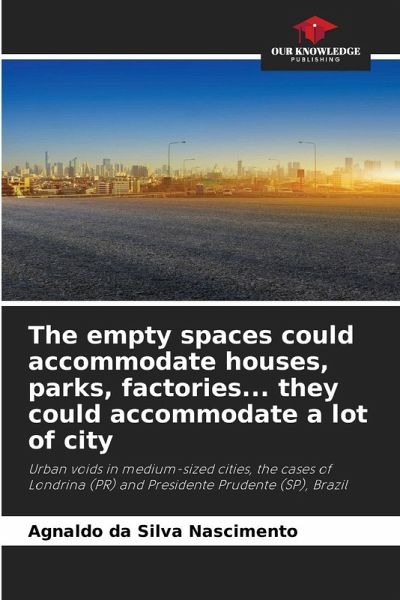
The book discusses urban space, with an emphasis on urban voids, questioning the contribution of this element in structuring the urban form of two medium-sized cities. Firstly, it considers that the existence, maintenance, and multiplication of these urban elements, inscribed in their landscape, have been indicative of the production of cities in terms of capital reproduction, to the detriment of a less unequal city that favors life from a social point of view. The work focuses on the expansion of the urban fabrics of Presidente Prudente and Londrina and the proliferation of urban voids, considering, as far as possible, the producing agents that act and benefit from the territorial dispersion of these cities. Through a comparative study, we aim to understand how urban forms, actions, and dynamics develop to produce this element-the urban void. Based on an assessment of the distinguishing characteristics of each city, as well as their common aspects, this movement, which is partlyknown, will be explained, in addition to understanding the dynamics and implications of the permanence of these empty areas for cities and urban life.