

Andere Kunden interessierten sich auch für
 The Market Space of Portuguese Cities137,99 €
") Paper Heritage in Italy, France, Spain and Beyond (16th to 19th Centuries)41,99 €
Paper Heritage in Italy, France, Spain and Beyond (16th to 19th Centuries)41,99 €") Paper Heritage in Italy, France, Spain and Beyond (16th to 19th Centuries)137,99 €
Paper Heritage in Italy, France, Spain and Beyond (16th to 19th Centuries)137,99 € Caesar's Commentaries on the Gallic and Civil Wars36,90 €
 First Eight Books of Caesar's Commentaries on the Gallic War26,90 €
 Parliamentarism in Northern and East-Central Europe in the Long Eighteenth Century137,99 €
") Hospitality and the Enlightenment (Encountering China)137,99 €
Hospitality and the Enlightenment (Encountering China)137,99 €



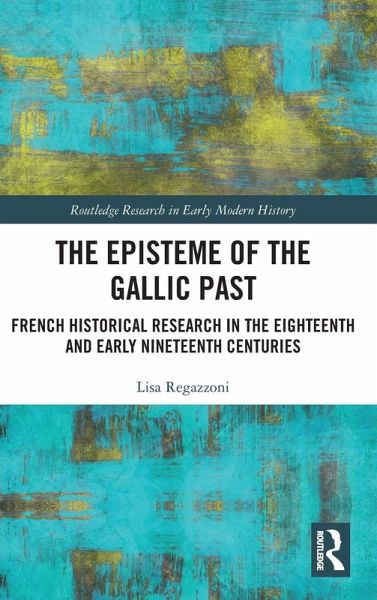
This book aims to reconceive the field of knowledge of the "Gallic past" in French discourse of the eighteenth and early nineteenth centuries by focusing on the monument as an object capable of underpinning insights into that past, the evolution of the concept, and the epistemic practices used to produce it.
Through monuments, the book redirects our gaze toward the French provinces, where material and immaterial evidence of the Gallic past was "discovered" and transformed into epistemic objects. This perspective results in a "provincialization" of Paris as a site of knowledge production and sheds light on the crucial role of provincial scholarship, not only in the "invention" of the Gallic past but also in methodological and epistemological renewal. The result is a revision of recent historiography, which interpreted the narrative of an "autochthonous" pre-Roman, Gallic past as nation-building.
This volume offers a pioneering contribution toward new directions in historical epistemology focused on the historicity of the "species" of evidence of each epoch.
Through monuments, the book redirects our gaze toward the French provinces, where material and immaterial evidence of the Gallic past was "discovered" and transformed into epistemic objects. This perspective results in a "provincialization" of Paris as a site of knowledge production and sheds light on the crucial role of provincial scholarship, not only in the "invention" of the Gallic past but also in methodological and epistemological renewal. The result is a revision of recent historiography, which interpreted the narrative of an "autochthonous" pre-Roman, Gallic past as nation-building.
This volume offers a pioneering contribution toward new directions in historical epistemology focused on the historicity of the "species" of evidence of each epoch.
"The overarching interest of this remarkable monograph... raises fundamental questions of historiography: What kind of thing is it that historians cite as proof of historical truth? Just what is historical evidence?"
Helmut Zedelmaier, LMU Munich, Germany
"Lisa Regazzoni's work is a great gain for the history of historiography."
Joëlle Weis, Trier University, Germany
"I highly recommend this book to everyone who relishes the complexity of early modern scholarly landscapes."
Tobias Winnerling, Heinrich Heine University Düsseldorf, Germany
Helmut Zedelmaier, LMU Munich, Germany
"Lisa Regazzoni's work is a great gain for the history of historiography."
Joëlle Weis, Trier University, Germany
"I highly recommend this book to everyone who relishes the complexity of early modern scholarly landscapes."
Tobias Winnerling, Heinrich Heine University Düsseldorf, Germany