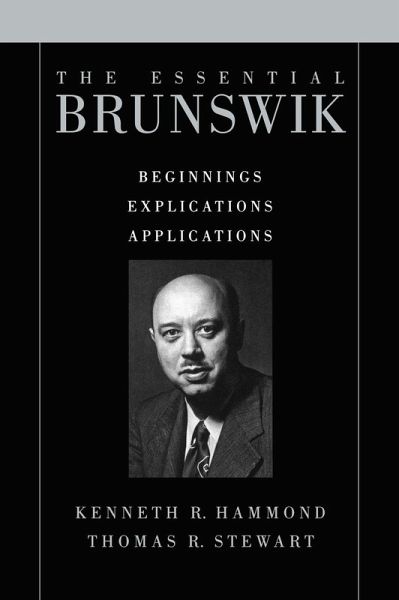
Egon Brunswik is one of the most brilliant, creative and least understood and appreciated psychologists/philosophers of the 20th century. This book presents a collection of Brunswik's most important papers together with interpretive comments by prominent scholars who explain the intent and development of his thought. This collection and the accompanying diverse examples of the application of his ideas will encourage a deeper understanding of Brunswik in the 21st century than was the case in the 20th century. The 21st century already shows signs of acceptance of Brunswikian thought with the…mehr
Egon Brunswik is one of the most brilliant, creative and least understood and appreciated psychologists/philosophers of the 20th century. This book presents a collection of Brunswik's most important papers together with interpretive comments by prominent scholars who explain the intent and development of his thought. This collection and the accompanying diverse examples of the application of his ideas will encourage a deeper understanding of Brunswik in the 21st century than was the case in the 20th century. The 21st century already shows signs of acceptance of Brunswikian thought with the appearance of psychologists with a different focus; emulation of physical science is of less importance, and positive contributions toward understanding behavior outside the laboratory without abandoning rigor are claiming more notice. As a result, Brunswik's theoretical and methodological views are already gaining the attention denied them in the 20th century. The plan of this book is to provide, for the first time, in one place the articles that show the origins of his thought, with all their imaginative and creative spirit, as well as thoughtful, scholarly interpretations of the development, meaning and application of his ideas to modern psychology. Thus, his views will become more understandable and more widely disseminated, as well as advanced through the fresh meaning given to them by the psychologists of the 21st century.
* Introduction * Part 1: Beginnings: The Grand Ideas Introduced * 1: The Organism and the Causal Texture of the Environment [1935] * 2: Psychology as a Science of Objective Relations [1937] * 3: Organismic Achievement and Environmental Probability [1943] * 4: Distal Focussing of Perception: Size Constancy in a Representative Sample of Situation [1944] * 5: Points of View: Components of Psychological Theorizing [1946] * 6: Remarks on Functionalism in Perception [1949] * 7: Representative Design and Probabilistic Theory in a Functional Psychology [1955] and In Defense of Probabilistic Functionalism: A Reply [1955] * Part 2: Explications: Iconoclasm at Work * A. Demonstrations of a New Methodology: Representative Design * 8: Probability Learning of Perceptual Cues in the Establishment of a Weight Illusion [1951] * 9: Thing Constancy as Measured by Correlation Coefficients [1940] * 10: Probability as a Determiner of Rat Behavior [1939] * 11: Ecoloigcal Cue-Validity of "Proximity" and of Other Gestalt factors [1953] * B. Demonstrations of a Comprehensive Theory * 12: The Conceptual Framework of Psychology [1952] * 13: Survival in a World of Probable Objects [1957] * C. Final Thoughts * 14: "Ratiomorphic" Models of Perception and Thinking [1955] * 15: Perception and the Representative Design of Psychological Experiments [1956] * 16: Ontogenetic and Other Developmental Parallels to the History of Science [1959] * 17: Historical and Thematic Relations of Psychology to Other Sciences [1956] * 18: Scope and Aspects of the Cognitive Problem [1957] * Part 3: Applications * A. Theoretical and Methodological Contributions to Psychology * 19: The Contribution of Representative Design to Calibration Research * 20: Assessing Self-Insight via Policy Capturing and Cognitive Feedback * 21: Judgment Analysis * 22: Brunswik's Theoretical and Methodological Contributions to Research in Interpersonal Perception * 23: Hierarchical Linear Models for the Nomothetic Aggregation of Idiographic Descriptions of Judgment * 24: Vicarious Functioning Reconsidered: A Fast and Frugal Lens Model * 25: Multiple Cue Probability Learning * 26: From Ecological to Moral Psychology: Morality and the Psychology of Egon Brunswik * 27: The Lens Model Equation * B. Overviews of Applications to Substantive Problems * 28: The Realistic Accuracy Model and Brunswik's Approach to Social Judgment * 29: Application of the Lens Model to the Evaluation of Professional Performance * 30: Brunswik and Medical Science * 31: The Perception and Judgment of Rapport * 32: The Relationship between Strategy and Achievement as the Basic Unit of Group Functioning * 33: Brunswikian Research on Social Perception, Interpersonal Learning and Conflict, and Negotiation * 34: Understanding the Effects of Psychiatric Drugs on Social Judgment * 35: Human Factors * 36: Representative Design: Cognitive Science from a Brunswikian Perspective * C. Examples of Current Brunswikian Research and Application * 37: Assessing the Reliability of Judgments * 38: Vicarious Functioning in Teams * 39: Probabilistic Functioning and Cognitive Aging * 40: A Brunswikian Approach to Emotional Communication in Music Performance * 41: An Application of the Lens Model to Guidance and Counselling of Adolescents * 42: How Probabilistic Functionalism Advances Evolutionary Psychology * 43: Brunswik and Quality of Life: A Brief Note * Part 4: Brunswik: The Man and His Ideas * 44: Ideas in Exile: The Struggles of an Upright Man * 45: Egon Brunswik before and after Emigration: A Study in the History of Science * 46: Expansion of Egon Brunswik's Psychology, 1955-1995 * 47: Notes from Berkeley, 1938, 1945-1948 * 48: Notes from a Student in Vienna * Epilogue * Complete Annotated List of Brunswik's Published Papers * References * Index
* Introduction * Part 1: Beginnings: The Grand Ideas Introduced * 1: The Organism and the Causal Texture of the Environment [1935] * 2: Psychology as a Science of Objective Relations [1937] * 3: Organismic Achievement and Environmental Probability [1943] * 4: Distal Focussing of Perception: Size Constancy in a Representative Sample of Situation [1944] * 5: Points of View: Components of Psychological Theorizing [1946] * 6: Remarks on Functionalism in Perception [1949] * 7: Representative Design and Probabilistic Theory in a Functional Psychology [1955] and In Defense of Probabilistic Functionalism: A Reply [1955] * Part 2: Explications: Iconoclasm at Work * A. Demonstrations of a New Methodology: Representative Design * 8: Probability Learning of Perceptual Cues in the Establishment of a Weight Illusion [1951] * 9: Thing Constancy as Measured by Correlation Coefficients [1940] * 10: Probability as a Determiner of Rat Behavior [1939] * 11: Ecoloigcal Cue-Validity of "Proximity" and of Other Gestalt factors [1953] * B. Demonstrations of a Comprehensive Theory * 12: The Conceptual Framework of Psychology [1952] * 13: Survival in a World of Probable Objects [1957] * C. Final Thoughts * 14: "Ratiomorphic" Models of Perception and Thinking [1955] * 15: Perception and the Representative Design of Psychological Experiments [1956] * 16: Ontogenetic and Other Developmental Parallels to the History of Science [1959] * 17: Historical and Thematic Relations of Psychology to Other Sciences [1956] * 18: Scope and Aspects of the Cognitive Problem [1957] * Part 3: Applications * A. Theoretical and Methodological Contributions to Psychology * 19: The Contribution of Representative Design to Calibration Research * 20: Assessing Self-Insight via Policy Capturing and Cognitive Feedback * 21: Judgment Analysis * 22: Brunswik's Theoretical and Methodological Contributions to Research in Interpersonal Perception * 23: Hierarchical Linear Models for the Nomothetic Aggregation of Idiographic Descriptions of Judgment * 24: Vicarious Functioning Reconsidered: A Fast and Frugal Lens Model * 25: Multiple Cue Probability Learning * 26: From Ecological to Moral Psychology: Morality and the Psychology of Egon Brunswik * 27: The Lens Model Equation * B. Overviews of Applications to Substantive Problems * 28: The Realistic Accuracy Model and Brunswik's Approach to Social Judgment * 29: Application of the Lens Model to the Evaluation of Professional Performance * 30: Brunswik and Medical Science * 31: The Perception and Judgment of Rapport * 32: The Relationship between Strategy and Achievement as the Basic Unit of Group Functioning * 33: Brunswikian Research on Social Perception, Interpersonal Learning and Conflict, and Negotiation * 34: Understanding the Effects of Psychiatric Drugs on Social Judgment * 35: Human Factors * 36: Representative Design: Cognitive Science from a Brunswikian Perspective * C. Examples of Current Brunswikian Research and Application * 37: Assessing the Reliability of Judgments * 38: Vicarious Functioning in Teams * 39: Probabilistic Functioning and Cognitive Aging * 40: A Brunswikian Approach to Emotional Communication in Music Performance * 41: An Application of the Lens Model to Guidance and Counselling of Adolescents * 42: How Probabilistic Functionalism Advances Evolutionary Psychology * 43: Brunswik and Quality of Life: A Brief Note * Part 4: Brunswik: The Man and His Ideas * 44: Ideas in Exile: The Struggles of an Upright Man * 45: Egon Brunswik before and after Emigration: A Study in the History of Science * 46: Expansion of Egon Brunswik's Psychology, 1955-1995 * 47: Notes from Berkeley, 1938, 1945-1948 * 48: Notes from a Student in Vienna * Epilogue * Complete Annotated List of Brunswik's Published Papers * References * Index
Es gelten unsere Allgemeinen Geschäftsbedingungen: www.buecher.de/agb
Impressum
www.buecher.de ist ein Internetauftritt der buecher.de internetstores GmbH
Geschäftsführung: Monica Sawhney | Roland Kölbl | Günter Hilger
Sitz der Gesellschaft: Batheyer Straße 115 - 117, 58099 Hagen
Postanschrift: Bürgermeister-Wegele-Str. 12, 86167 Augsburg
Amtsgericht Hagen HRB 13257
Steuernummer: 321/5800/1497
USt-IdNr: DE450055826