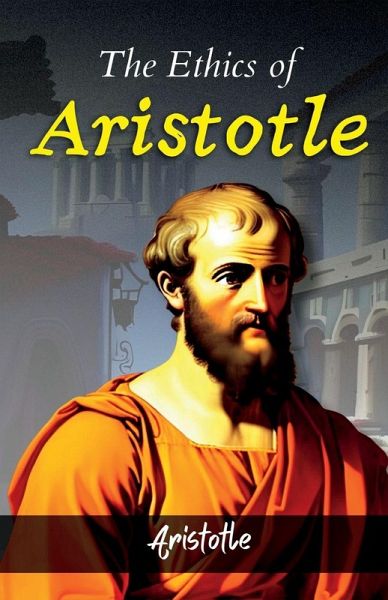
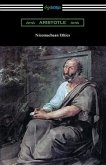
The Ethics of Aristotle is a timeless masterpiece by the ancient Greek philosopher Aristotle. In this influential work, Aristotle delves into the nature of ethics, exploring questions of morality, virtue, and the pursuit of the good life. Through his profound insights and logical reasoning, Aristotle lays the foundation for ethical theories and provides guidance on living a virtuous and fulfilling existence. With its enduring relevance, this philosophical treatise remains a cornerstone of ethical thought and an essential read for anyone seeking to deepen their understanding of human morality…mehr
The Ethics of Aristotle is a timeless masterpiece by the ancient Greek philosopher Aristotle. In this influential work, Aristotle delves into the nature of ethics, exploring questions of morality, virtue, and the pursuit of the good life. Through his profound insights and logical reasoning, Aristotle lays the foundation for ethical theories and provides guidance on living a virtuous and fulfilling existence. With its enduring relevance, this philosophical treatise remains a cornerstone of ethical thought and an essential read for anyone seeking to deepen their understanding of human morality and the complexities of ethical decision-making. The Ethics of Aristotle: Delve into the world of ethics and moral philosophy with Aristotle's teachings. Explore ethical principles, moral values, virtue ethics, and ethical decision-making. This book provides a foundation for understanding ethical theories and moral education. The Ethics of Aristotle by Aristotle Key Points: Classic philosophical work exploring the nature of ethics. Explores questions of morality, virtue, and the pursuit of the good life. Provides a foundation for ethical theories and principles. Offers guidance on living a virtuous and fulfilling existence. Enduring relevance as a cornerstone of ethical thought.
Aristotle (Greek: ¿¿¿¿¿¿¿¿¿¿¿ Aristotél¿s, pronounced [aristotél¿¿s]; 384-322 BC)[A] was a Greek philosopher and polymath during the Classical period in Ancient Greece. Taught by Plato, he was the founder of the Lyceum, the Peripatetic school of philosophy, and the Aristotelian tradition. His writings cover many subjects. including physics, biology, zoology, metaphysics, logic, ethics, estheticspoetry, theatre, music, rhetoric, psychology, linguistics, economics, politics, and government. Aristotle provided a complex synthesis of the various philosophies existing prior to him. It was above all from his teachings that the West inherited its intellectual lexicon, as well as problems and methods of inquiry. As a result, his philosophy has exerted a unique influence on almost every form of knowledge in the West and it continues to be a subject of contemporary philosophical discussion. Little is known about his life. Aristotle was born in the city of Stagira in Northern Greece. His father, Nicomachus, died when Aristotle was a child, and he was brought up by a guardian. At seventeen or eighteen years of age he joined Plato's Academy in Athens and remained there until the age of thirty-seven (c. 347 BC).[4] Shortly after Plato died, Aristotle left Athens and, at the request of Philip II of Macedon, tutored Alexander the Great beginning in 343 BC.[5] He established a library in the Lyceum which helped him to produce many of his hundreds of books on papyrus scrolls. Though Aristotle wrote many elegant treatises and dialogues for publication, only around a third of his original output has survived, none of it intended for publication.[6] Aristotle's views on physical science profoundly shaped medieval scholarship. Their influence extended from Late Antiquity and the Early Middle Ages into the Renaissance, and were not replaced systematically until the Enlightenment and theories such as classical mechanics. Some of Aristotle's zoological observations found in his biology, such as on the hectocotyl (reproductive) arm of the octopus, were disbelieved until the 19th century. His works contain the earliest known formal study of logic, studied by medieval scholars such as Peter Abelard and John Buridan. Aristotle's influence on logic also continued well into the 19th century.
Es gelten unsere Allgemeinen Geschäftsbedingungen: www.buecher.de/agb
Impressum
www.buecher.de ist ein Internetauftritt der buecher.de internetstores GmbH
Geschäftsführung: Monica Sawhney | Roland Kölbl | Günter Hilger
Sitz der Gesellschaft: Batheyer Straße 115 - 117, 58099 Hagen
Postanschrift: Bürgermeister-Wegele-Str. 12, 86167 Augsburg
Amtsgericht Hagen HRB 13257
Steuernummer: 321/5800/1497
USt-IdNr: DE450055826