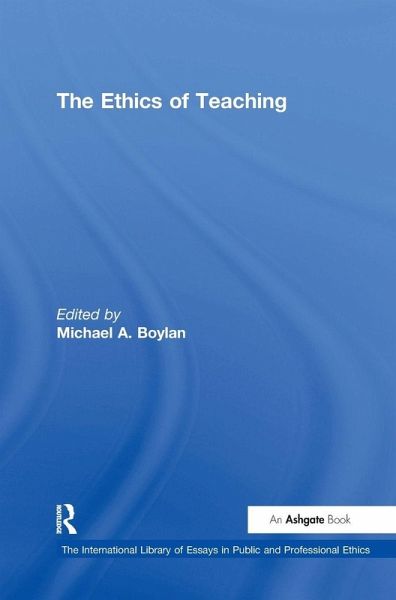
This anthology is designed to give a snapshot of the seminal work in the philosophy of education and the input of ethical issues upon that work. It provides an authoritative tour of the profession and pivotal issues that confront it, written from a variety of international and critical perspectives.
This anthology is designed to give a snapshot of the seminal work in the philosophy of education and the input of ethical issues upon that work. It provides an authoritative tour of the profession and pivotal issues that confront it, written from a variety of international and critical perspectives.
Michael Boylan is the John J. McDonnell, Jr. Chair in Ethics at Marymount University in Arlington, Virginia, USA.
Inhaltsangabe
Contents: Series preface; Introduction. Part I the Philosophy of Education: Classic readings on the Purpose of Education: Democracy and educational administration, John Dewey; The justification of education, R.S. Peters; What is teaching?, Paul H. Hirst; Learning and teaching, Michael Oakeshott. Contemporary Readings on the Purpose of Education: Colleges must reconstruct the unity of knowledge, Vartan Gregorian; The true scholar, Robert N. Bellah; The corporate university and the politics of education, Stanley Aronowitz and Henry A. Giroux; Re-education of humankind: globalizing the curriculum and teaching international ethics for the new century, Roseann Runte. Part II The Process of Education: Critical Thinking: A concept of 'critical thinking', Robert H. Ennis; Critical thinking and the 'trivial pursuit' theory of knowledge, John E. McPeck; Format effects on critical thinking test performance, Stephen P. Norris. Aesthetics: The something more, Sharon Bailin; Social vision and the dance of life, Maxime Green. Part III Ethics and Social Responsibility: Toward a philosophy of moral education, William K. Frankena; Introducing ethics into every department: an overview, Michael Boylan and James A. Donahue; The primacy of political education, Amy Gutmann; Access to the university and the problem of racial inequality, Derek Bok; Liberal civic education and religious fundamentalism: the case of God v. John Rawls, Stephen Macedo; Justice and the threshold of educational equality, Randall R. Curren); Non-exclusion is not the same as inclusion: a response to Curren, Kenneth R. Howe; Human rights and academic freedom, Alan Gewirth. Part IV Students and Teachers: Cheating and Plagiarism: In other (people's) words: plagiarism by university students - literature and lessons, Chris Park; Academic dishonesty: a plague on our profession, Kenneth C. Petress (2003); Dishonesty in academic environments: the influence of peer reporting requirements, Donald L. McCabe, Linda Klebe Trev
Contents: Series preface; Introduction. Part I the Philosophy of Education: Classic readings on the Purpose of Education: Democracy and educational administration, John Dewey; The justification of education, R.S. Peters; What is teaching?, Paul H. Hirst; Learning and teaching, Michael Oakeshott. Contemporary Readings on the Purpose of Education: Colleges must reconstruct the unity of knowledge, Vartan Gregorian; The true scholar, Robert N. Bellah; The corporate university and the politics of education, Stanley Aronowitz and Henry A. Giroux; Re-education of humankind: globalizing the curriculum and teaching international ethics for the new century, Roseann Runte. Part II The Process of Education: Critical Thinking: A concept of 'critical thinking', Robert H. Ennis; Critical thinking and the 'trivial pursuit' theory of knowledge, John E. McPeck; Format effects on critical thinking test performance, Stephen P. Norris. Aesthetics: The something more, Sharon Bailin; Social vision and the dance of life, Maxime Green. Part III Ethics and Social Responsibility: Toward a philosophy of moral education, William K. Frankena; Introducing ethics into every department: an overview, Michael Boylan and James A. Donahue; The primacy of political education, Amy Gutmann; Access to the university and the problem of racial inequality, Derek Bok; Liberal civic education and religious fundamentalism: the case of God v. John Rawls, Stephen Macedo; Justice and the threshold of educational equality, Randall R. Curren); Non-exclusion is not the same as inclusion: a response to Curren, Kenneth R. Howe; Human rights and academic freedom, Alan Gewirth. Part IV Students and Teachers: Cheating and Plagiarism: In other (people's) words: plagiarism by university students - literature and lessons, Chris Park; Academic dishonesty: a plague on our profession, Kenneth C. Petress (2003); Dishonesty in academic environments: the influence of peer reporting requirements, Donald L. McCabe, Linda Klebe Trev
Es gelten unsere Allgemeinen Geschäftsbedingungen: www.buecher.de/agb
Impressum
www.buecher.de ist ein Internetauftritt der buecher.de internetstores GmbH
Geschäftsführung: Monica Sawhney | Roland Kölbl | Günter Hilger
Sitz der Gesellschaft: Batheyer Straße 115 - 117, 58099 Hagen
Postanschrift: Bürgermeister-Wegele-Str. 12, 86167 Augsburg
Amtsgericht Hagen HRB 13257
Steuernummer: 321/5800/1497
USt-IdNr: DE450055826