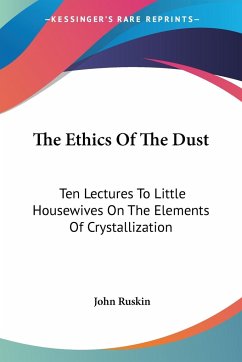
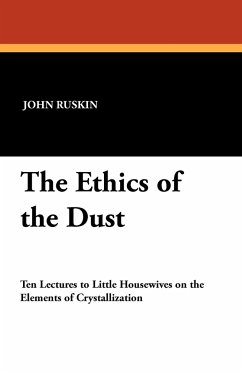
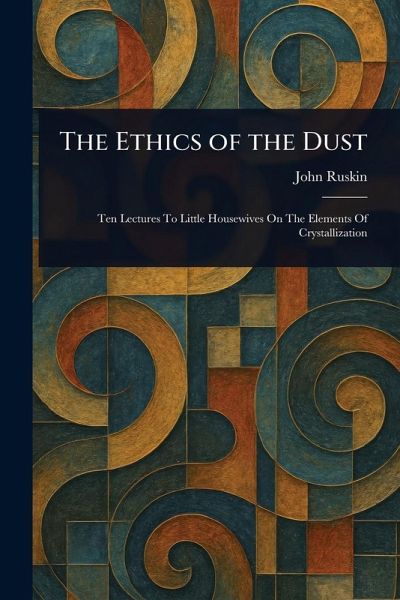
"The Ethics of the Dust" by John Ruskin offers a fascinating exploration of ethics and moral philosophy through the lens of crystallography and mineralogy. In this unique work, Ruskin utilizes the study of crystals as a springboard to discuss broader educational and philosophical concepts. Delving into the structure and formation of minerals, Ruskin connects the principles of the natural world to fundamental ethical considerations. Readers interested in the intersection of science and philosophy will find this a stimulating and thought-provoking read. This book provides a unique perspective on…mehr
"The Ethics of the Dust" by John Ruskin offers a fascinating exploration of ethics and moral philosophy through the lens of crystallography and mineralogy. In this unique work, Ruskin utilizes the study of crystals as a springboard to discuss broader educational and philosophical concepts. Delving into the structure and formation of minerals, Ruskin connects the principles of the natural world to fundamental ethical considerations. Readers interested in the intersection of science and philosophy will find this a stimulating and thought-provoking read. This book provides a unique perspective on education, seamlessly blending scientific observation with moral reflection, making it a valuable resource for anyone interested in the history of ideas and the relationship between the physical world and ethical principles. A timeless classic that continues to resonate with those seeking a deeper understanding of both the natural world and the principles that guide human conduct. This work has been selected by scholars as being culturally important, and is part of the knowledge base of civilization as we know it. This work is in the public domain in the United States of America, and possibly other nations. Within the United States, you may freely copy and distribute this work, as no entity (individual or corporate) has a copyright on the body of the work. Scholars believe, and we concur, that this work is important enough to be preserved, reproduced, and made generally available to the public. We appreciate your support of the preservation process, and thank you for being an important part of keeping this knowledge alive and relevant.
John Ruskin was an English writer, philosopher, art expert, and general know-it-all who lived from February 8, 1819, to January 20, 1900. He wrote about a lot of different things, like architecture, mythology, birds, literature, schooling, botany, politics, and the economy. Ruskin was very interested in Viollet le Duc's work and taught it to all of his students, including William Morris. He thought Viollet le Duc's Dictionary was "the only book of any value on architecture." Ruskin used a lot of different writing styles and literary types. Besides essays and treatises, he also wrote poems, gave talks, traveled guides and manuals, letters, and even a fairy tale. He also drew and painted scenes with rocks, plants, birds, scenery, buildings, and decorations in great detail. His early writings on art were written in a very complicated style. Over time, he switched to simpler language that was meant to get his ideas across more clearly. He always stressed the links between nature, art, and society in everything he wrote. Up until the First World War, Ruskin had a huge impact on the second half of the 1800s. After a time of decline, his reputation has steadily gotten better since the 1960s, when a lot of academic studies of his work came out.
Es gelten unsere Allgemeinen Geschäftsbedingungen: www.buecher.de/agb
Impressum
www.buecher.de ist ein Internetauftritt der buecher.de internetstores GmbH
Geschäftsführung: Monica Sawhney | Roland Kölbl | Günter Hilger
Sitz der Gesellschaft: Batheyer Straße 115 - 117, 58099 Hagen
Postanschrift: Bürgermeister-Wegele-Str. 12, 86167 Augsburg
Amtsgericht Hagen HRB 13257
Steuernummer: 321/5800/1497
USt-IdNr: DE450055826

![Diamond Dust [microform]](https://bilder.buecher.de/produkte/66/66116/66116360m.jpg "Diamond Dust [microform]")