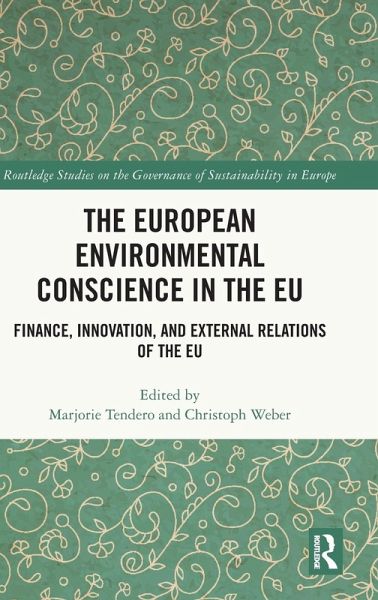
This book analyses how sustainability affects internal decision-making within the European Union and its external relations in working towards achieving its long-term goal of a climate-neutral Europe by 2050. Applying the term "European environmental conscience" as the perception of environmental degradation leading to a growing public awareness of the issues, a notion of common responsibility, and European institutions dealing with these growing concerns, the book investigates its emergence as a lever for deeper European integration and in fostering a genuine European identity. Examining…mehr
This book analyses how sustainability affects internal decision-making within the European Union and its external relations in working towards achieving its long-term goal of a climate-neutral Europe by 2050.
Applying the term "European environmental conscience" as the perception of environmental degradation leading to a growing public awareness of the issues, a notion of common responsibility, and European institutions dealing with these growing concerns, the book investigates its emergence as a lever for deeper European integration and in fostering a genuine European identity. Examining policy areas such as green finance, innovation policies, and foreign policy, it reveals the impact these concerns have for other policy fields.
This book is of key interest to scholars and students of environmental economics and politics, sustainability governance, green finance, climate policy, energy policy, and more broadly, to European studies and international relations.
Produktdetails
Produktdetails
Routledge Studies on the Governance of Sustainability in Europe
Marjorie Tendero is an Associate Professor of Economics at ESSCA School of Management, Angers, France, and a member of the EU*Asia Institute. She is an associate researcher at the SMART(Structures and Markets in Agriculture, Resources and Territories) laboratory. Christoph Weber is an Associate Professor of Economics at ESSCA, School of Management, Lyon, France. He is the Deputy Director of the EU*Asia Institute at ESSCA School of Management.
Inhaltsangabe
Introduction: The European Environmental conscience in EU Economics PART 1: The influence of sustainability on the external relations of the European Union 1. Financial Enforcement Instruments of Sustainability 2. Climate Change: New Challenges and Unexpected Threats the Iraqi Case PART 2: The growing role of green finance and sustainability-oriented financial regulation in the European Union 3. Financing Europe's Transition to a Low-Carbon Economy: The Role of Sustainable Finance 4. Financial Enforcement Instruments of Sustainability 5. The EU Green Bond Market 6. Macroeconomic impact of a green finance shock 7. Going green? The changing role of the ECB in the sustainability strategy of the EU PART 3: The impact of innovation and knowledge transfer on sustainability in the European Union 8. Enabling Sustainability: The Role of Knowledge Flows in Advancing Sustainable Technologies 9. New economic models for sustainability-oriented knowledge transfer? A contrasting case study on two knowledge transfer projects 10. The long walk to digital sobriety in the European Union: A French case study Conclusion: Perspectives for the governance of sustainability in Europe and the European environmental conscience
Introduction: The European Environmental conscience in EU Economics PART 1: The influence of sustainability on the external relations of the European Union 1. Financial Enforcement Instruments of Sustainability 2. Climate Change: New Challenges and Unexpected Threats the Iraqi Case PART 2: The growing role of green finance and sustainability-oriented financial regulation in the European Union 3. Financing Europe's Transition to a Low-Carbon Economy: The Role of Sustainable Finance 4. Financial Enforcement Instruments of Sustainability 5. The EU Green Bond Market 6. Macroeconomic impact of a green finance shock 7. Going green? The changing role of the ECB in the sustainability strategy of the EU PART 3: The impact of innovation and knowledge transfer on sustainability in the European Union 8. Enabling Sustainability: The Role of Knowledge Flows in Advancing Sustainable Technologies 9. New economic models for sustainability-oriented knowledge transfer? A contrasting case study on two knowledge transfer projects 10. The long walk to digital sobriety in the European Union: A French case study Conclusion: Perspectives for the governance of sustainability in Europe and the European environmental conscience
Es gelten unsere Allgemeinen Geschäftsbedingungen: www.buecher.de/agb
Impressum
www.buecher.de ist ein Internetauftritt der buecher.de internetstores GmbH
Geschäftsführung: Monica Sawhney | Roland Kölbl | Günter Hilger
Sitz der Gesellschaft: Batheyer Straße 115 - 117, 58099 Hagen
Postanschrift: Bürgermeister-Wegele-Str. 12, 86167 Augsburg
Amtsgericht Hagen HRB 13257
Steuernummer: 321/5800/1497
USt-IdNr: DE450055826