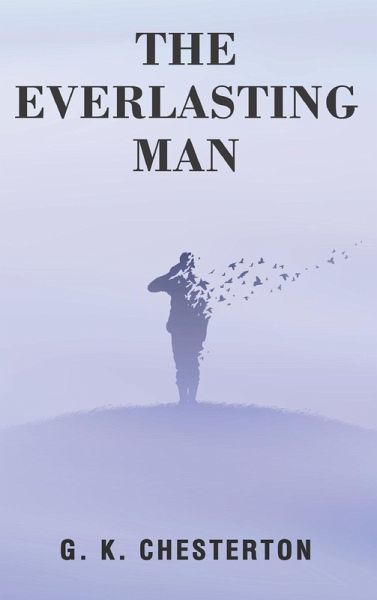
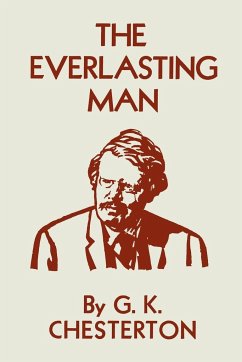
"There are two ways of getting home; and one of them is to stay there. The other is to walk round the whole world till we come back to the same place." -G.K. Chesterton What, if anything, is it that makes the human uniquely human? This, in part, is the question that G.K. Chesterton starts with exploration of human history in this classic. Responding to the evolutionary materialism of his contemporary H.G. Wells, Chesterton in this work affirms human uniqueness and the unique message of the Christian faith. Writing at a time when social Darwinism was increasingly popular, Chesterton argued that…mehr
"There are two ways of getting home; and one of them is to stay there. The other is to walk round the whole world till we come back to the same place." -G.K. Chesterton What, if anything, is it that makes the human uniquely human? This, in part, is the question that G.K. Chesterton starts with exploration of human history in this classic. Responding to the evolutionary materialism of his contemporary H.G. Wells, Chesterton in this work affirms human uniqueness and the unique message of the Christian faith. Writing at a time when social Darwinism was increasingly popular, Chesterton argued that the idea that society has been steadily progressing from a starting point of primitivism towards civilization, and of Jesus Christ as simply another charismatic figure, is completely inaccurate. Chesterton saw in Christianity a rare blending of philosophy and mythology, which he felt satisfies both the mind and the heart. Here, as so often in Chesterton, we sense a lived, awakened faith. All that he writes derives from a keen intellect guided by the heart's own knowledge.
Gilbert Keith Chesterton was an English author, philosopher, Christian apologist, and literary and art critic, best known for creating the fictional priest-detective Father Brown. Born on May 29, 1874, in Kensington, London, Chesterton was educated at St. Paul's Juniors and University College London before studying at the Slade School of Fine Art. His career spanned a variety of genres, from fiction to essays, and he was deeply involved in Christian apologetics, with works like Orthodoxy and The Everlasting Man solidifying his place as a prominent thinker of his time. Chesterton's works often reflected his devotion to Christianity and his philosophical musings on society, morality, and faith. He was a close associate of Hilaire Belloc and was influenced by thinkers such as Thomas Aquinas and Charles Dickens. Chesterton married Frances Blogg in 1901, and the couple remained together until his death on June 14, 1936, at the age of 62 in Beaconsfield, United Kingdom. His literary legacy continues to influence writers and thinkers, and his Father Brown stories remain a celebrated part of detective fiction.
Es gelten unsere Allgemeinen Geschäftsbedingungen: www.buecher.de/agb
Impressum
www.buecher.de ist ein Internetauftritt der buecher.de internetstores GmbH
Geschäftsführung: Monica Sawhney | Roland Kölbl | Günter Hilger
Sitz der Gesellschaft: Batheyer Straße 115 - 117, 58099 Hagen
Postanschrift: Bürgermeister-Wegele-Str. 12, 86167 Augsburg
Amtsgericht Hagen HRB 13257
Steuernummer: 321/5800/1497
USt-IdNr: DE450055826