Is there a 'Western way of war' which pursues battles of annihilation and single-minded military victory? Is warfare on a path to ever greater destructive force? This magisterial account answers these questions by tracing the history of Western thinking about strategy - the employment of military force as a political instrument - from antiquity to the present day. Assessing sources from Vegetius to contemporary America, and with a particular focus on strategy since the Napoleonic Wars, Beatrice Heuser explores the evolution of strategic thought, the social institutions, norms and patterns of…mehr
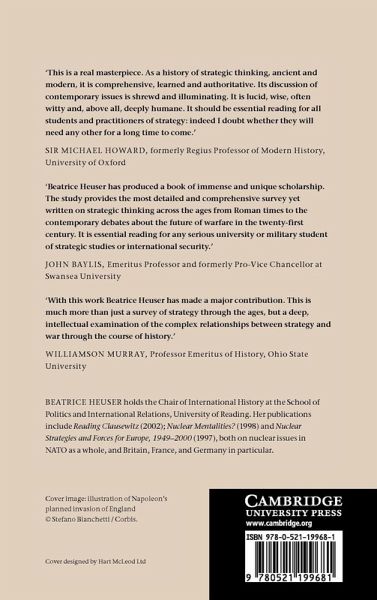
Is there a 'Western way of war' which pursues battles of annihilation and single-minded military victory? Is warfare on a path to ever greater destructive force? This magisterial account answers these questions by tracing the history of Western thinking about strategy - the employment of military force as a political instrument - from antiquity to the present day. Assessing sources from Vegetius to contemporary America, and with a particular focus on strategy since the Napoleonic Wars, Beatrice Heuser explores the evolution of strategic thought, the social institutions, norms and patterns of behaviour within which it operates, the policies that guide it and the cultures that influence it. Ranging across technology and warfare, total warfare and small wars as well as land, sea, air and nuclear warfare, she demonstrates that warfare and strategic thinking have fluctuated wildly in their aims, intensity, limitations and excesses over the past two millennia.
Beatrice Heuser is Chair of International History at the School of Politics and International Relations at the University of Reading. Her widely-translated publications include Reading Clausewitz (2002) and The Bomb: Nuclear Weapons in their Historical, Strategic and Ethical Context (1999).
Inhaltsangabe
Part I. Introduction: 1. What is strategy? Part II. Long-Term Constants: 2. Warfare and mindsets from antiquity to the middle ages 3. Warfare and mindsets in early modern Europe 4. Themes in early thinking about strategy Part III. The Napoleonic Paradigm and Total War: 5. The age and mindset of the Napoleonic paradigm 6. The Napoleonic paradigm transformed: from total mobilisation to total war 7. Challenges to the Napoleonic paradigm vs. the culmination of total war Part IV. Naval and Maritime Strategy: 8. Long-term trends and early maritime strategy 9. The age of steam to the First World War 10. The World Wars and their lessons for maritime strategists 11. Maritime strategy in the nuclear age Part V. Air Power and Nuclear Strategy: 12. War in the third dimension 13. Four schools of air power 14. Nuclear strategy Part VI. Asymmetric or 'Small' Wars: 15. From partisan war to people's war 16. Counterinsurgency Part VII. The Quest for New Paradigms after the World Wars: 17. Wars without victories, victories without peace 18. No end of history: the dialectic continues 19. Epilogue: strategy making vs. bureaucratic politics 20. Summaries and conclusions.
Es gelten unsere Allgemeinen Geschäftsbedingungen: www.buecher.de/agb
Impressum
www.buecher.de ist ein Internetauftritt der buecher.de internetstores GmbH
Geschäftsführung: Monica Sawhney | Roland Kölbl | Günter Hilger
Sitz der Gesellschaft: Batheyer Straße 115 - 117, 58099 Hagen
Postanschrift: Bürgermeister-Wegele-Str. 12, 86167 Augsburg
Amtsgericht Hagen HRB 13257
Steuernummer: 321/5800/1497
USt-IdNr: DE450055826