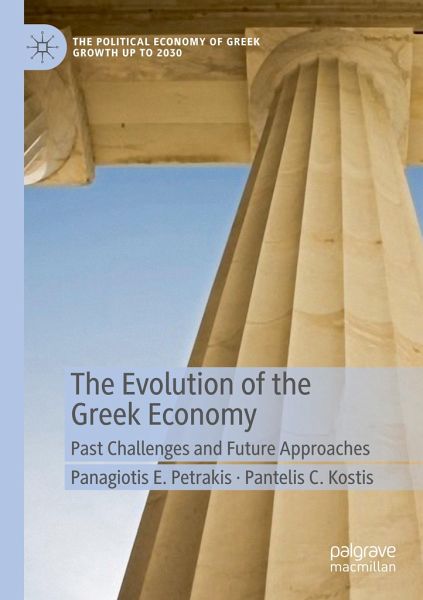
This book assesses the current state of the Greek economy and detects its development and growth prospects up to 2030. The analysis begins with 19th century Greece, addressing the repeated defaults that led to the formation of a dependent state, and the failed modernizing attempts. Then the book addresses current geostrategic dimensions as well as the current structure of institutions and culture in Greece. The second part presents the evolution of sustainability, governance, and inclusivity, as well as the evolution of culture in Greek society and insights into the production prototype. The…mehr
This book assesses the current state of the Greek economy and detects its development and growth prospects up to 2030. The analysis begins with 19th century Greece, addressing the repeated defaults that led to the formation of a dependent state, and the failed modernizing attempts. Then the book addresses current geostrategic dimensions as well as the current structure of institutions and culture in Greece. The second part presents the evolution of sustainability, governance, and inclusivity, as well as the evolution of culture in Greek society and insights into the production prototype. The third part of the book looks forward to what lays ahead for Greece up to 2030. It presents the theoretical background for two scenarios: the normal scenario (business as usual, including the effects of the recent Covid-19 pandemic) and the optimal scenario (a pro-growth scenario including increases of Total Factor Productivity through structural reforms). In presenting these scenarios, the book discusses issues ranging from a comparative analysis between Greece and the Eurozone, the developments in output gap and potential output, public debt, competitiveness, basic macroeconomic variables, a detailed analysis on investments, and inclusive growth.
Artikelnr. des Verlages: 89081052, 978-3-030-47212-2
Seitenzahl: 328
Erscheinungstermin: 1. November 2021
Englisch
Abmessung: 210mm x 148mm x 18mm
Gewicht: 426g
ISBN-13: 9783030472122
ISBN-10: 3030472124
Artikelnr.: 62674351
Herstellerkennzeichnung
Springer-Verlag GmbH
Tiergartenstr. 17
69121 Heidelberg
ProductSafety@springernature.com
Autorenporträt
Panagiotis E. Petrakis is the professor emeritus in the Department of Economics at National and Kapodistrian University of Athens (NKUA), Greece. He is the scientific coordinator of Distance Education Training Programs at the NKUA. He is the author of numerous monographs and has extensive publications in recognized academic journals on economic development, entrepreneurship, and cultural background.Pantelis C. Kostis is an assistant professor at the Department of Economics at the NKUA and a teaching staff at the Hellenic Open University, Greece. His research has been published in distinguished international academic journals including the Journal of Comparative Economics, Journal of Business Research, and Economic Modelling. He is also the co-author of several books regarding economic development and growth. Kyriaki I. Kafka is an adjunct lecturer of Economics at the Department of Economics at the NKUA, Greece. She has publishedbooks and articles in distinguished academic journals including the Journal of Comparative Economics, the Journal of Business Research, and the Journal of Innovation and Knowledge. Her research interests include economic development and growth, economic policy, economic shocks and uncertainty, entrepreneurship, and innovation. Anna-Maria Kanzola is a researcher in the Department of Economics at NKUA, Greece. She holds a B.Sc. degree with honors (9/10) in Economics from NKUA. Currently, she is working toward her M.Sc. at NKUA, in applied economics and finance. She works as a graduate research assistant at NKUA. She is mainly interested in microeconomics, macroeconomics, international economics, sociology, and anthropology.
Inhaltsangabe
1. A Brief Economic History of Repeated Defaults.- 2. The Institutional Evolution and the Failed Modernizing Attempts.- 3. The Geostrategic Settings, National Resources, and the Systemic Risks.- 4. The Formation of Idiosyncratic Structure of Institutions and Culture.- 5. Sustainable Development.- 6. Sustainable Governance.- 7. Inclusivity.- 8. Human Behaviors.- 9. Growth in the Greek Economy.- 10. Insights of the Production Prototype Change.- 11. The Requirements of a Long-Term View.- 12. The Long-term View of the Greek Economy under the Normal and the Optimal Pro-Growth Scenario (2020-2030).
1. A Brief Economic History of Repeated Defaults.- 2. The Institutional Evolution and the Failed Modernizing Attempts.- 3. The Geostrategic Settings, National Resources, and the Systemic Risks.- 4. The Formation of Idiosyncratic Structure of Institutions and Culture.- 5. Sustainable Development.- 6. Sustainable Governance.- 7. Inclusivity.- 8. Human Behaviors.- 9. Growth in the Greek Economy.- 10. Insights of the Production Prototype Change.- 11. The Requirements of a Long-Term View.- 12. The Long-term View of the Greek Economy under the Normal and the Optimal Pro-Growth Scenario (2020-2030).
Es gelten unsere Allgemeinen Geschäftsbedingungen: www.buecher.de/agb
Impressum
www.buecher.de ist ein Internetauftritt der buecher.de internetstores GmbH
Geschäftsführung: Monica Sawhney | Roland Kölbl | Günter Hilger
Sitz der Gesellschaft: Batheyer Straße 115 - 117, 58099 Hagen
Postanschrift: Bürgermeister-Wegele-Str. 12, 86167 Augsburg
Amtsgericht Hagen HRB 13257
Steuernummer: 321/5800/1497
USt-IdNr: DE450055826