
Andere Kunden interessierten sich auch für
 Lo scambio di consonanti occlusive orali in portoghese mozambicano23,99 €
 L'échange de consonnes occlusives orales en portugais mozambicain23,99 €
 The mystery of the future subjunctive in Spanish and Portuguese40,99 €
 The syntax of Portuguese and Kimbundu40,99 €
 A Descriptive Study of the Modern Bengali Script52,99 €
 The Influence of Scots, Irish and English on Northern Irish English15,95 €
 Effects of the second formant on the perception of velarization consonants in Arabic80,99 €


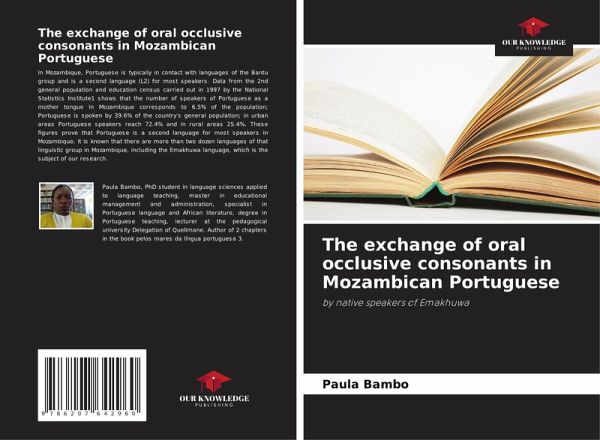
In Mozambique, Portuguese is typically in contact with languages of the Bantu group and is a second language (L2) for most speakers. Data from the 2nd general population and education census carried out in 1997 by the National Statistics Institute1 shows that the number of speakers of Portuguese as a mother tongue in Mozambique corresponds to 6.5% of the population; Portuguese is spoken by 39.6% of the country's general population; in urban areas Portuguese speakers reach 72.4% and in rural areas 25.4%. These figures prove that Portuguese is a second language for most speakers in Mozambique. It is known that there are more than two dozen languages of that linguistic group in Mozambique, including the Emakhuwa language, which is the subject of our research.