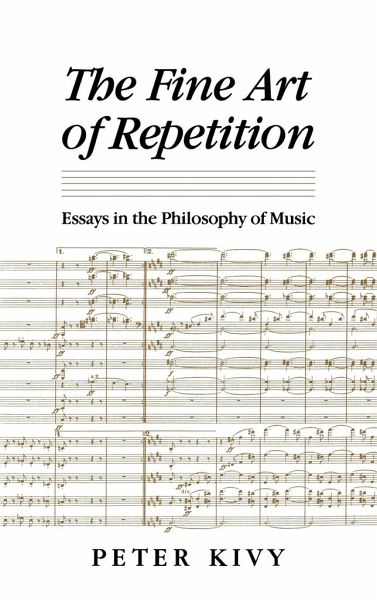
Peter Kivy is the author of many books on the history of art and, in particular, the aesthetics of music. This collection of essays spans a period of some thirty years and focuses on a richly diverse set of issues: the biological origins of music, the role of music in the liberal education, the nature of the musical work and its performance, the aesthetics of opera, the emotions of music, and the very nature of music itself. Some of these subjects are viewed as part of the history of ideas, others as current problems in the philosophy of art. A particular feature of the volume is that Kivy…mehr
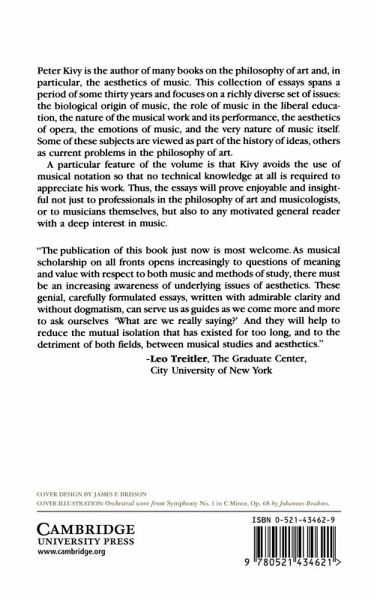
Peter Kivy is the author of many books on the history of art and, in particular, the aesthetics of music. This collection of essays spans a period of some thirty years and focuses on a richly diverse set of issues: the biological origins of music, the role of music in the liberal education, the nature of the musical work and its performance, the aesthetics of opera, the emotions of music, and the very nature of music itself. Some of these subjects are viewed as part of the history of ideas, others as current problems in the philosophy of art. A particular feature of the volume is that Kivy avoids the use of musical notation so that no technical knowledge at all is required to appreciate his work. The essays will prove enjoyable and insightful not just to professionals in the philosophy of art and musicologists, or to musicians themselves, but also to any motivated general reader with a deep interest in music.
Peter Kivy is Board of Governors Professor of Philosophy Emeritus, at Rutgers University. He is the author of numerous books and articles on aesthetics and philosophy of art, including De Gustibus: Arguing About Taste and Why We Do It (OUP, 2015), Music Alone: Philosophical Reflections on the Purely Musical Experience (Cornell UP, 2009), The Blackwell Guide to Aesthetics (2004) and Antithetical Arts: On the Ancient Quarrel Between Literature and Music (OUP, 2009). Several of his books have been translated into Chinese, Italian, Korean, Portuguese, and Spanish. He is a former Guggenheim Fellow and a past President of the American Society for Aesthetics.
Inhaltsangabe
Preface Introduction PART I: I. Mattheson as philosopher of art II. Mainwaring's Handel: its relation to English aesthetics III. Charles Burney, music critic IV. Kant and the Affektenlehre: what he said, and what I wish he had said V. Mozart and monotheism: an essay in spurious aesthetics VI. Child Mozart as an aesthetic symbol VII. Something I've always wanted to know about Hanslick VIII. What was Hanslick denying? IX. Charles Darwin on music X. Herbert Spencer and a musical dispute PART II: XI. The fine art of repetition XII. Platonism in music: a kind of defense XIII. Platonism in music: another kind of defense XIV. Orchestrating platonism XV. Opera talk: a philosophical 'phantasie' XVI. How did Mozart do it?: living conditions in the world of opera XVII. How did Mozart do it?: Replies to my critics XVIII. Live performances and dead composers: on the ethics of musical interpretation XIX. On the concept of the 'historically authentic' performance XX. Paul Robinson's Opera and Ideas XXI. From ideology to music: Leonard Meyer's theory of style change XXII. Music and liberal education XXIII. A new music criticism? XXIV. Is music an art?
Preface Introduction PART I: I. Mattheson as philosopher of art II. Mainwaring's Handel: its relation to English aesthetics III. Charles Burney, music critic IV. Kant and the Affektenlehre: what he said, and what I wish he had said V. Mozart and monotheism: an essay in spurious aesthetics VI. Child Mozart as an aesthetic symbol VII. Something I've always wanted to know about Hanslick VIII. What was Hanslick denying? IX. Charles Darwin on music X. Herbert Spencer and a musical dispute PART II: XI. The fine art of repetition XII. Platonism in music: a kind of defense XIII. Platonism in music: another kind of defense XIV. Orchestrating platonism XV. Opera talk: a philosophical 'phantasie' XVI. How did Mozart do it?: living conditions in the world of opera XVII. How did Mozart do it?: Replies to my critics XVIII. Live performances and dead composers: on the ethics of musical interpretation XIX. On the concept of the 'historically authentic' performance XX. Paul Robinson's Opera and Ideas XXI. From ideology to music: Leonard Meyer's theory of style change XXII. Music and liberal education XXIII. A new music criticism? XXIV. Is music an art?
Es gelten unsere Allgemeinen Geschäftsbedingungen: www.buecher.de/agb
Impressum
www.buecher.de ist ein Internetauftritt der buecher.de internetstores GmbH
Geschäftsführung: Monica Sawhney | Roland Kölbl | Günter Hilger
Sitz der Gesellschaft: Batheyer Straße 115 - 117, 58099 Hagen
Postanschrift: Bürgermeister-Wegele-Str. 12, 86167 Augsburg
Amtsgericht Hagen HRB 13257
Steuernummer: 321/5800/1497
USt-IdNr: DE450055826