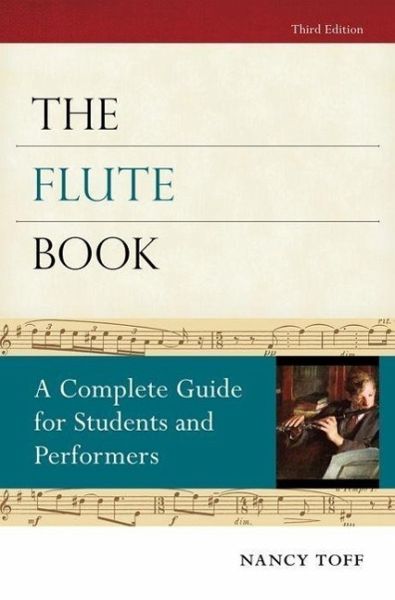
Teachers and flutists at all levels have praised Nancy Toff's The Flute Book, a unique one-stop guide to the flute and its music. Organized into four main parts--The Instrument, Performance, The Music, and Repertoire Catalog--the book begins with a description of the instrument and its making, offers information on choosing and caring for a flute, sketches a history of the flute, and discusses differences between members of the flute family. In the Performance section, readers learn about breathing, tone, vibrato, articulation, technique, style, performing, and recording. In the extensive…mehr
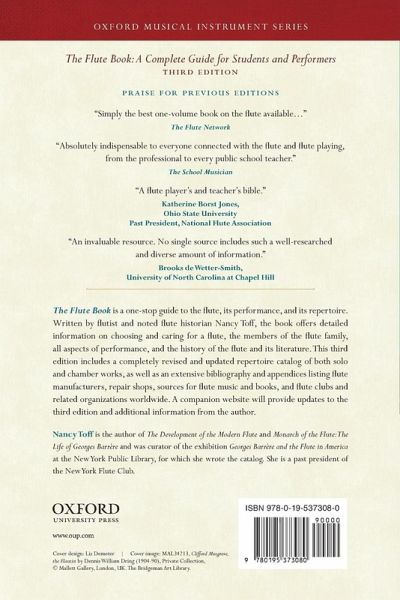
Teachers and flutists at all levels have praised Nancy Toff's The Flute Book, a unique one-stop guide to the flute and its music. Organized into four main parts--The Instrument, Performance, The Music, and Repertoire Catalog--the book begins with a description of the instrument and its making, offers information on choosing and caring for a flute, sketches a history of the flute, and discusses differences between members of the flute family. In the Performance section, readers learn about breathing, tone, vibrato, articulation, technique, style, performing, and recording. In the extensive analysis of flute literature that follows, Toff places individual pieces in historical context. The book ends with a comprehensive catalog of solo and chamber repertoire, and includes appendices with fingering charts as well as lists of current flute manufacturers, repair shops, sources for flute music and books, and flute clubs and related organizations worldwide. In this Third Edition, Toff has updated the book to reflect technology's advancements--like new digital recording technology and recordings' more prevalent online availability--over the last decade. She has also accounted for new scholarship on baroque flutes; recent developments like those of the contrabass flute, quarter-tone flute, and various manufacturing refinements and experiments; consumers' purchase prices for flutes; and an updated repertoire catalog, index, and appendices.
Nancy Toff is the author of The Development of the Modern Flute, Georges Barrère and the Flute in America, and Monarch of the Flute: The Life of Georges Barrère. Highly respected as a writer, researcher, and lecturer, she has been a consultant to the Dayton C. Miller Flute Collection in the Library of Congress and the Department of Musical Instruments of the Metropolitan Museum of Art and was curator of an exhibit on Georges Barrère at the New York Public Library for the Performing Arts at Lincoln Center. She is the president of the New York Flute Club.
Inhaltsangabe
* About the Companion Website * Figures * Plates * Terminology used in this book * Preface * Acknowledgments * THE INSTRUMENT * 1. The Flute Today * What Is a Flute? Manufacturing: The State of the Art * 2. How to Choose an Instrument * To Rent or To Buy Setting Priorities Materials Open or Closed Holes C or B Footjoint Mechanical Options Testing an Instrument * 3. Care and Maintenance of the Flute * Preventive Maintenance: Assembling the Instrument Daily Cleaning Storage Polishing Replating Lubrication The Headjoint Cork Mechanical Problems * 4. A Brief History of the Flute * Old System Flutes The Boehm Flute Other Nineteenth Century Flutes Minor Modifications to the Boehm System * 5. The Flute Family * The Piccolo The Alto Flute The Bass Flute The Contr'alto, Contrabass, and Subcontrabass Flutes The Flute Choir * PERFORMANCE * 6. Breathing * Posture Inhalation Suspension Exhalation The Diaphragm Exercises Breathing and Phrasing Circular Breathing * 7. Tone * The Acoustical Basis Tone Production Focus and Projection Homogeneity of Sound Interpretation through Tone Development Intonation National Styles of Flute Playing * 8. Vibrato * What is Vibrato? The History of Vibrato The Uses of Vibrato * 9. Articulation * The Bowing Analogy Single-Tonguing Double-Tonguing Triple-Tonguing Flutter-Tonguing Tongueless Attack Legato Note Endings Practice * 10. Technique * Position Practice Fingering Harmonics The B-flat Thumb Key Three Fingering Tricks * 11. Style * Virtuosity and Interpretation The Theoretical Background: Basic Musicianship Analysis Phrasing Performance Practice The Early Music Movement and Questions of Authenticity * 12. Performance * Opportunities for Performance Planning a Recital Program Accompanists and Assisting Artists Choosing a Recital Hall The Printed Program Publicity Preparation and Rehearsal Stage Protocol The Entrance Playing the Program Memorization Breaks between Pieces Encores * 13. Recordings * Building a Recording Collection How to Listen Playing Along Making Your Own Recordings * THE MUSIC * 14. The Baroque Era * Flute Versus Recorder Musical Forms France Italy England Germany * 15. The Classic Era * Musical Forms Paris Germany Spain England Vienna * 16. The Romantic Era * Music by Nonflutists Music by Flutists * 17. The Modern Era * France Great Britain Elsewhere in Western Europe Eastern Europe The United States The Avant-Garde The Flute and Electronics * REPERTOIRE CATALOG * Introduction * A. The Baroque Era * B. The Classic Era * C. The Romantic Era * D. The Modern Era * E. Study Materials * APPENDICES * A. Fingering Chart for the Boehm Flute * B. Flute Manufacturers * C. Repair Shops * D. Sources for Instruments and Accessories * E. Sources for Music and Books * F. Journals, Societies, and Service Organizations * G. Flute Clubs and Societies * Notes * Selected Bibliography * Index
* About the Companion Website * Figures * Plates * Terminology used in this book * Preface * Acknowledgments * THE INSTRUMENT * 1. The Flute Today * What Is a Flute? Manufacturing: The State of the Art * 2. How to Choose an Instrument * To Rent or To Buy Setting Priorities Materials Open or Closed Holes C or B Footjoint Mechanical Options Testing an Instrument * 3. Care and Maintenance of the Flute * Preventive Maintenance: Assembling the Instrument Daily Cleaning Storage Polishing Replating Lubrication The Headjoint Cork Mechanical Problems * 4. A Brief History of the Flute * Old System Flutes The Boehm Flute Other Nineteenth Century Flutes Minor Modifications to the Boehm System * 5. The Flute Family * The Piccolo The Alto Flute The Bass Flute The Contr'alto, Contrabass, and Subcontrabass Flutes The Flute Choir * PERFORMANCE * 6. Breathing * Posture Inhalation Suspension Exhalation The Diaphragm Exercises Breathing and Phrasing Circular Breathing * 7. Tone * The Acoustical Basis Tone Production Focus and Projection Homogeneity of Sound Interpretation through Tone Development Intonation National Styles of Flute Playing * 8. Vibrato * What is Vibrato? The History of Vibrato The Uses of Vibrato * 9. Articulation * The Bowing Analogy Single-Tonguing Double-Tonguing Triple-Tonguing Flutter-Tonguing Tongueless Attack Legato Note Endings Practice * 10. Technique * Position Practice Fingering Harmonics The B-flat Thumb Key Three Fingering Tricks * 11. Style * Virtuosity and Interpretation The Theoretical Background: Basic Musicianship Analysis Phrasing Performance Practice The Early Music Movement and Questions of Authenticity * 12. Performance * Opportunities for Performance Planning a Recital Program Accompanists and Assisting Artists Choosing a Recital Hall The Printed Program Publicity Preparation and Rehearsal Stage Protocol The Entrance Playing the Program Memorization Breaks between Pieces Encores * 13. Recordings * Building a Recording Collection How to Listen Playing Along Making Your Own Recordings * THE MUSIC * 14. The Baroque Era * Flute Versus Recorder Musical Forms France Italy England Germany * 15. The Classic Era * Musical Forms Paris Germany Spain England Vienna * 16. The Romantic Era * Music by Nonflutists Music by Flutists * 17. The Modern Era * France Great Britain Elsewhere in Western Europe Eastern Europe The United States The Avant-Garde The Flute and Electronics * REPERTOIRE CATALOG * Introduction * A. The Baroque Era * B. The Classic Era * C. The Romantic Era * D. The Modern Era * E. Study Materials * APPENDICES * A. Fingering Chart for the Boehm Flute * B. Flute Manufacturers * C. Repair Shops * D. Sources for Instruments and Accessories * E. Sources for Music and Books * F. Journals, Societies, and Service Organizations * G. Flute Clubs and Societies * Notes * Selected Bibliography * Index
Es gelten unsere Allgemeinen Geschäftsbedingungen: www.buecher.de/agb
Impressum
www.buecher.de ist ein Internetauftritt der buecher.de internetstores GmbH
Geschäftsführung: Monica Sawhney | Roland Kölbl | Günter Hilger
Sitz der Gesellschaft: Batheyer Straße 115 - 117, 58099 Hagen
Postanschrift: Bürgermeister-Wegele-Str. 12, 86167 Augsburg
Amtsgericht Hagen HRB 13257
Steuernummer: 321/5800/1497
USt-IdNr: DE450055826