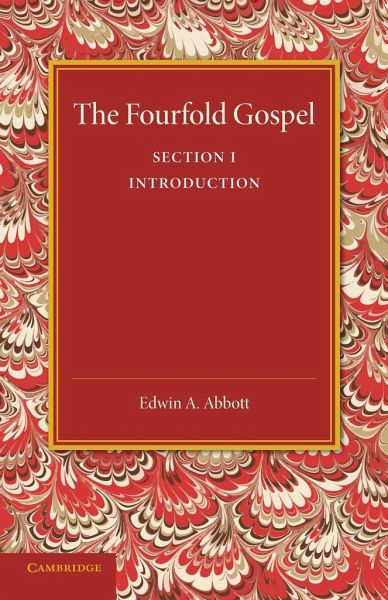
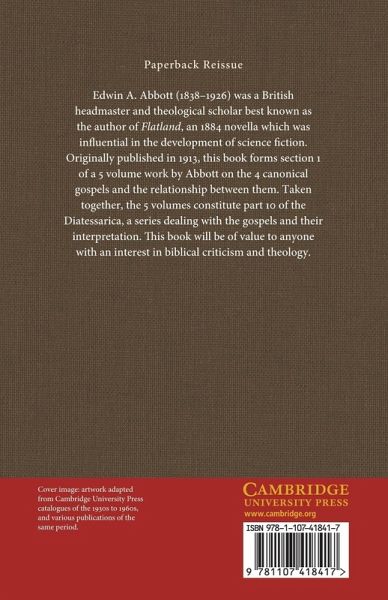
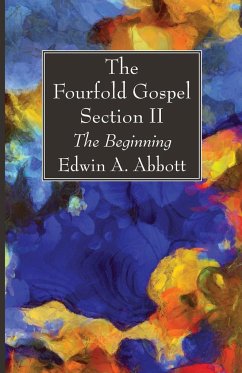
Edwin A. Abbott (1838-1926) was a British headmaster and theological scholar best known as the author of Flatland, an 1884 novella which was influential in the development of science fiction. Originally published in 1913, this book forms section 1 of a 5 volume work by Abbott on the four canonical gospels and the relationship between them. Taken together, the five volumes constitute part 10 of the Diatessarica, a series dealing with the gospels and their interpretation. This book will be of value to anyone with an interest in biblical criticism and theology.
Edwin A. Abbott (1838-1926) was a British headmaster and theological scholar best known as the author of Flatland, an 1884 novella which was influential in the development of science fiction. Originally published in 1913, this book forms section 1 of a 5 volume work by Abbott on the four canonical gospels and the relationship between them. Taken together, the five volumes constitute part 10 of the Diatessarica, a series dealing with the gospels and their interpretation. This book will be of value to anyone with an interest in biblical criticism and theology.
Edwin Abbott Abbott (1838-1926) was an English schoolmaster, theologian, and author, renowned for his novella Flatland. Born in Marylebone, London, he was the eldest son of Edwin Abbott, headmaster of the Philological School, and his wife, Jane. Abbott received his education at the City of London School and St John's College, Cambridge, excelling in classics, mathematics, and theology.In 1865, at the age of 26, Abbott became headmaster of the City of London School, where he served until 1889. During his tenure, he was known for his progressive educational views and oversaw the education of notable students, including future Prime Minister H. H. Asquith. After retiring, Abbott dedicated himself to literary and theological pursuits, producing works such as Shakespearian Grammar (1870) and a biography of Francis Bacon (1885).Abbott's theological writings often reflected his open-minded approach, as seen in his anonymously published religious romances like Philochristus (1878) and Onesimus (1882). His most enduring work, Flatland (1884), is a satirical novella that explores dimensions and societal hierarchies, blending mathematical fiction with social commentary. Abbott's contributions to literature and theology continue to be recognized for their depth and insight.
Inhaltsangabe
References and abbreviations 1. The object of this treatise 2. Which gospel should stand first? 3. Which gospel should stand last? 4. Allusions in John to Mark 5. The course of procedure 6. 'Paraleipomena' or 'things omitted' 7. Order and arrangement in Hebrew histories 8. Order and arrangement in Mark 9. Order and arrangement in Matthew 10. Order and arrangement in Luke 11. Order and arrangement in John.
References and abbreviations 1. The object of this treatise 2. Which gospel should stand first? 3. Which gospel should stand last? 4. Allusions in John to Mark 5. The course of procedure 6. 'Paraleipomena' or 'things omitted' 7. Order and arrangement in Hebrew histories 8. Order and arrangement in Mark 9. Order and arrangement in Matthew 10. Order and arrangement in Luke 11. Order and arrangement in John.
Es gelten unsere Allgemeinen Geschäftsbedingungen: www.buecher.de/agb
Impressum
www.buecher.de ist ein Internetauftritt der buecher.de internetstores GmbH
Geschäftsführung: Monica Sawhney | Roland Kölbl | Günter Hilger
Sitz der Gesellschaft: Batheyer Straße 115 - 117, 58099 Hagen
Postanschrift: Bürgermeister-Wegele-Str. 12, 86167 Augsburg
Amtsgericht Hagen HRB 13257
Steuernummer: 321/5800/1497
USt-IdNr: DE450055826