
Andere Kunden interessierten sich auch für
 The Lower Limbs: Learning How We Use Our Thighs, Knees, Legs, and Feet30,99 €
 Future Opportunities to Leverage the Alzheimer's Disease Neuroimaging Initiative20,99 €
 The Future of Health Services Research21,99 €
 Stem Cells and the Future of Regenerative Medicine38,99 €
 The Head and Neck: Learning How We Use Our Muscles30,99 €
 Medicine of the Senses22,00 €
 The new spectrum of Tourette therapy28,90 €



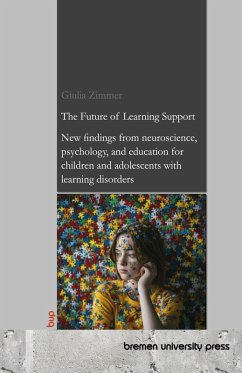
Learning disorders are among the most overlooked phenomena in child and adolescent development-and at the same time among the most misunderstood. Although modern neuroscience, psychology, and education have long shown that reading, writing, and math difficulties are expressions of neurocognitive diversity, myths persist in schools, families, and society. Those affected not only experience learning barriers, but often also fear, shame, and feelings of inadequacy. This book dispels old ideas and presents a comprehensive, internationally compatible understanding of learning disorders. It combines current research on genetics, epigenetics, and brain development with findings from education, learning therapy, and modern technology. In doing so, it shows how learning disorders arise, how they are diagnosed, and-above all-how those affected can be effectively supported. The focus is on the entire system: on schools and education policy, on family dynamics, on therapeutic concepts, and on new opportunities offered by digitalization and AI. Instead of focusing on deficits, the book opens up space for a resource-oriented understanding that takes human development in all its diversity seriously. Bremen University Press has published over 5,500 specialist books in various languages since 2005. November 2025