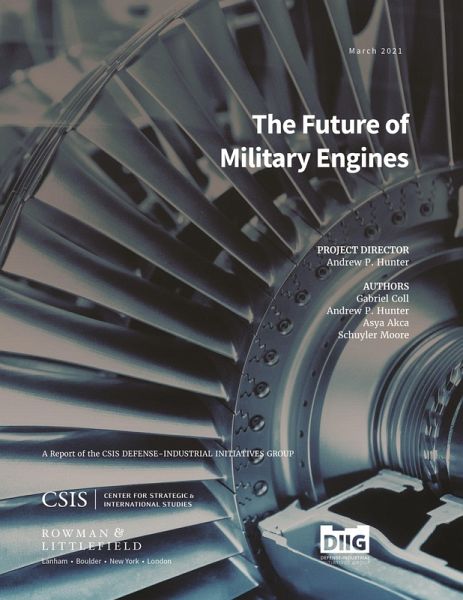
This CSIS report describes how DoDâ s investment in military aircraft engines will decrease significantly, presenting a challenge for the industrial base. The report also argues that DoD must make four major policy choices in its investment approach to military engines: priority, resources, business model, and competition.
This CSIS report describes how DoDâ s investment in military aircraft engines will decrease significantly, presenting a challenge for the industrial base. The report also argues that DoD must make four major policy choices in its investment approach to military engines: priority, resources, business model, and competition.
Gabriel Coll was a program manager and research associate for the Defense-Industrial Initiatives Group at the Center for Strategic and International Studies (CSIS) from 2015 to 2020. Andrew P. Hunter is a senior fellow in the International Security Program and director of the Defense-Industrial Initiatives Group at CSIS. Asya Akca was a program manager and research associate for the Defense-Industrial Initiatives Group at CSIS from 2018 to 2020. Schuyler Moore was a research intern in the Defense-Industrial Initiatives Group at CSIS in 2018.
Inhaltsangabe
Chapter 1 Introduction 1 Chapter 2 The Four Key Policy Choices for Military Engines 4 Priority 4 Allocation of Resources 5 Business Model 6 Competition 7 Informing the Critical Policy Choices 8 Chapter 3 The U.S. Engine Industrial Base 9 Relationship between Commercial and Military Engines 9 Differences between Commercial and Military Engines 9 Benefits and Challenges of a Common Engine Industrial Base 13 The Criticality of the Engine Supply Chain 14 Understanding the Military Aircraft Engine Market 17 Major Military Engine Competitors 23 Chapter 4 Military Aircraft and Engine Trends 27 Aircraft Trends 27 Fighter/Attack Aircraft Trends 35 Chapter 5 Defense Investment in Military Engines 44 Engine-Related Acquisition Trends 44 Engine-Related Research and Development in the Future Years Defense Program 51 Recent Engine-Related Research and Development Programs 55 Business Model for Engine Development 59 Competition in the U.S. Fighter Engine Market 62 Chapter 6 Conclusion 66 Appendix Methodology 67 Inventory 67 Contracts 70 Budget 72 About the Authors 76
Chapter 1 Introduction 1 Chapter 2 The Four Key Policy Choices for Military Engines 4 Priority 4 Allocation of Resources 5 Business Model 6 Competition 7 Informing the Critical Policy Choices 8 Chapter 3 The U.S. Engine Industrial Base 9 Relationship between Commercial and Military Engines 9 Differences between Commercial and Military Engines 9 Benefits and Challenges of a Common Engine Industrial Base 13 The Criticality of the Engine Supply Chain 14 Understanding the Military Aircraft Engine Market 17 Major Military Engine Competitors 23 Chapter 4 Military Aircraft and Engine Trends 27 Aircraft Trends 27 Fighter/Attack Aircraft Trends 35 Chapter 5 Defense Investment in Military Engines 44 Engine-Related Acquisition Trends 44 Engine-Related Research and Development in the Future Years Defense Program 51 Recent Engine-Related Research and Development Programs 55 Business Model for Engine Development 59 Competition in the U.S. Fighter Engine Market 62 Chapter 6 Conclusion 66 Appendix Methodology 67 Inventory 67 Contracts 70 Budget 72 About the Authors 76
Es gelten unsere Allgemeinen Geschäftsbedingungen: www.buecher.de/agb
Impressum
www.buecher.de ist ein Internetauftritt der buecher.de internetstores GmbH
Geschäftsführung: Monica Sawhney | Roland Kölbl | Günter Hilger
Sitz der Gesellschaft: Batheyer Straße 115 - 117, 58099 Hagen
Postanschrift: Bürgermeister-Wegele-Str. 12, 86167 Augsburg
Amtsgericht Hagen HRB 13257
Steuernummer: 321/5800/1497
USt-IdNr: DE450055826