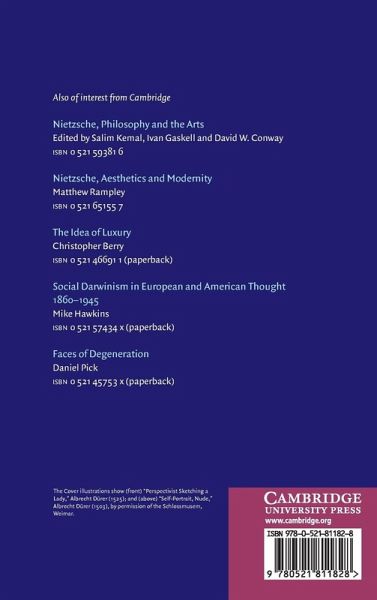
Ekbert Faas
The Genealogy of Aesthetics
Ekbert Faas
The Genealogy of Aesthetics
- Gebundenes Buch
- Merkliste
- Auf die Merkliste
- Bewerten Bewerten
- Teilen
- Produkt teilen
- Produkterinnerung
- Produkterinnerung
Offers a new aesthetics, heavily influenced by Nietzsche, that draws on contemporary cognitive science.
Andere Kunden interessierten sich auch für
D. LillekerPolitical Communication and Cognition38,99 €
Paul M. W. HackettPsychology and Philosophy of Abstract Art42,99 €
Jerome Neu (ed.)The Cambridge Companion to Freud40,99 €
Sebastiano BavettaFreedom and the Pursuit of Happiness82,99 €
Erich NeumannArt And The Creative Unconscious47,99 €
T. PaavolainenTheatre/Ecology/Cognition76,99 €-
-
-
Offers a new aesthetics, heavily influenced by Nietzsche, that draws on contemporary cognitive science.
Produktdetails
- Produktdetails
- Verlag: Cambridge University Press
- Seitenzahl: 454
- Erscheinungstermin: 15. August 2002
- Englisch
- Abmessung: 235mm x 157mm x 29mm
- Gewicht: 805g
- ISBN-13: 9780521811828
- ISBN-10: 0521811821
- Artikelnr.: 21326434
- Herstellerkennzeichnung
- Libri GmbH
- Europaallee 1
- 36244 Bad Hersfeld
- gpsr@libri.de
- Verlag: Cambridge University Press
- Seitenzahl: 454
- Erscheinungstermin: 15. August 2002
- Englisch
- Abmessung: 235mm x 157mm x 29mm
- Gewicht: 805g
- ISBN-13: 9780521811828
- ISBN-10: 0521811821
- Artikelnr.: 21326434
- Herstellerkennzeichnung
- Libri GmbH
- Europaallee 1
- 36244 Bad Hersfeld
- gpsr@libri.de
EKBERT FAAS is Professor of Humanities and Graduate English at York University, Toronto, Canada. He has published very widely as both critic (e.g. Shakespeare's Poetics, Cambridge, 1986), biographer (Robert Creeley: a biography) and novelist (The Revolutionist and Mengele's Friend).
Acknowledgements
Introduction
1. Plato's transvaluations of aesthetic values
2. Proto-Nietzschean opponents to Plato
3. Late Antiquity, Plotinus, and Augustine
4. Augustine's Platonopolis
5. The Middle Ages
6. The Renaissance
7. The Renaissance Academy, Ficino, Montaigne, and Shakespeare
8. Hobbes and Shaftesbury
9. Mandeville, Burke, Hume, and E. Darwin
10. Kant's ethicoteleological aesthetics
11. Kant's midlife conversion
12. Hegel, Feuerbach, and Marx
13. Marx's Nietzschean moment
14. Heidegger's 'destruction' of traditional aesthetics
15. Heidegger contra Nietzsche
16. Heidegger, Nietzsche, and Derrida
17. Différance, Freud, Nietzsche, and Artaud
18. Derrida's mega-transcendentalist Mimesis
19. Postmodern or Pre-Nietszschean? Derrida, Lyotard, and de Man
20. The Postmodern revival of the aesthetic ideal
Afterword.

Introduction
1. Plato's transvaluations of aesthetic values
2. Proto-Nietzschean opponents to Plato
3. Late Antiquity, Plotinus, and Augustine
4. Augustine's Platonopolis
5. The Middle Ages
6. The Renaissance
7. The Renaissance Academy, Ficino, Montaigne, and Shakespeare
8. Hobbes and Shaftesbury
9. Mandeville, Burke, Hume, and E. Darwin
10. Kant's ethicoteleological aesthetics
11. Kant's midlife conversion
12. Hegel, Feuerbach, and Marx
13. Marx's Nietzschean moment
14. Heidegger's 'destruction' of traditional aesthetics
15. Heidegger contra Nietzsche
16. Heidegger, Nietzsche, and Derrida
17. Différance, Freud, Nietzsche, and Artaud
18. Derrida's mega-transcendentalist Mimesis
19. Postmodern or Pre-Nietszschean? Derrida, Lyotard, and de Man
20. The Postmodern revival of the aesthetic ideal
Afterword.
Acknowledgements
Introduction
1. Plato's transvaluations of aesthetic values
2. Proto-Nietzschean opponents to Plato
3. Late Antiquity, Plotinus, and Augustine
4. Augustine's Platonopolis
5. The Middle Ages
6. The Renaissance
7. The Renaissance Academy, Ficino, Montaigne, and Shakespeare
8. Hobbes and Shaftesbury
9. Mandeville, Burke, Hume, and E. Darwin
10. Kant's ethicoteleological aesthetics
11. Kant's midlife conversion
12. Hegel, Feuerbach, and Marx
13. Marx's Nietzschean moment
14. Heidegger's 'destruction' of traditional aesthetics
15. Heidegger contra Nietzsche
16. Heidegger, Nietzsche, and Derrida
17. Différance, Freud, Nietzsche, and Artaud
18. Derrida's mega-transcendentalist Mimesis
19. Postmodern or Pre-Nietszschean? Derrida, Lyotard, and de Man
20. The Postmodern revival of the aesthetic ideal
Afterword.
Introduction
1. Plato's transvaluations of aesthetic values
2. Proto-Nietzschean opponents to Plato
3. Late Antiquity, Plotinus, and Augustine
4. Augustine's Platonopolis
5. The Middle Ages
6. The Renaissance
7. The Renaissance Academy, Ficino, Montaigne, and Shakespeare
8. Hobbes and Shaftesbury
9. Mandeville, Burke, Hume, and E. Darwin
10. Kant's ethicoteleological aesthetics
11. Kant's midlife conversion
12. Hegel, Feuerbach, and Marx
13. Marx's Nietzschean moment
14. Heidegger's 'destruction' of traditional aesthetics
15. Heidegger contra Nietzsche
16. Heidegger, Nietzsche, and Derrida
17. Différance, Freud, Nietzsche, and Artaud
18. Derrida's mega-transcendentalist Mimesis
19. Postmodern or Pre-Nietszschean? Derrida, Lyotard, and de Man
20. The Postmodern revival of the aesthetic ideal
Afterword.