
Andere Kunden interessierten sich auch für
 Music in Conflict178,99 €
 Soundscapes from the Americas169,99 €
 The Jews-Harp in Britain and Ireland169,99 €
 Queerness in Heavy Metal Music185,99 €
 The Places of Van Morrison's Songwriting149,99 €
 Gender, Age and Musical Creativity168,99 €
 Beethoven and Greco-Roman Antiquity168,99 €



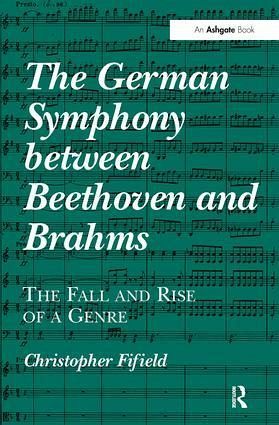
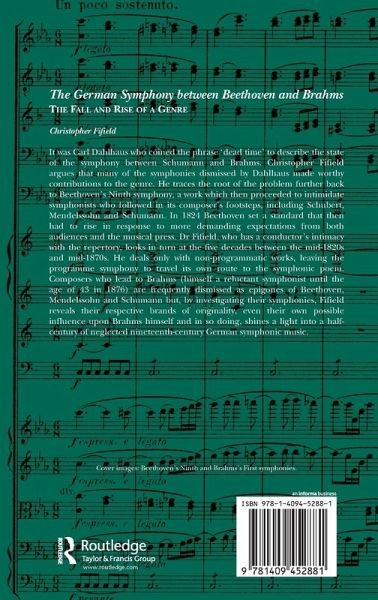
It was Carl Dahlhaus who coined the phrase 'dead time' to describe the state of the symphony between Schumann and Brahms. Christopher Fifield argues that many of the symphonies dismissed by Dahlhaus made worthy contributions to the genre. He looks at the non-programmatic works of the five decades between the mid-1820s and mid-1870s. Composers who lead to Brahms are frequently dismissed as epigones of Beethoven, Mendelssohn and Schumann but by investigating their symphonies, Fifield reveals their respective brands of originality and in so doing, shines a light into a half-century of neglected nineteenth-century German symphonic music.
'... a must-buy for all those interested in 19th century music, specifically the German classical (not programme) symphony as it developed in the half-century between the appearance of Beethoven's 9th in 1824 and Brahms' 1st in 1876. ... reads like a musicological detective story. It is an extremely important contribution to the understanding of the development of the Symphony in the nineteenth century'. www.unsungcomposers.com 'Dr. Fifield is known to CD collectors as a good conductor of the music of 19th Century composers like Scharwenka and Schnyder von Warttnsee. Covering as it does a half-century missing from symphonic research, his book fills a gap - to put it mildly. American Record Guide