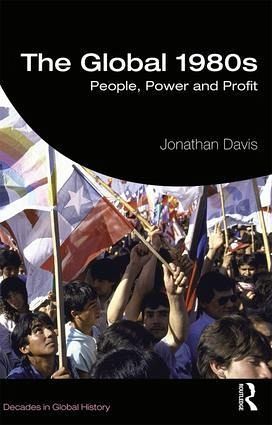
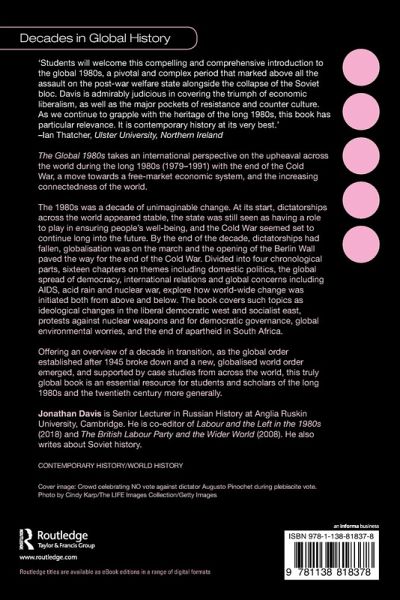
The Global 1980s takes an international perspective on the upheaval across the world during the long 1980s (1979-1991) with the end of the Cold War, a move towards a free-market economic system, and the increasing connectedness of the world.
The Global 1980s takes an international perspective on the upheaval across the world during the long 1980s (1979-1991) with the end of the Cold War, a move towards a free-market economic system, and the increasing connectedness of the world.
Jonathan Davis is Senior Lecturer in Russian History at Anglia Ruskin University, Cambridge. He is co-editor of Labour and the Left in the 1980s (2018) and The British Labour Party and the Wider World (2008). He also writes about Soviet history.
Inhaltsangabe
Acknowledgements Introduction Part One: 1979-1982 Chapter One: Revolutions in east and west: Iran and Nicaragua Chapter Two: Thatcher, Reagan and free markets: ghost towns, rust belts and a new individualism Chapter Three: Inside the Soviet bloc: the end of détente and the rise of Solidarnö¿ Chapter Four: Africa and decolonisation: twenty years after the 'winds of change' Part Two: 1983-1985 Chapter Five: Changes in China: the consequences of Deng Xiaoping's reforms Chapter Six: Bombs, jobs and famine: music and global concerns Chapter Seven: Global crises: AIDS, acid rain and the ozone layer Chapter Eight: Mikhail Gorbachev: new man, new thinking Part Three: 1986-1988 Chapter Nine: Making a 'modern' decade: computers, videos and yuppies Chapter Ten: The first wave of Indian liberalisation: the Rajiv Gandhi era Chapter Eleven: South Korea's twisted path to democracy Chapter Twelve: The Middle East in turmoil: Iran-Iraq and the first intifada Part Four: 1989-1991 Chapter Thirteen: Reagan and Thatcher depart, a new world order emerges Chapter Fourteen: Latin America's transition to democracy: Chile and Haiti Chapter Fifteen: 'Free Nelson Mandela': the end of apartheid in South Africa Chapter Sixteen: The communist world breaks Conclusion Bibliography Index
Acknowledgements Introduction Part One: 1979-1982 Chapter One: Revolutions in east and west: Iran and Nicaragua Chapter Two: Thatcher, Reagan and free markets: ghost towns, rust belts and a new individualism Chapter Three: Inside the Soviet bloc: the end of détente and the rise of Solidarnö¿ Chapter Four: Africa and decolonisation: twenty years after the 'winds of change' Part Two: 1983-1985 Chapter Five: Changes in China: the consequences of Deng Xiaoping's reforms Chapter Six: Bombs, jobs and famine: music and global concerns Chapter Seven: Global crises: AIDS, acid rain and the ozone layer Chapter Eight: Mikhail Gorbachev: new man, new thinking Part Three: 1986-1988 Chapter Nine: Making a 'modern' decade: computers, videos and yuppies Chapter Ten: The first wave of Indian liberalisation: the Rajiv Gandhi era Chapter Eleven: South Korea's twisted path to democracy Chapter Twelve: The Middle East in turmoil: Iran-Iraq and the first intifada Part Four: 1989-1991 Chapter Thirteen: Reagan and Thatcher depart, a new world order emerges Chapter Fourteen: Latin America's transition to democracy: Chile and Haiti Chapter Fifteen: 'Free Nelson Mandela': the end of apartheid in South Africa Chapter Sixteen: The communist world breaks Conclusion Bibliography Index
Es gelten unsere Allgemeinen Geschäftsbedingungen: www.buecher.de/agb
Impressum
www.buecher.de ist ein Internetauftritt der buecher.de internetstores GmbH
Geschäftsführung: Monica Sawhney | Roland Kölbl | Günter Hilger
Sitz der Gesellschaft: Batheyer Straße 115 - 117, 58099 Hagen
Postanschrift: Bürgermeister-Wegele-Str. 12, 86167 Augsburg
Amtsgericht Hagen HRB 13257
Steuernummer: 321/5800/1497
USt-IdNr: DE450055826