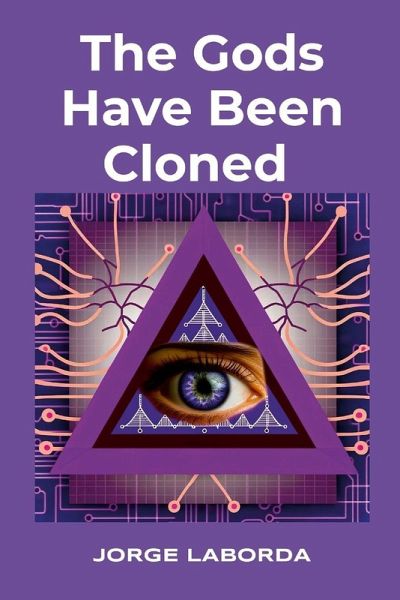
The novel you have in your hands is an extensive and original work that could be classified within the science fiction genre, but it is actually a novelized essay, inspired by science, religion, and philosophy, in which many intellectual inconsistencies are analyzed and many preconceived ideas of our time are challenged. The work describes a future time in which humans have lost faith, not only in God but also in themselves. The advance of science and knowledge, as well as exciting events involving the Pope, have caused the death of faith in God and in humanity, and with it, the loss of the…mehr
The novel you have in your hands is an extensive and original work that could be classified within the science fiction genre, but it is actually a novelized essay, inspired by science, religion, and philosophy, in which many intellectual inconsistencies are analyzed and many preconceived ideas of our time are challenged. The work describes a future time in which humans have lost faith, not only in God but also in themselves. The advance of science and knowledge, as well as exciting events involving the Pope, have caused the death of faith in God and in humanity, and with it, the loss of the meaning of life in all members of society. Without faith, society disintegrates. To save it, some scientists decide to clone a man who died decades earlier possessing faith in God and humanity and whose "cerebral coordinates" had been stored on a computer. The scientists analyze his brain with the new technologies available in that future time to discover what faith consists of and to artificially implant it again in the brains of everyone. Since, generally, science ends up destroying or at least modifying anything it seeks to understand, in this process, the cloned protagonist will lose his faith. This will happen during conversations with the scientist who cloned him, who will explain to him what has happened during the decades he was dead that led to the loss of faith in the world. A novel that will make you reflect on yourself and the society in which you live.
Jorge Laborda is Professor of Biochemistry and Molecular Biology (BBM) in the Faculty of Pharmacy at the University of Castilla-La Mancha, Spain. Among his scientific contributions, it is worth mentioning the discoveries that reveal the existence of two genes regulating the activity of Notch receptors, one of the most important for the control of cell growth and differentiation and for the functioning of the immune system. During his work at the FDA, from 1991 to 1999, he was responsible for the evaluation of numerous projects on new anticancer therapies based on monoclonal antibodies. From November 2003 to May 2004, he was appointed as a Leading National Expert at the European Commission, where he worked on the management and promotion of the area of Synthetic Biology. In April 2004, he was elected Dean of the UCLM School of Medicine. From June 2007 to June 2011, he held the position of Councilor for Science, Technology and Consumer Affairs at Albacete City Council. Among his contributions in that capacity is the creation of the Promenade of the Planets, a scale reproduction of the Solar System: https://es.wikipedia.org/wiki/Paseo_de_los_Planetas. Among the extensive contributions in the area of scientific popularization he was PI of eight popularization projects financed by the FECYT (Spanish Foundation for Science and Technology) for the popularization of the scientific activities of the UCLM through the program Talking to Scientists (http://cienciaes.com/entrevistas/). He has authored 22 books on scientific subjects. Thirteen of these correspond to compilations of the more than one thousand popular science articles published in the newspaper La Tribuna de Albacete, newspapers of the Promecal group, and El País, and available in the blog Quilo de Ciencia (https://jorlab.blogspot.com). He has participated numerous times as a popularizer in Vanguardia de la Ciencia and Hablando con Científicos programs. It also produces the podcast Quilo de Ciencia. He has also been the initiator and director of the podcast Ciencia Fresca. Finally, he was one of the initial promoters of the Spanish Science in the Parliament initiative, in which he participated as one of the six national experts to develop it.
Es gelten unsere Allgemeinen Geschäftsbedingungen: www.buecher.de/agb
Impressum
www.buecher.de ist ein Internetauftritt der buecher.de internetstores GmbH
Geschäftsführung: Monica Sawhney | Roland Kölbl | Günter Hilger
Sitz der Gesellschaft: Batheyer Straße 115 - 117, 58099 Hagen
Postanschrift: Bürgermeister-Wegele-Str. 12, 86167 Augsburg
Amtsgericht Hagen HRB 13257
Steuernummer: 321/5800/1497
USt-IdNr: DE450055826