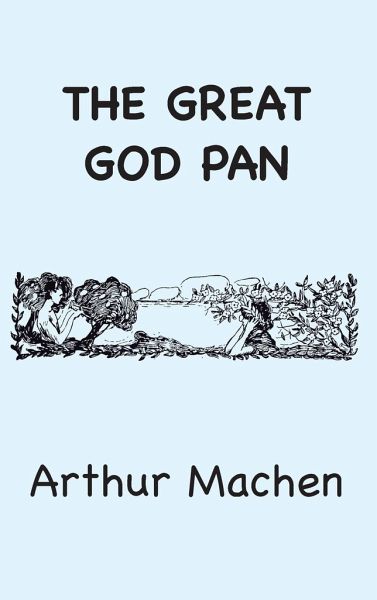
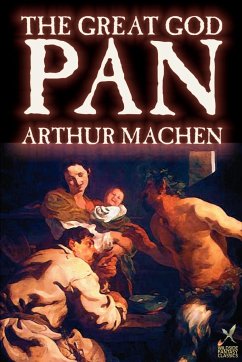
The Great God Pan is a short horror and fiction book by Arthur Machen, who is Welsh. Machen saw and felt the ruins of a pagan temple in Wales, which made him want to write The Great God Pan. In 1890, the magazine The Whirlwind gave out what would become the first part of the story. Later, Machen incorporated additional elements into The Great God Pan, leading to its publication as a book in 1894, which also included the story "The Inmost Light." At the start of the story, a woman named Mary is put through an experiment that aims to help her see the supernatural. After this, there is a story…mehr
The Great God Pan is a short horror and fiction book by Arthur Machen, who is Welsh. Machen saw and felt the ruins of a pagan temple in Wales, which made him want to write The Great God Pan. In 1890, the magazine The Whirlwind gave out what would become the first part of the story. Later, Machen incorporated additional elements into The Great God Pan, leading to its publication as a book in 1894, which also included the story "The Inmost Light." At the start of the story, a woman named Mary is put through an experiment that aims to help her see the supernatural. After this, there is a story about a woman named Helen Vaughan who was involved in several strange deaths and events over a long period. In the end, the heroes talk to Helen and make her kill herself. Before she dies, she goes through a series of strange changes that show her to be a magical being. When the story came out, the press widely viewed it as degenerate and awful due to its apparent sexual content, which damaged Machen's reputation as an author. Critics re-evaluated Machen's work in the 1920s, establishing The Great God Pan as a classic in the horror genre. Literary experts have acknowledged the influence of other 1800s works on The Great God Pan, yet they disagree on its classification as Gothic or science fiction. The short story, which has spawned two plays, served as inspiration for horror writers such as Bram Stoker, H. P. Lovecraft, and Stephen King.
Arthur Machen, baptized Arthur Llewellyn Jones-Machen, was a Welsh writer in the 19th and 20th centuries. He received a classical education as a boy; however, he couldn't afford to attend university, so he lived a life of relative poverty as he attempted to work in several professions before finding literary success.In 1897, Machen married his first wife, Amelia Hogg, who introduced him to A. E. White, who became close friends with Machen and helped him break into literary circles. Soon after, Machen also began receiving legacies from distant relatives, which allowed him to devote more time to writing.While he wrote fiction and nonfiction, Machen is best known for his supernatural and horror stories, which were inspired by Celtic, Roman, and medieval history as well as his own childhood in Wales. His books were popular, though his success fell after some unfortunate events-including a scandal from Oscar Wilde that hurt the reputation of the genres Machen wrote and the death of his first wife, and he was eventually forced to take on a full-time journalist position to provide for his family. This trend of success followed by poverty repeated throughout the years until an appeal was launched, naming Machen as a distinguished man of letters, which allowed him to finally live in some amount of comfort until his death in 1947.
Es gelten unsere Allgemeinen Geschäftsbedingungen: www.buecher.de/agb
Impressum
www.buecher.de ist ein Internetauftritt der buecher.de internetstores GmbH
Geschäftsführung: Monica Sawhney | Roland Kölbl | Günter Hilger
Sitz der Gesellschaft: Batheyer Straße 115 - 117, 58099 Hagen
Postanschrift: Bürgermeister-Wegele-Str. 12, 86167 Augsburg
Amtsgericht Hagen HRB 13257
Steuernummer: 321/5800/1497
USt-IdNr: DE450055826