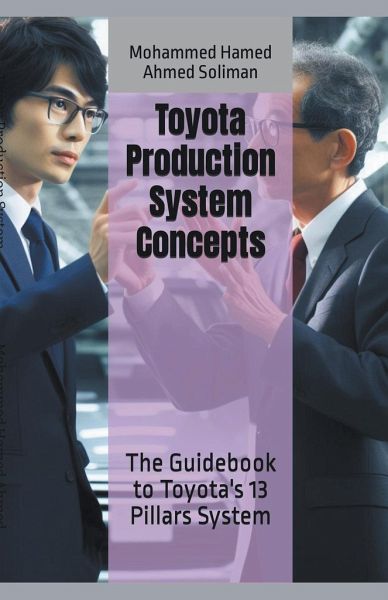
Master the full depth of the Toyota Production System (TPS) with this essential guidebook series-Books 7 to 17, bundled in one powerful collection. Designed for lean practitioners, managers, engineers, and students of operations excellence, this box set explores the foundational principles that transformed Toyota into the most efficient automaker in the world. Rooted in just-in-time (JIT) and jidoka (built-in quality), TPS is much more than a manufacturing tool-it's a philosophy of continuous improvement, flow, and respect for people. This book set breaks down Toyota's 13 core pillars and…mehr
Master the full depth of the Toyota Production System (TPS) with this essential guidebook series-Books 7 to 17, bundled in one powerful collection. Designed for lean practitioners, managers, engineers, and students of operations excellence, this box set explores the foundational principles that transformed Toyota into the most efficient automaker in the world. Rooted in just-in-time (JIT) and jidoka (built-in quality), TPS is much more than a manufacturing tool-it's a philosophy of continuous improvement, flow, and respect for people. This book set breaks down Toyota's 13 core pillars and shows how they work together to eliminate waste, ensure quality, and increase productivity. You'll discover:The historical roots of TPS-from Sakichi Toyoda's self-stopping loom to Taiichi Ohno's system-wide innovations after WWII How Kiichiro Toyoda developed the Just-in-Time concept to eliminate overproduction How Toyota built a system of continuous improvement (kaizen) using the PDCA scientific method Why jidoka empowers machines and people to prevent defects in real-time How TPS principles apply not just in Japan-but across global industries This box set includes Books 7 through 17 in the TPS Series-perfect for professionals who want to accelerate learning and drive lean transformation in their own organizations. If you're serious about understanding the thinking behind Toyota's success and want a practical, in-depth, and historical overview, this set will guide you through the full system step by step.
Dr. Mohammed Hamed Ahmed Soliman is an internationally recognized Lean expert, author, and university lecturer. He has published over 100 books and articles on Lean thinking, quality systems, and industrial excellence. He currently teaches Industrial Engineering and Management Systems at the American University in Cairo, an Executive Advisor and a member of the Advisory Committee of the IEOM International Society, and consults for global organizations across manufacturing, public services, and education. With nearly two decades of academic and professional experience, Dr. Soliman has trained professionals across the Middle East, including engagements with Princess Nourah University in Saudi Arabia and Vale Oman Pelletizing Company. He has designed and delivered over 60 leadership and technical development programs, helping organizations build a culture of continuous improvement and operational excellence. Earlier in his career, he worked in various industrial sectors including crystal-glass manufacturing, fertilizers, and chemicals, while educating teams on the Toyota Production System. He has led numerous lean transformation projects, delivering measurable results and uncovering substantial cost savings by targeting waste across production and service environments. His lectures and training materials have reached over 200,000 learners via SlideShare, and his research is ranked among the most downloaded papers on the Social Science Research Network (SSRN) by Elsevier. Dr. Soliman holds a BSc in Engineering, a master's in Quality Management, and postgraduate degrees in Industrial Engineering and Engineering Management. He also holds certifications in quality, cost, and operations management. He is a member of the Institute of Industrial and Systems Engineers (IISE) and the Society for Engineering and Management Systems (SEMS). His insights have been featured in SAGE Publications, Industrial Management, Lean Thinking, and other peer-reviewed platforms.
Es gelten unsere Allgemeinen Geschäftsbedingungen: www.buecher.de/agb
Impressum
www.buecher.de ist ein Internetauftritt der buecher.de internetstores GmbH
Geschäftsführung: Monica Sawhney | Roland Kölbl | Günter Hilger
Sitz der Gesellschaft: Batheyer Straße 115 - 117, 58099 Hagen
Postanschrift: Bürgermeister-Wegele-Str. 12, 86167 Augsburg
Amtsgericht Hagen HRB 13257
Steuernummer: 321/5800/1497
USt-IdNr: DE450055826