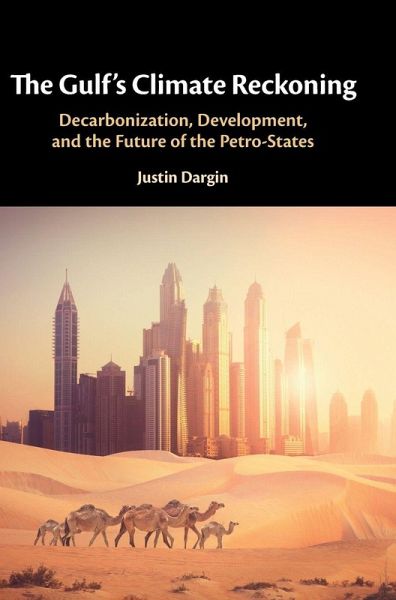
This book analyses the Gulf's decarbonization and economic development strategies following their Paris Agreement pledges. It explores urgent climate action amidst geopolitical shifts, energy transitions, and economic diversification. It is essential reading for researchers and policymakers in energy policy, climate change, and the Middle East.
This book analyses the Gulf's decarbonization and economic development strategies following their Paris Agreement pledges. It explores urgent climate action amidst geopolitical shifts, energy transitions, and economic diversification. It is essential reading for researchers and policymakers in energy policy, climate change, and the Middle East.
Dr Justin Dargin is a senior scholar at the University of Oxford specializing in global energy policy, carbon markets, and climate-industrial strategy, with deep expertise in the Middle East and North Africa. A former fellow at the Harvard Kennedy School and a Fulbright Scholar for the region, he received the Harvard Arab Alumni Award for his seminal work on Gulf decarbonization and climate strategy. Dargin authored the first comprehensive framework for sovereign carbon market development in the Gulf-research that both predated and anticipated the region's emerging climate and energy agenda. He has advised Gulf governments, international energy companies, and multilateral institutions on regulatory design, energy transition planning, and climate finance architecture. He is a frequent media commentator on energy geopolitics and the author of numerous publications on carbon governance and the reconfiguration of the global energy order.
Inhaltsangabe
Introduction: climate crossroads: gulf decarbonization and the legacy of oil Part I. The Birth of the Petro-State: How Oil Reshaped the Gulf: 1. The philosophy of oil: theorizing development in the gulf states 2. Oil and Ambition: the gulf's industrial ascendancy 3. Modernization and its discontents: climate change, socio-political reform, and demographic anxiety 4. Geo-strategic norm-shaping and the art of the subsidy 5. Gaslighting the gulf: the perils of low-priced natural gas Part II. Reinventing the Petro-State: The Gulf's Race Against the Climate Clock: 6. Shifting sands: the geopolitics of climate diplomacy 7. From crude to clean: the renewable energy surge 8. Crafting the future: design pathways for gulf carbon emission reductions 9. The sixth wave imperative: the gulf's strategic reset for a post-carbon world Appendix References Index.
Introduction: climate crossroads: gulf decarbonization and the legacy of oil Part I. The Birth of the Petro-State: How Oil Reshaped the Gulf: 1. The philosophy of oil: theorizing development in the gulf states 2. Oil and Ambition: the gulf's industrial ascendancy 3. Modernization and its discontents: climate change, socio-political reform, and demographic anxiety 4. Geo-strategic norm-shaping and the art of the subsidy 5. Gaslighting the gulf: the perils of low-priced natural gas Part II. Reinventing the Petro-State: The Gulf's Race Against the Climate Clock: 6. Shifting sands: the geopolitics of climate diplomacy 7. From crude to clean: the renewable energy surge 8. Crafting the future: design pathways for gulf carbon emission reductions 9. The sixth wave imperative: the gulf's strategic reset for a post-carbon world Appendix References Index.
Es gelten unsere Allgemeinen Geschäftsbedingungen: www.buecher.de/agb
Impressum
www.buecher.de ist ein Internetauftritt der buecher.de internetstores GmbH
Geschäftsführung: Monica Sawhney | Roland Kölbl | Günter Hilger
Sitz der Gesellschaft: Batheyer Straße 115 - 117, 58099 Hagen
Postanschrift: Bürgermeister-Wegele-Str. 12, 86167 Augsburg
Amtsgericht Hagen HRB 13257
Steuernummer: 321/5800/1497
USt-IdNr: DE450055826