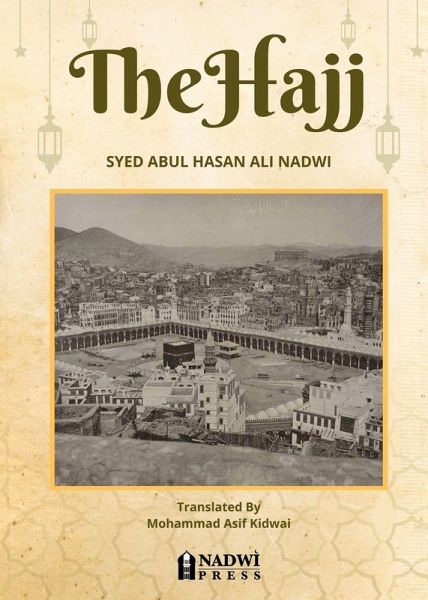
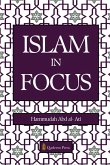
This concise and thoughtful work offers a clear perspective on one of Islam's most sacred duties-Hajj, the pilgrimage to the House of Allah in Makkah. Adapted from the author's widely acclaimed book The Four Pillars of Islam, this volume isolates and expands upon the themes specific to Hajj, presenting it in its true Islamic framework, free from political overlays or misinformed interpretations. With clarity and spiritual insight, the book explains the deeper aims, historical roots, and transformative meaning of this unique act of worship. It reminds readers that Hajj is not merely a journey…mehr
This concise and thoughtful work offers a clear perspective on one of Islam's most sacred duties-Hajj, the pilgrimage to the House of Allah in Makkah. Adapted from the author's widely acclaimed book The Four Pillars of Islam, this volume isolates and expands upon the themes specific to Hajj, presenting it in its true Islamic framework, free from political overlays or misinformed interpretations. With clarity and spiritual insight, the book explains the deeper aims, historical roots, and transformative meaning of this unique act of worship. It reminds readers that Hajj is not merely a journey or a gathering, but a revival of the mission of Prophet Ibrahim (peace be upon him), grounded in submission, unity, and remembrance of the Divine. Intended especially for English-speaking readers and prospective pilgrims, the text avoids excessive legal detail and instead focuses on why the pilgrimage matters-internally, spiritually, and ethically. It encourages pilgrims to perform the rites with understanding, intention, and humility. Essential for first-time hajis, educators, or anyone seeking to understand the significance of Hajj beyond its physical aspects, this book is a timely companion in an age where the meaning of sacred rituals is often overshadowed by formality or politicisation. A sincere call to rediscover the heart of the pilgrimage: devotion, reflection, and return to Allah.
Sayyid Abul Hasan Ali Hasani Nadwi (19141999) stands among the twentieth century's most influential Islamic scholars, whose intellectual contributions transcended geographical, linguistic, and sectarian boundaries. Born into a distinguished scholarly family in Rae Bareli, Uttar Pradesh, India, on Muharram 6, 1333 AH (December 5, 1914), Nadwi inherited a rich legacy of Islamic learning that he would expand and transmit to global audiences.
Nadwi's education combined traditional Islamic sciences with modern academic disciplines. He studied at Nadwat al-'Ulama', Lucknow, where he later served as Rector for five decades, transforming it into a center of Islamic scholarship respected worldwide. His mastery of Arabic enabled him to engage directly with classical texts and communicate with Arab intellectuals, earning him unique standing in both Eastern and Western Islamic spheres.
As an author, Nadwi's productivity and range were remarkable. His bibliography exceeds fifty books addressing Islamic history, spirituality, biography, theology, and contemporary challenges facing Muslim societies. Works such as Islam and the World, What the World Lost Through the Decline of Muslims, and the monumental eight-volume Saviors of Islamic Spirit established him as a historian and analyst of Islamic civilization. His writings combined rigorous scholarship with literary elegance, making sophisticated theological and historical arguments accessible to educated general readers.
Nadwi's contributions extended beyond scholarship to practical educational reform and interfaith dialogue. He participated actively in international Islamic organizations, represented Islamic perspectives in global forums, and maintained correspondence with scholars, political leaders, and intellectuals across continents. His approach emphasized Islamic authenticity while engaging constructively with modernity, avoiding both rigid traditionalism and uncritical Westernization.
The international Islamic community recognized Nadwi's scholarship with numerous honors, including the King Faisal International Prize for Service to Islam (1980), the Sultanate of Oman's Award for Distinguished Contributions to Islamic Culture (1998), and the Order of King Abdul Aziz from Saudi Arabia. Universities across the Muslim world conferred honorary doctorates upon him.
Nadwi's scholarly methodology integrated Qur'anic exegesis, hadith sciences, Sufi spirituality, and contemporary analysis. He wrote with equal facility in Arabic, Urdu, and English, with his works translated into Turkish, Persian, Indonesian, French, German, and numerous other languages. His Arabic prose style garnered particular admiration, with Arab literary critics considering him among the finest non-Arab Arabic stylists of his era.
Throughout his career, Nadwi maintained a delicate balance between preserving Islamic tradition and addressing contemporary challenges. His writings never adopted apologetic tones, nor did they retreat into defensive postures. Instead, he presented Islam with scholarly confidence, trusting in the inherent strength and relevance of Islamic teachings when properly understood and articulated.
Nadwi passed away on December 31, 1999, in Lucknow, leaving behind an intellectual legacy that continues to influence Islamic thought, education, and scholarship worldwide. His works remain essential references for understanding Islam's spiritual dimensions, historical trajectory, and contemporary relevance.
Es gelten unsere Allgemeinen Geschäftsbedingungen: www.buecher.de/agb
Impressum
www.buecher.de ist ein Internetauftritt der buecher.de internetstores GmbH
Geschäftsführung: Monica Sawhney | Roland Kölbl | Günter Hilger
Sitz der Gesellschaft: Batheyer Straße 115 - 117, 58099 Hagen
Postanschrift: Bürgermeister-Wegele-Str. 12, 86167 Augsburg
Amtsgericht Hagen HRB 13257
Steuernummer: 321/5800/1497
USt-IdNr: DE450055826