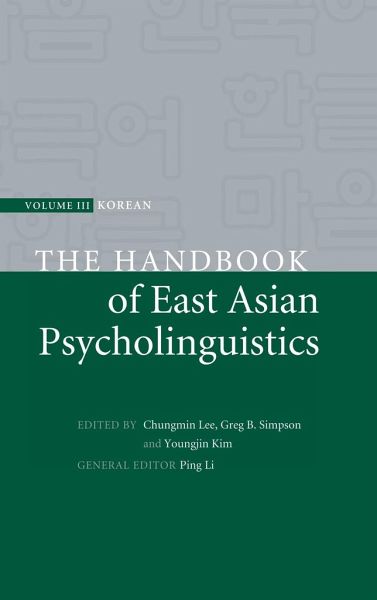
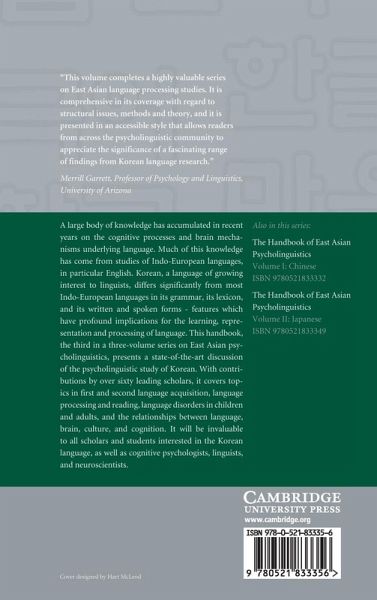
A large body of knowledge has accumulated in recent years on the cognitive processes and brain mechanisms underlying language. Much of this knowledge has come from studies of Indo-European languages, in particular English. Korean, a language of growing interest to linguists, differs significantly from most Indo-European languages in its grammar, its lexicon, and its written and spoken forms - features which have profound implications for the learning, representation and processing of language. This handbook, the third in a three-volume series on East Asian psycholinguistics, presents a…mehr
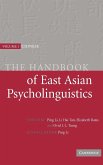
A large body of knowledge has accumulated in recent years on the cognitive processes and brain mechanisms underlying language. Much of this knowledge has come from studies of Indo-European languages, in particular English. Korean, a language of growing interest to linguists, differs significantly from most Indo-European languages in its grammar, its lexicon, and its written and spoken forms - features which have profound implications for the learning, representation and processing of language. This handbook, the third in a three-volume series on East Asian psycholinguistics, presents a state-of-the-art discussion of the psycholinguistic study of Korean. With contributions by over sixty leading scholars, it covers topics in first and second language acquisition, language processing and reading, language disorders in children and adults, and the relationships between language, brain, culture, and cognition. It will be invaluable to all scholars and students interested in the Korean language, as well as cognitive psychologists, linguists, and neuroscientists.
Introduction: advances in Korean psycholinguistics Chungmin Lee, Youngjin Kim and Greg Simpson; 1. Acquisition of the subject and topic nominals and markers in the spontaneous speech by young children in Korean Chungmin Lee; 2. The acquisition of argument structure and transitivity in Korean: a discourse-functional approach Patricia M. Clancy; 3. Acquisition of case markers and grammatical functions Gyeonghee No; 4. Do Korean children acquire verbs earlier than nouns? You-kyung Chang-Song and Soyeong Pae; 5. The acquisition of the placement of the verb in the clause structure of Korean Chung-hye Han, Jeffrey Lidz and Julien Musolino; 6. Learning locative verb syntax: a cross-linguistic experimental study Meesook Kim; 7. Language-specific spatial semantics and cognition: developmental patterns in English and Korean Soonja Choi; 8. The acquisition of negation in Korean Judy Yoo-Kyung Baek and Kenneth Wexler; 9. The acquisition of Korean numeral classifiers Kwee-Ock Lee and Sun-Young Lee; 10. Acquisition of Korean reflexive anaphora Sook Whan Cho; 11. The Korean relative clause: issues of processing and acquisition Jong Sup Jun; 12. The accessibility hierarchy in Korean: head-external and head-internal relative clauses Sookeun Cho and William O'Grady; 13. Development of functional categories in child Korean Ho Han; 14. The acquisition of modality Chungmin Lee; 15. The syntax of overmarking and kes in child Korean John Whitman; 16. Events in passive development Youngjoo Lee; 17. Universal quantification in child grammar Hye-Kyung Kang; 18. The acquisition of prosody in Korean Youngon Choi and Reiko Mazuka; 19. Korean as a heritage language Terry Kit-fong Au and Janet Sae Oh; 20. Maturational effects on L2 acquisition Dami Lee; 21. Acquisition of English articles by Koreans Heejeong Ko, Tania Ionin and Kenneth Wexler; 22. The acquisition of wanna contraction by adult Korean learners of English Soo-Ok Kweon; 23. Phonological abilities of Korean-English bilinguals Grace H. Yeni-Komshian; 24. Parameters and languages in contact: an altered view of codeswitching Keumsil Kim Yoon; 25. Influence of socio-psychological categories in bilingual interaction M. Agnes Kang; 26. Ontological concept versus shape in word learning from the cross-linguistic point of view Hyeonjin Lee; 27. An overview of Korean sign language Se-Eun Jhang; 28. Visual processing of Hangul, the Korean script ChangHo Park; 29. English vowel spaces produced and perceived by Americans and Koreans Byunggon Yang; 30. Morphological representation and processing of Sino-Korean words Kwangoh Yi; 31. The role of phonology in word recognition of Korean Hangul and Hanja Jeung-Ryeul Cho; 32. Lexical and sublexical processes in Korean word recognition Greg B. Simpson and Hyewon Kang; 33. Prosody in sentence processing Sun-Ah Jun; 34. Korean sentence processing Youngjin Kim and Kwangill Choi; 35. Sentence processing and memory representation in Korean Jae-Ho Lee and Sung-il Kim; 36. Understanding complex sentences: memory constraints and information structures Yoonhyung Lee and Peter Gordon; 37. Korean language processing by ERP studies: word order effects Kyung Soon Shin and Jun Soo Kwon; 38. Inferences during discourse comprehension in Korean Soyoung Suh Kim, Jung-Mo Lee and Jae-Ho Lee; 39. Morpho-syntactic processing in Korean aphasics Yu Mi Hwang, Kichun Nam and Myung-Yoon Kang; 40. Morpho-syntactic processing of Korean-speaking adults with Broca's aphasia and children with SLI Mina Hwang; 41. Comprehension deficits in Korean agrammatic aphasia Miseon Lee; 42. Developmental reading disorders in Korean Jeesun Kim and Chris Davis; 43. Individual differences in Korean language processing: context-dependent processing of skilled readers in word ambiguity resolution Byeong-Taek Lee; 44. The computational model of lexical and morphological processing in Korean HeuiSeok Lim.
Introduction: advances in Korean psycholinguistics Chungmin Lee, Youngjin Kim and Greg Simpson; 1. Acquisition of the subject and topic nominals and markers in the spontaneous speech by young children in Korean Chungmin Lee; 2. The acquisition of argument structure and transitivity in Korean: a discourse-functional approach Patricia M. Clancy; 3. Acquisition of case markers and grammatical functions Gyeonghee No; 4. Do Korean children acquire verbs earlier than nouns? You-kyung Chang-Song and Soyeong Pae; 5. The acquisition of the placement of the verb in the clause structure of Korean Chung-hye Han, Jeffrey Lidz and Julien Musolino; 6. Learning locative verb syntax: a cross-linguistic experimental study Meesook Kim; 7. Language-specific spatial semantics and cognition: developmental patterns in English and Korean Soonja Choi; 8. The acquisition of negation in Korean Judy Yoo-Kyung Baek and Kenneth Wexler; 9. The acquisition of Korean numeral classifiers Kwee-Ock Lee and Sun-Young Lee; 10. Acquisition of Korean reflexive anaphora Sook Whan Cho; 11. The Korean relative clause: issues of processing and acquisition Jong Sup Jun; 12. The accessibility hierarchy in Korean: head-external and head-internal relative clauses Sookeun Cho and William O'Grady; 13. Development of functional categories in child Korean Ho Han; 14. The acquisition of modality Chungmin Lee; 15. The syntax of overmarking and kes in child Korean John Whitman; 16. Events in passive development Youngjoo Lee; 17. Universal quantification in child grammar Hye-Kyung Kang; 18. The acquisition of prosody in Korean Youngon Choi and Reiko Mazuka; 19. Korean as a heritage language Terry Kit-fong Au and Janet Sae Oh; 20. Maturational effects on L2 acquisition Dami Lee; 21. Acquisition of English articles by Koreans Heejeong Ko, Tania Ionin and Kenneth Wexler; 22. The acquisition of wanna contraction by adult Korean learners of English Soo-Ok Kweon; 23. Phonological abilities of Korean-English bilinguals Grace H. Yeni-Komshian; 24. Parameters and languages in contact: an altered view of codeswitching Keumsil Kim Yoon; 25. Influence of socio-psychological categories in bilingual interaction M. Agnes Kang; 26. Ontological concept versus shape in word learning from the cross-linguistic point of view Hyeonjin Lee; 27. An overview of Korean sign language Se-Eun Jhang; 28. Visual processing of Hangul, the Korean script ChangHo Park; 29. English vowel spaces produced and perceived by Americans and Koreans Byunggon Yang; 30. Morphological representation and processing of Sino-Korean words Kwangoh Yi; 31. The role of phonology in word recognition of Korean Hangul and Hanja Jeung-Ryeul Cho; 32. Lexical and sublexical processes in Korean word recognition Greg B. Simpson and Hyewon Kang; 33. Prosody in sentence processing Sun-Ah Jun; 34. Korean sentence processing Youngjin Kim and Kwangill Choi; 35. Sentence processing and memory representation in Korean Jae-Ho Lee and Sung-il Kim; 36. Understanding complex sentences: memory constraints and information structures Yoonhyung Lee and Peter Gordon; 37. Korean language processing by ERP studies: word order effects Kyung Soon Shin and Jun Soo Kwon; 38. Inferences during discourse comprehension in Korean Soyoung Suh Kim, Jung-Mo Lee and Jae-Ho Lee; 39. Morpho-syntactic processing in Korean aphasics Yu Mi Hwang, Kichun Nam and Myung-Yoon Kang; 40. Morpho-syntactic processing of Korean-speaking adults with Broca's aphasia and children with SLI Mina Hwang; 41. Comprehension deficits in Korean agrammatic aphasia Miseon Lee; 42. Developmental reading disorders in Korean Jeesun Kim and Chris Davis; 43. Individual differences in Korean language processing: context-dependent processing of skilled readers in word ambiguity resolution Byeong-Taek Lee; 44. The computational model of lexical and morphological processing in Korean HeuiSeok Lim.
Es gelten unsere Allgemeinen Geschäftsbedingungen: www.buecher.de/agb
Impressum
www.buecher.de ist ein Internetauftritt der buecher.de internetstores GmbH
Geschäftsführung: Monica Sawhney | Roland Kölbl | Günter Hilger
Sitz der Gesellschaft: Batheyer Straße 115 - 117, 58099 Hagen
Postanschrift: Bürgermeister-Wegele-Str. 12, 86167 Augsburg
Amtsgericht Hagen HRB 13257
Steuernummer: 321/5800/1497
USt-IdNr: DE450055826