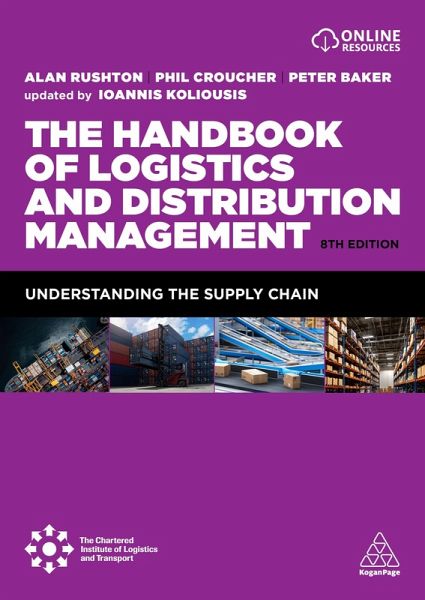
Learn how to plan, operate and optimize a supply chain that delivers maximum value. The Handbook of Logistics and Distribution Management is the definitive guide for students, operations leaders and logistics professionals who want to master strategy, planning and execution in today's fast-changing environment. Now in its eighth edition, this comprehensive resource blends strategic insight with step-by-step tactical guidance, supported by real-world data, flow charts and worked examples from the authors' hands-on experience. It covers everything from setting up and managing supply chains to…mehr
Learn how to plan, operate and optimize a supply chain that delivers maximum value. The Handbook of Logistics and Distribution Management is the definitive guide for students, operations leaders and logistics professionals who want to master strategy, planning and execution in today's fast-changing environment. Now in its eighth edition, this comprehensive resource blends strategic insight with step-by-step tactical guidance, supported by real-world data, flow charts and worked examples from the authors' hands-on experience. It covers everything from setting up and managing supply chains to leveraging the latest technologies and driving sustainable performance. You'll learn how to: - Design and operate efficient, resilient and sustainable supply chains - Apply AI, data analytics and digital tools to optimize performance - Manage logistics networks, inventory, transport and distribution channels - Translate strategic goals into practical, measurable actions Featuring new insights into digital transformation, AI, blockchain and the future of sustainable operations, plus online resources including lecture slides, infographics and acronyms, this book equips readers to make smarter decisions, deliver results and strengthen their professional impact. Themes include: supply chain strategy, logistics optimization, distribution management, sustainable operations, AI in logistics, digital transformation
Alan Rushton graduated from the University of Warwick with a degree in Economics, after which he spent several years in industry as Raw Materials Controller with the International Synthetic Rubber Company and as a distribution executive with Rio Tinto Zinc based in London. He studied for an MSc in Transport Studies at Cranfield University and then joined the National Materials Handling Centre, initially to carry out research into urban delivery problems and goods consolidation. He was a senior consultant with the Centre for many years, undertaking a variety of consultancy projects, specializing in transport and logistics systems and strategies. After helping to create the Distribution Studies Unit (DSU) at Cranfield, he became the Director of Studies for the MSc in Distribution Technology and Management, and Head of the DSU. With the creation of the Cranfield Centre for Logistics and Transportation (later the Cranfield Centre for Logistics and Supply Chain Management, CLSCM) he became the Director of Graduate Programmes for the new Centre where he set up and, for many years, ran the Executive MSc in Logistics and Supply Chain Management. He became the Director of eLearning for CLSCM and chaired the eLearning Committee for the Cranfield School of Management. As well as his research and consultancy experience in transport, distribution, logistics and the supply chain, he has lectured in Europe, the Far East, the Middle East, North America, South America and Africa. He has published widely and co-wrote the original and subsequent editions of The Handbook of Logistics and Distribution Management, which was first published in 1989. He is also co-author of International Logistics and Supply Chain Outsourcing. He has continued to undertake consultancy, both nationally and internationally, and is the Director of Dialog Consultants Ltd, a consultancy specializing in distribution, logistics and supply chain management. Alan is a Fellow of the Chartered Institute of Logistics and Transport.
Inhaltsangabe
Section ONE: Concepts of Logistics and Distribution; Chapter 01: Introduction to Logistics and Distribution; Chapter 02: Integrated Logistics and the Supply Chain; Chapter 03: Customer Service and Logistics; Chapter 04: Channels of Distribution; Chapter 05: Key Issues and Challenges for Logistics; Section TWO: Planning for Logistics; Chapter 06: Planning Framework for Logistics; Chapter 07: Logistics Processes; Chapter 08: Supply Chain Segmentation; Chapter 09: Logistics Costs and Trade Offs; Chapter 10: Logistics Network Planning; Chapter 11: Logistics Management and Organisation; Chapter 12: Omnichannel Fulfilment; Chapter 13: Manufacturing Logistics; Section THREE: Procurement, Inventory and Demand Forecasting; Chapter 14: Procurement and Supply; Chapter 15: Inventory The Basic Concepts; Chapter 16: Inventory and the Supply Chain; Chapter 17: Inventory Planning and Demand Forecasting; Section FOUR: Warehousing and Storage; Chapter 18: Principles of Warehousing; Chapter 19: Storage and Handling Systems (Palletised); Chapter 20: Storage and Handling Systems (Non Palletised); Chapter 21: Order Picking and Packing; Chapter 22: Receiving and Despatch; Chapter 23: Warehouse Design; Chapter 24: Warehouse Management and Information; Section FIVE: Freight Transport; Chapter 25: International Logistics Modal Choice; Chapter 26: Maritime Transport; Chapter 27: Air Transport; Chapter 28: Rail and Intermodal Transport; Chapter 29: Road Freight Transport Vehicle Selection; Chapter 30: Road Freight Transport Vehicle Costing; Chapter 31: Road Freight Transport Planning and Resourcing; Chapter 32: Road Freight Transport Vehicle Routeing & Scheduling; Chapter 33: International Freight Forwarding; Section SIX: Outsourcing Logistics; Chapter 34: Outsourcing Operations & Services; Chapter 35: Outsourcing Decision Criteria; Chapter 36: Outsourcing The Selection Process; Chapter 37: Outsourcing Management; Section SEVEN: Operational Management; Chapter 38: Cost and Performance Monitoring; Chapter 39: Benchmarking; Chapter 40: AI, Blockchains, Digital Twins and the digitalization of Supply Chain; Chapter 41: Security and Safety; Chapter 42: Sustainable Logistics; Chapter 43: Humanitarian and Disaster Logistics