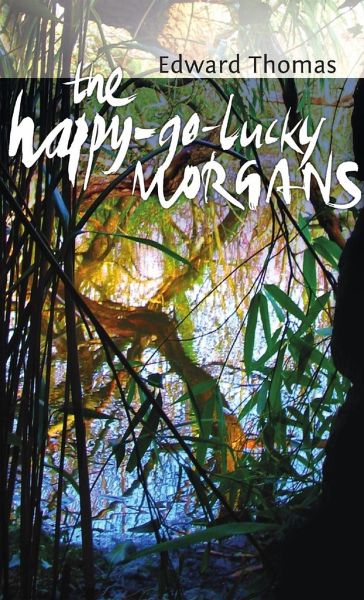
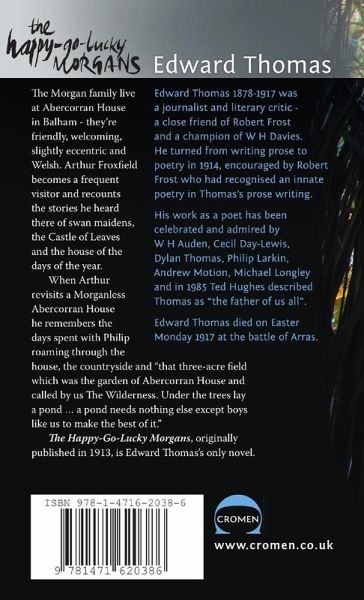
The Morgan family live at Abercorran House in Balham - they're friendly, welcoming, slightly eccentric and Welsh. Arthur Froxfield becomes a frequent visitor and recounts the stories he heard there of swan maidens, the Castle of Leaves and the house of the days of the year. When Arthur revisits a Morganless Abercorran House he remembers the days spent with Philip roaming through the house, the countryside and "that three-acre field which was the garden of Abercorran House and called by us The Wilderness. Under the trees lay a pond ... a pond needs nothing else except boys like us to make the…mehr
The Morgan family live at Abercorran House in Balham - they're friendly, welcoming, slightly eccentric and Welsh. Arthur Froxfield becomes a frequent visitor and recounts the stories he heard there of swan maidens, the Castle of Leaves and the house of the days of the year. When Arthur revisits a Morganless Abercorran House he remembers the days spent with Philip roaming through the house, the countryside and "that three-acre field which was the garden of Abercorran House and called by us The Wilderness. Under the trees lay a pond ... a pond needs nothing else except boys like us to make the best of it." The Happy-Go-Lucky Morgans, originally published in 1913, is Edward Thomas's only novel. Edward Thomas 1878-1917 was a journalist and literary critic - a close friend of Robert Frost and a champion of W H Davies. He turned from writing prose to poetry in 1914, encouraged by Robert Frost who had recognised an innate poetry in Thomas's prose writing.
Philip Edward Thomas was a British poet and prose writer known for his thoughtful and lyrical works that captured the spirit of the English landscape and the human relationship with nature. Born in London in 1878 to Mary Elizabeth Thomas and Philip Henry Thomas, he was educated at St Paul's Juniors and Lincoln College. His writings often explored themes of nature, rural life, and quiet contemplation, reflecting his deep connection to the countryside. Although widely regarded for his poetry, he also produced notable prose and critical essays. Thomas's work is frequently associated with the subtle complexities of personal reflection and the fleeting moments of everyday life. Though sometimes identified as a war poet due to his service during World War I, much of his poetry does not focus directly on the battlefield but instead on the emotional and spiritual landscapes shaped by the war. His literary legacy remains influential, with his distinctive voice offering insight into both the beauty of nature and the human condition. Thomas died in 1917 during the Battle of Arras.
Es gelten unsere Allgemeinen Geschäftsbedingungen: www.buecher.de/agb
Impressum
www.buecher.de ist ein Internetauftritt der buecher.de internetstores GmbH
Geschäftsführung: Monica Sawhney | Roland Kölbl | Günter Hilger
Sitz der Gesellschaft: Batheyer Straße 115 - 117, 58099 Hagen
Postanschrift: Bürgermeister-Wegele-Str. 12, 86167 Augsburg
Amtsgericht Hagen HRB 13257
Steuernummer: 321/5800/1497
USt-IdNr: DE450055826