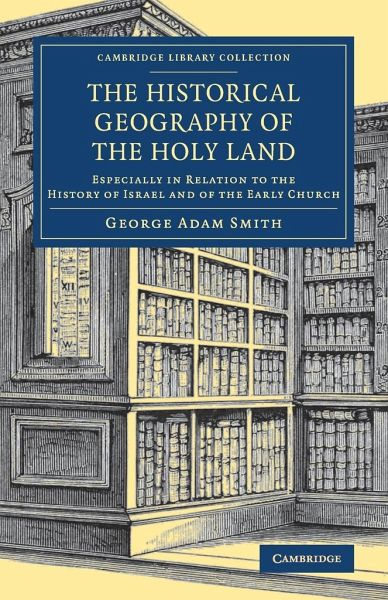
This book was immediately recognised on its publication in 1894 as a major work of scholarship, and reached twenty-five editions during its author's lifetime. The intention of George Adam Smith (1856-1942) was to produce a work which would 'give a vision of the land as a whole' and help the reader 'to hear through it the sound of running history'. Smith, an enthusiastic alpinist, had studied divinity in Edinburgh, and first visited Palestine in 1880, travelling around the country on foot. The book was written while Smith was teaching at Glasgow, and working on various social projects in…mehr
This book was immediately recognised on its publication in 1894 as a major work of scholarship, and reached twenty-five editions during its author's lifetime. The intention of George Adam Smith (1856-1942) was to produce a work which would 'give a vision of the land as a whole' and help the reader 'to hear through it the sound of running history'. Smith, an enthusiastic alpinist, had studied divinity in Edinburgh, and first visited Palestine in 1880, travelling around the country on foot. The book was written while Smith was teaching at Glasgow, and working on various social projects in Scotland. His detailed knowledge of the territory, together with his wide familiarity with the archaeological and historical background, gives the work authority. The book places the land in its historical context, and describes the physical geography and climate; the readability of its style is enhanced by detailed maps, some in colour.
Sir George Adam Smith was a Scottish theologian. He was the Principal of the University of Aberdeen from 1909 to 1935 and a prominent figure in the United Free Church of Scotland. He was born in Calcutta, where his father, George Smith, C.I.E., was the principal of Doveton College, a boys' school in Madras. His mother's name was Janet Colquhoun Smith. By 1870, the family had returned to Scotland and resided at Scagore House in Seafield, Edinburgh. He was educated at Edinburgh's Royal High School. He subsequently went on to study Divinity at the University of Edinburgh and New College, graduating with an MA in 1875. In 1892, he was appointed Professor of Hebrew and Old Testament at the Free Church College, Glasgow. He transferred from the Free Church of Scotland to the United Free Church of Scotland in 1900, when it was founded. He was appointed Principal and Vice Chancellor of the University of Aberdeen in 1909 and served until his retirement in 1935. In 1916, he was chosen as a Fellow of the British Academy and knighted. He was Moderator of the General Assembly of the United Free Church of Scotland from 1916 to 1917. In 1917, he was made a Fellow of the Royal Society of Edinburgh. His proposers included John Horne, Cargill Gilston Knott, Ben Peach, and John Sutherland Black.
Inhaltsangabe
Preface Chronological table Part I. The Land as a Whole: 1. The place of Syria in the world's history 2. The form of the land and its historical consequences 3. The climate and fertility of the land, with their effects on its religion 4. The scenery of the land, with its reflection on the poetry of the Old Testamant 5. The land and questions of faith 6. The view from Mount Ebal Part II. Western Palestine: 7. The coast 8. The maritime plain 9. The Philistines and their cities 10. The Shephelah 11. Early Christianity in the Shephelah 12. Judaea and Samaria 13. The borders and bulwarks of Judaea 14. An estimate of the real strength of Judaea 15. The character of Judaea 16. Samaria 17. The strong places of Samaria 18. The question of Sychar 19. Esdraelon 20. Galilee 21. The lake of Galilee 22. The Jordan valley 23. The Dead Sea Part III. Eastern Palestine: 24. Over Jordan: general features 25. The names and divisions of eastern Palestine 26. Moab and the coming of Israel 27. Israel in Gilead and Bashan 28. Greece over Jordan: the Decapolis 29. Hauran and its cities 30. Damascus Appendices Index of subjects Index of authorities.
Preface Chronological table Part I. The Land as a Whole: 1. The place of Syria in the world's history 2. The form of the land and its historical consequences 3. The climate and fertility of the land, with their effects on its religion 4. The scenery of the land, with its reflection on the poetry of the Old Testamant 5. The land and questions of faith 6. The view from Mount Ebal Part II. Western Palestine: 7. The coast 8. The maritime plain 9. The Philistines and their cities 10. The Shephelah 11. Early Christianity in the Shephelah 12. Judaea and Samaria 13. The borders and bulwarks of Judaea 14. An estimate of the real strength of Judaea 15. The character of Judaea 16. Samaria 17. The strong places of Samaria 18. The question of Sychar 19. Esdraelon 20. Galilee 21. The lake of Galilee 22. The Jordan valley 23. The Dead Sea Part III. Eastern Palestine: 24. Over Jordan: general features 25. The names and divisions of eastern Palestine 26. Moab and the coming of Israel 27. Israel in Gilead and Bashan 28. Greece over Jordan: the Decapolis 29. Hauran and its cities 30. Damascus Appendices Index of subjects Index of authorities.
Es gelten unsere Allgemeinen Geschäftsbedingungen: www.buecher.de/agb
Impressum
www.buecher.de ist ein Internetauftritt der buecher.de internetstores GmbH
Geschäftsführung: Monica Sawhney | Roland Kölbl | Günter Hilger
Sitz der Gesellschaft: Batheyer Straße 115 - 117, 58099 Hagen
Postanschrift: Bürgermeister-Wegele-Str. 12, 86167 Augsburg
Amtsgericht Hagen HRB 13257
Steuernummer: 321/5800/1497
USt-IdNr: DE450055826