When this work first appeared in 1767, electricity was seen as such a minor aspect of natural philosophy that its investigation was not considered a priority for contemporary scientists. The polymath Joseph Priestley (1733-1804) was one of the few who devoted serious effort to advancing the field. Here he charts the history of electrical study from experiments with amber in ancient Greece to the most recent discoveries. The book comprises explanations of the principal theories of electricity - both historical and contemporary - in addition to a selection of well-known experiments carried out…mehr
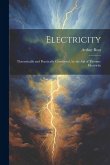
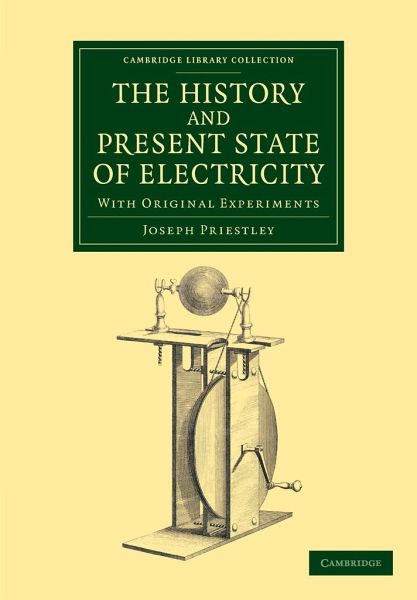
When this work first appeared in 1767, electricity was seen as such a minor aspect of natural philosophy that its investigation was not considered a priority for contemporary scientists. The polymath Joseph Priestley (1733-1804) was one of the few who devoted serious effort to advancing the field. Here he charts the history of electrical study from experiments with amber in ancient Greece to the most recent discoveries. The book comprises explanations of the principal theories of electricity - both historical and contemporary - in addition to a selection of well-known experiments carried out by previous researchers. Priestley also details his own experiments, covering such topics as the colour of electric light, the effects of temperature, and even the musical tone of electrical discharges. One of his most successful works, testifying to the clarity of his explanations, the book remains an important text in the history of science.
English scientist, theologian, and political theorist Joseph Priestley (1733-1804) made numerous contributions to chemistry, physics, and philosophy. Priestley, who was raised in Birstall, West Yorkshire, attended local schools before going to Daventry Academy, where he became very interested in natural philosophy. Priestley made significant scientific advances. His greatest-known distxtery, made in 1774, was oxygen, which he dubbed "dephlogisticated air." His investigations into gases and their characteristics, which are detailed in "Experiments and Observations on Different Kinds of Air," greatly enhanced our knowledge of chemistry. Priestley also studied nitrous oxide and carbon dioxide, among other gases. In addition to his scientific interests, Priestley was a prolific writer on theological and political topics as well as a dissident clergyman. He received criticism for his Unitarian beliefs and his perceived radical religious ideas. Priestley was a liberal and democratic idealist whose political writings shaped the early American history.
Inhaltsangabe
Preface Part I. The History of Electricity Part II. A Series of Propositions, Comprising All the General Properties of Electricity Part III. Theories of Electricity Part IV. Desiderata in the Science of Electricity, and Hints for the Further Extension of it Part V. Of the Construction of Electrical Machines, and the Principal Parts of an Electrical Apparatus Part VI. Practical Maxims for the Use of Young Electricians Part VII. A Description of the Most Entertaining Experiments Performed by Electricity Part VIII. New Experiments in Electricity, Made in the Year 1766.
Es gelten unsere Allgemeinen Geschäftsbedingungen: www.buecher.de/agb
Impressum
www.buecher.de ist ein Internetauftritt der buecher.de internetstores GmbH
Geschäftsführung: Monica Sawhney | Roland Kölbl | Günter Hilger
Sitz der Gesellschaft: Batheyer Straße 115 - 117, 58099 Hagen
Postanschrift: Bürgermeister-Wegele-Str. 12, 86167 Augsburg
Amtsgericht Hagen HRB 13257
Steuernummer: 321/5800/1497
USt-IdNr: DE450055826