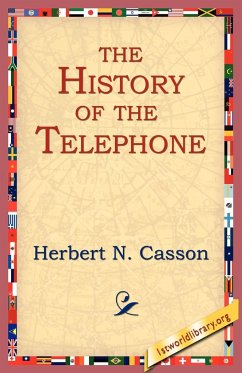
Purchase one of 1st World Library's Classic Books and help support our free internet library of downloadable eBooks. Visit us online at www.1stWorldLibrary.ORG - - Thirty-five short years, and presto! the newborn art of telephony is fullgrown. Three million telephones are now scattered abroad in foreign countries, and seven millions are massed here, in the land of its birth. So entirely has the telephone outgrown the ridicule with which, as many people can well remember, it was first received, that it is now in most places taken for granted, as though it were a part of the natural phenomena of…mehr
Purchase one of 1st World Library's Classic Books and help support our free internet library of downloadable eBooks. Visit us online at www.1stWorldLibrary.ORG - - Thirty-five short years, and presto! the newborn art of telephony is fullgrown. Three million telephones are now scattered abroad in foreign countries, and seven millions are massed here, in the land of its birth. So entirely has the telephone outgrown the ridicule with which, as many people can well remember, it was first received, that it is now in most places taken for granted, as though it were a part of the natural phenomena of this planet. It has so marvellously extended the facilities of conversation - that "art in which a man has all mankind for competitors" - that it is now an indispensable help to whoever would live the convenient life. The disadvantage of being deaf and dumb to all absent persons, which was universal in pre-telephonic days, has now happily been overcome; and I hope that this story of how and by whom it was done will be a welcome addition to American libraries.
Herbert Newton Casson was a Canadian journalist, author, and public speaker whose prolific writing and activism reflected a lifelong engagement with social reform, business innovation, and technology. Born in Odessa, Ontario in 1869, Casson was largely self-educated, eventually attending Victoria College and graduating in theology. Although he was ordained as a Methodist minister, his career in the church was short-lived after he was tried for heresy and chose to leave the ministry. Relocating to Boston in the 1890s, he became active in labor and socialist movements, co-founding a Labor Church and participating in progressive causes alongside figures such as Keir Hardie and Samuel Gompers. He later helped establish Ruskin College at Oxford. As a journalist, Casson worked for major newspapers in New York, interviewing leading political and technological figures of his time, including presidents and inventors. His work increasingly focused on industrial efficiency, leading him to write extensively on business, industry, and innovation. Casson authored over 160 books, including influential titles like The Romance of Steel and History of the Telephone. He spent his later years in England, lecturing and writing until his death in 1951.
Es gelten unsere Allgemeinen Geschäftsbedingungen: www.buecher.de/agb
Impressum
www.buecher.de ist ein Internetauftritt der buecher.de internetstores GmbH
Geschäftsführung: Monica Sawhney | Roland Kölbl | Günter Hilger
Sitz der Gesellschaft: Batheyer Straße 115 - 117, 58099 Hagen
Postanschrift: Bürgermeister-Wegele-Str. 12, 86167 Augsburg
Amtsgericht Hagen HRB 13257
Steuernummer: 321/5800/1497
USt-IdNr: DE450055826