The Yoruba creation story describes the creation of the world and humanity by the orishas (deities). It begins with a supreme god, Olodumare, who gives Obatala, the divine sculptor, a golden chain, a snail shell full of sand, a white hen, and a palm nut to create solid land from the primordial waters. After scattering the sand with the hen, land forms, and Obatala names it Ife, the "cradle of existence". He then molds the first humans from clay, and Olodumare breathes life into them by The Rev. Samuel Johnson (24 June 1846 - 29 April 1901) was an Anglican priest, diplomat, and historian of the…mehr
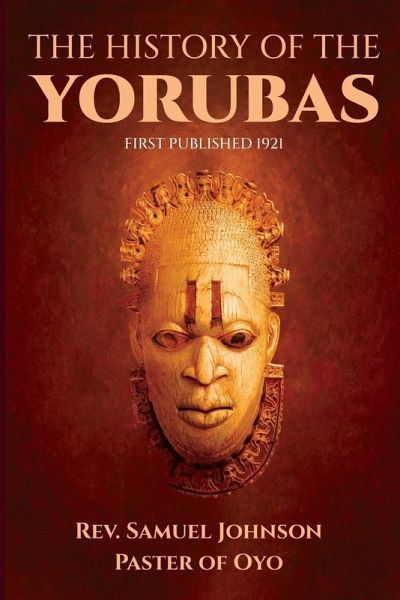
The Yoruba creation story describes the creation of the world and humanity by the orishas (deities). It begins with a supreme god, Olodumare, who gives Obatala, the divine sculptor, a golden chain, a snail shell full of sand, a white hen, and a palm nut to create solid land from the primordial waters. After scattering the sand with the hen, land forms, and Obatala names it Ife, the "cradle of existence". He then molds the first humans from clay, and Olodumare breathes life into them by The Rev. Samuel Johnson (24 June 1846 - 29 April 1901) was an Anglican priest, diplomat, and historian of the Yoruba people, as well as the great-grandson of alaafin Abiodun, a powerful Yoruba king of the Oyo empire.
DR. SAMUEL JOHNSON (1709-1784), British essayist and critic, created the first English dictionary, published in 1755. He may be the most quoted writer in the English language, after Shakespeare.
Inhaltsangabe
Author's preface Editor's preface Part I. The People, Country, and the Language: 1. Origin and early history 2. The origin of the tribes 3. Religion 4. Government 5. Yoruba names 6. Yoruba towns and villages 7. The principles of land law 8. Manners and customs Part II Section 1. First Period - Mythological Kings and Deified Heroes: 1. The founders of the Yoruba nation Section 2. Second Period - Growth, Prosperity and Oppression: 2. Historical kings 3. The kings of Oyo Igboho 4. A succession of despotic kings 5. Bosorun Gaha and his atrocities and Abiodun's peaceful reign Third Period - Revolutionary Wars and Disruption: 6. The revolution 7. The rise of the Fulanis to power 8. Consequences of the revolution 9. Further development of the anarchy 10. Spread of the anarchy 11. The revolution in the Epo districts 12. Wars for the consolidation and balance of power 13. The last of Katunga 14. The interregnum Section 3. Fourth Period - Arrest of Disintegration. Inter-tribal Wars. British Protectorate: 15. The new city, new government, Ilorin checked 16. Fratricidal wars 17. Subjugation of the Ijesas and Ekiti's social reforms 18. A glorious end and a gory dawn of two reigns 19. Sequels to the Ijaye war 20. The close and the opening careers of two heroes 21. Two administrations of opposite policies 22. A new reign and evil prognostication 23. The commencement of the 16 Years' War 24. Conflicts in the north 25. Ibadan at its extremity 26. Failures at reconciliation 27. A rift in the cloud 28. The Rev. J. B. wood and the A.O.K. 29. The intervention of the British government 30. Dispersal of the combatants by special commissioners 31. Disturbance in every part of the country 32. Abortive measures to terminate the war 33. The dark before the dawn 34. The end of the war 35. The establishment of the British Protectorate Appendices Index.
Author's preface Editor's preface Part I. The People, Country, and the Language: 1. Origin and early history 2. The origin of the tribes 3. Religion 4. Government 5. Yoruba names 6. Yoruba towns and villages 7. The principles of land law 8. Manners and customs Part II Section 1. First Period - Mythological Kings and Deified Heroes: 1. The founders of the Yoruba nation Section 2. Second Period - Growth, Prosperity and Oppression: 2. Historical kings 3. The kings of Oyo Igboho 4. A succession of despotic kings 5. Bosorun Gaha and his atrocities and Abiodun's peaceful reign Third Period - Revolutionary Wars and Disruption: 6. The revolution 7. The rise of the Fulanis to power 8. Consequences of the revolution 9. Further development of the anarchy 10. Spread of the anarchy 11. The revolution in the Epo districts 12. Wars for the consolidation and balance of power 13. The last of Katunga 14. The interregnum Section 3. Fourth Period - Arrest of Disintegration. Inter-tribal Wars. British Protectorate: 15. The new city, new government, Ilorin checked 16. Fratricidal wars 17. Subjugation of the Ijesas and Ekiti's social reforms 18. A glorious end and a gory dawn of two reigns 19. Sequels to the Ijaye war 20. The close and the opening careers of two heroes 21. Two administrations of opposite policies 22. A new reign and evil prognostication 23. The commencement of the 16 Years' War 24. Conflicts in the north 25. Ibadan at its extremity 26. Failures at reconciliation 27. A rift in the cloud 28. The Rev. J. B. wood and the A.O.K. 29. The intervention of the British government 30. Dispersal of the combatants by special commissioners 31. Disturbance in every part of the country 32. Abortive measures to terminate the war 33. The dark before the dawn 34. The end of the war 35. The establishment of the British Protectorate Appendices Index.
Es gelten unsere Allgemeinen Geschäftsbedingungen: www.buecher.de/agb
Impressum
www.buecher.de ist ein Internetauftritt der buecher.de internetstores GmbH
Geschäftsführung: Monica Sawhney | Roland Kölbl | Günter Hilger
Sitz der Gesellschaft: Batheyer Straße 115 - 117, 58099 Hagen
Postanschrift: Bürgermeister-Wegele-Str. 12, 86167 Augsburg
Amtsgericht Hagen HRB 13257
Steuernummer: 321/5800/1497
USt-IdNr: DE450055826