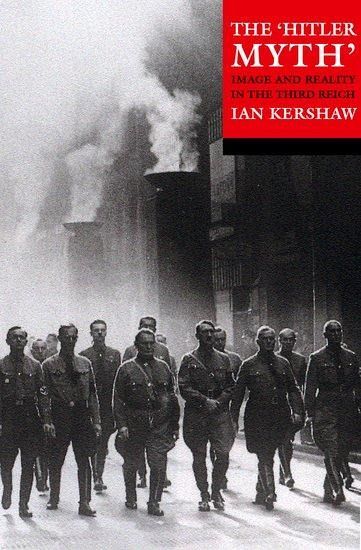
Auf eindrucksvolle Weise zeigt Ian Kershaw, 'wie gewöhnliche Deutsche während des Dritten Reichs Hitler sahen'. Seine profunde Quellenkenntnis und sein ausgewogenes historisches Urteil ermöglichen es Kershaw, lebendig und scharf analysierend zugleich die Stimmung in der deutschen Bevölkerung einzufangen, die verschiedenen Strömungen zu verfolgen und so die Entwicklung und den Niedergang des Hitler-Mythos nachzuzeichnen. Few twentieth-century political leaders enjoyed greater popularity among their own people than Hitler in the 1930s and 1940s. The German people's admiration rested less on the…mehr
Auf eindrucksvolle Weise zeigt Ian Kershaw, 'wie gewöhnliche Deutsche während des Dritten Reichs Hitler sahen'. Seine profunde Quellenkenntnis und sein ausgewogenes historisches Urteil ermöglichen es Kershaw, lebendig und scharf analysierend zugleich die Stimmung in der deutschen Bevölkerung einzufangen, die verschiedenen Strömungen zu verfolgen und so die Entwicklung und den Niedergang des Hitler-Mythos nachzuzeichnen. Few twentieth-century political leaders enjoyed greater popularity among their own people than Hitler in the 1930s and 1940s. The German people's admiration rested less on the bizarre and arcane precepts of Nazi ideology than on social and political values recognizable in many societies other than the Third Reich. Kershaw charts the creation, growth, and decline of the 'Hitler myth', and demonstrates how the manufactured Führer-cult formed a crucial integrating force in the Third Reich and a vital element in the attainment of Nazi political aims.
Ian Kershaw is Professor of History at the University of Sheffield. His publications include Popular Opinion and Political Dissent in the Third Reich: Bavaria 1933-45 (OUP, 1983); (ed.), Weimar: Why did German Democracy Fail? (Weidenfeld, 1990); Hitler: A Profile in Power (Longman, 1991); The Nazi Dictatorship: Problems and Perspectives of Interpretation (Edward Arnold, 3rd edn, 1993); (ed., with Moshe Lewin), Stalinism and Nazism: Dictatorships in Comparison (Cambridge U. P., 1997); Hitler, 1889-1936: Hubris (Penguin, 1998). His focus includes numerous aspects of German history in the periods of the Weimar Republic, the Third Reich, and the postwar era. His research interests extend to include numerous aspects of German history in the periods of the Weimar Republic, the Third Reich, and the postwar era.
Inhaltsangabe
* Introduction * The Making of the 'Hitler Myth', 1920-1940 * 2: 'Symbol of the Nation': The Propaganda Profile of Hitler, 1933-1936 * 3: 'Fuhrer without Sin': Hitler and the 'Little Hitlers' * 'The Fuhrer restores Order': 'The Night of the Long Knives', 30 June 1934 * The 'Little Hitlers': The Image of the Local Party Bosses * 4.: The Fuhrer versus the Radicals: Hitler's Image and the 'Church Struggle' * 5: Hitler the Statesman: War and Peace in the Balance * 'Triumph without Bloddshed' * Tension * War * Part Two: The Breaking of the 'Hitler Myth', 1940-1945 * 7.: The War turns Sour: The 'Hitler Myth' starts to crumble * 8.: Defeat and Disaster: The 'Hitler Myth' collapses * Part Three: The 'Hitler Myth' and the Path to Genecide * Conclusion
* Introduction * The Making of the 'Hitler Myth', 1920-1940 * 2: 'Symbol of the Nation': The Propaganda Profile of Hitler, 1933-1936 * 3: 'Fuhrer without Sin': Hitler and the 'Little Hitlers' * 'The Fuhrer restores Order': 'The Night of the Long Knives', 30 June 1934 * The 'Little Hitlers': The Image of the Local Party Bosses * 4.: The Fuhrer versus the Radicals: Hitler's Image and the 'Church Struggle' * 5: Hitler the Statesman: War and Peace in the Balance * 'Triumph without Bloddshed' * Tension * War * Part Two: The Breaking of the 'Hitler Myth', 1940-1945 * 7.: The War turns Sour: The 'Hitler Myth' starts to crumble * 8.: Defeat and Disaster: The 'Hitler Myth' collapses * Part Three: The 'Hitler Myth' and the Path to Genecide * Conclusion
Es gelten unsere Allgemeinen Geschäftsbedingungen: www.buecher.de/agb
Impressum
www.buecher.de ist ein Internetauftritt der buecher.de internetstores GmbH
Geschäftsführung: Monica Sawhney | Roland Kölbl | Günter Hilger
Sitz der Gesellschaft: Batheyer Straße 115 - 117, 58099 Hagen
Postanschrift: Bürgermeister-Wegele-Str. 12, 86167 Augsburg
Amtsgericht Hagen HRB 13257
Steuernummer: 321/5800/1497
USt-IdNr: DE450055826