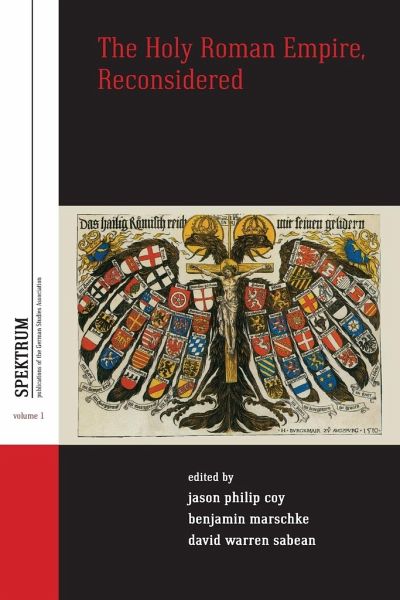
Major revision of the history of the Holy Roman Empire Studies in Early Modern European political communication Studies in Early Modern European symbolic systems Political cultures of Early Modern Germany
Major revision of the history of the Holy Roman Empire Studies in Early Modern European political communication Studies in Early Modern European symbolic systems Political cultures of Early Modern Germany
Jason Philip Coy is an Associate Professor of History at the College of Charleston, in Charleston, South Carolina. He has received a DAAD Research Grant and a Maria Sibylla Merian Fellowship for Postdoctoral Studies from the University of Erfurt, Germany. He is the author of Strangers and Misfits: Banishment, Social Control, and Authority in Early Modern Germany (2008).
Inhaltsangabe
List of Illustrations Series Preface Volume Preface List of Contributors Introduction: The Holy Roman Empire in History and Historiography Jason Coy SECTION I: PRESENCE, PERFORMANCE, AND TEXT Chapter 1. Discontinuities: Political Transformation, Media Change, and the City in the Holy Roman Empire from the Fifteenth to Seventeenth Centuries Philip Hoffmann-Rehnitz Chapter 2. Overloaded Interaction: Effects of the Growing Use of Writing in German Imperial Cities, 1500-1800 Alexander Schlaak Chapter 3. Princes' Power, Aristocratic Norms, and Personal Eccentricities: Le Caractère Bizarre of Frederick William I of Prussia (1713-1740) Benjamin Marschke SECTION II: SYMBOLIC MEANING, IDENTITY, AND MEMORY Chapter 4. The Illuminated Reich: Memory, Crisis, and the Visibility of Monarchy in Late Medieval Germany Len Scales Chapter 5. The Production of Knowledge about Confessions: Witnesses and their Testimonies about Normative Years in and after the Thirty Years' War Ralf-Peter Fuchs Chapter 6. Staging Individual Rank and Corporate Identity: Pre-Modern Nobilities in Provincial Politics Elizabeth Harding 7. The Importance of Being Seated: Ceremonial Conflict in Territorial Diets Tim Neu SECTION III: CEREMONY, PROCEDURE, AND LEGITIMATION Chapter 8. Ceremony and Dissent: Religion, Procedural Conflicts, and the "Fiction of Consensus" in Seventeenth-Century Germany David M. Luebke Chapter 9. Contested Bodies: Schwäbisch Hall and its Neighbors in Conflicts Regarding High Jurisdiction (1550-1800) Patrick Oelze Chapter 10. Conflict and Consensus around German Princes' Unequal Marriages: Prince's Autonomy, Emperor's Intervention, and the Juridification of Dynastic Politics Michael Sikora Chapter 11. Power and Good Governance: The Removal of Ruling Princes in the Holy Roman Empire, 1680-1794 Werner Trossbach SECTION IV: IMPERIAL INSTITUTIONS, CONFESSION, AND POWER RELATIONS Chapter 12. Marital Affairs as a Public Matter within the Holy Roman Empire: The Case of Duke Ulrich and Duchess Sabine of Württemberg at the Beginning of the Sixteenth Century Michaela Hohkamp Chapter 13. The Corpus Evangelicorum: A Culturalist Perspective on its Procedure in the Eighteenth-Century Holy Roman Empire Andreas Kalipke Chapter 14. Gallican Longings: Church and Nation in Eighteenth-Century Germany Michael Printy Conclusion: New Directions in the Study of the Holy Roman Empire - A Cultural Approach André Krischer Glossary Bibliography Index
List of Illustrations Series Preface Volume Preface List of Contributors Introduction: The Holy Roman Empire in History and Historiography Jason Coy SECTION I: PRESENCE, PERFORMANCE, AND TEXT Chapter 1. Discontinuities: Political Transformation, Media Change, and the City in the Holy Roman Empire from the Fifteenth to Seventeenth Centuries Philip Hoffmann-Rehnitz Chapter 2. Overloaded Interaction: Effects of the Growing Use of Writing in German Imperial Cities, 1500-1800 Alexander Schlaak Chapter 3. Princes' Power, Aristocratic Norms, and Personal Eccentricities: Le Caractère Bizarre of Frederick William I of Prussia (1713-1740) Benjamin Marschke SECTION II: SYMBOLIC MEANING, IDENTITY, AND MEMORY Chapter 4. The Illuminated Reich: Memory, Crisis, and the Visibility of Monarchy in Late Medieval Germany Len Scales Chapter 5. The Production of Knowledge about Confessions: Witnesses and their Testimonies about Normative Years in and after the Thirty Years' War Ralf-Peter Fuchs Chapter 6. Staging Individual Rank and Corporate Identity: Pre-Modern Nobilities in Provincial Politics Elizabeth Harding 7. The Importance of Being Seated: Ceremonial Conflict in Territorial Diets Tim Neu SECTION III: CEREMONY, PROCEDURE, AND LEGITIMATION Chapter 8. Ceremony and Dissent: Religion, Procedural Conflicts, and the "Fiction of Consensus" in Seventeenth-Century Germany David M. Luebke Chapter 9. Contested Bodies: Schwäbisch Hall and its Neighbors in Conflicts Regarding High Jurisdiction (1550-1800) Patrick Oelze Chapter 10. Conflict and Consensus around German Princes' Unequal Marriages: Prince's Autonomy, Emperor's Intervention, and the Juridification of Dynastic Politics Michael Sikora Chapter 11. Power and Good Governance: The Removal of Ruling Princes in the Holy Roman Empire, 1680-1794 Werner Trossbach SECTION IV: IMPERIAL INSTITUTIONS, CONFESSION, AND POWER RELATIONS Chapter 12. Marital Affairs as a Public Matter within the Holy Roman Empire: The Case of Duke Ulrich and Duchess Sabine of Württemberg at the Beginning of the Sixteenth Century Michaela Hohkamp Chapter 13. The Corpus Evangelicorum: A Culturalist Perspective on its Procedure in the Eighteenth-Century Holy Roman Empire Andreas Kalipke Chapter 14. Gallican Longings: Church and Nation in Eighteenth-Century Germany Michael Printy Conclusion: New Directions in the Study of the Holy Roman Empire - A Cultural Approach André Krischer Glossary Bibliography Index
Es gelten unsere Allgemeinen Geschäftsbedingungen: www.buecher.de/agb
Impressum
www.buecher.de ist ein Internetauftritt der buecher.de internetstores GmbH
Geschäftsführung: Monica Sawhney | Roland Kölbl | Günter Hilger
Sitz der Gesellschaft: Batheyer Straße 115 - 117, 58099 Hagen
Postanschrift: Bürgermeister-Wegele-Str. 12, 86167 Augsburg
Amtsgericht Hagen HRB 13257
Steuernummer: 321/5800/1497
USt-IdNr: DE450055826