Pita Kelekna
The Horse in Human History
Pita Kelekna
The Horse in Human History
- Gebundenes Buch
- Merkliste
- Auf die Merkliste
- Bewerten Bewerten
- Teilen
- Produkt teilen
- Produkterinnerung
- Produkterinnerung
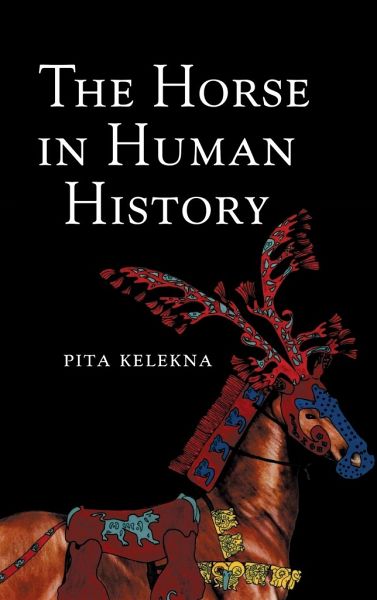
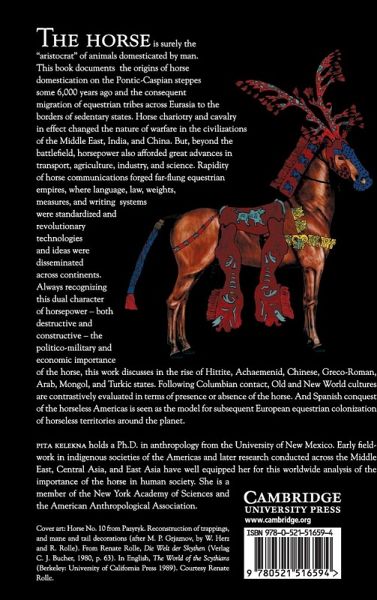
The book assesses the impact of the horse on human society from 4000 BC to AD 2000.
Andere Kunden interessierten sich auch für
John Clark RidpathRidpath's History of the World: Being an Account of the Principal Events in the Career of the Human Race From the Beginnings of Civilization to the Pr32,99 €
Nathaniel WanleyThe Wonders Of The Little World: Or, A General History Of Man, Displaying The Various Faculties, Capacities, Powers And Defects Of The Human Body And36,99 €
John Clark RidpathRidpath's History of the World: Being an Account of the Principal Events in the Career of the Human Race From the Beginnings of Civilization to the Pr34,99 €
Henry John RousOn the Laws and Practice of Horse Racing, Etc., Etc29,99 €
Thomas ClarksonAn Essay on the Slavery and Commerce of the Human Species, Particularly the African19,99 €
John Clark RidpathRidpath's History of the World; Being an Account of the Principal Events in the Career of the Human Race From the Beginnings of Civilization to the Pr32,99 €
Horace BushnellA Discourse on the Moral Tendencies and Results of Human History25,99 €-
-
-
The book assesses the impact of the horse on human society from 4000 BC to AD 2000.
Produktdetails
- Produktdetails
- Verlag: Cambridge University Press
- Seitenzahl: 478
- Erscheinungstermin: 11. Juni 2009
- Englisch
- Abmessung: 235mm x 157mm x 30mm
- Gewicht: 837g
- ISBN-13: 9780521516594
- ISBN-10: 0521516595
- Artikelnr.: 25546094
- Herstellerkennzeichnung
- Libri GmbH
- Europaallee 1
- 36244 Bad Hersfeld
- gpsr@libri.de
- Verlag: Cambridge University Press
- Seitenzahl: 478
- Erscheinungstermin: 11. Juni 2009
- Englisch
- Abmessung: 235mm x 157mm x 30mm
- Gewicht: 837g
- ISBN-13: 9780521516594
- ISBN-10: 0521516595
- Artikelnr.: 25546094
- Herstellerkennzeichnung
- Libri GmbH
- Europaallee 1
- 36244 Bad Hersfeld
- gpsr@libri.de
Pita Kelekna holds a Ph.D. in anthropology from the University of New Mexico. Early fieldwork in indigenous societies of the Americas and later research conducted across the Middle East, Central and East Asia have well equipped her for this world-wide analysis of the importance of the horse in human society. She is a member of the New York Academy of Sciences and the American Anthropological Association.
1. Introduction to equestrian man and to Equus
2. Equus Caballus: horse domestication and Agro-Pastoralism across the Eurasian steppes
3. Nomadic horse culture of the steppes
4. Expansion from the steppes to Southwestern and Southern Asia
5. China and the steppes beyond its borders
6. Equestrian Europe - solar edifices, hippodromes, and Arthurian chivalry
7. Arabian conquest from the South
8. Turkic-invader converts to Islam and crusader opponents
9. From the steppes, the Altaic nomad conquest of Eurasia
10. From Europe, Equus returns to its continent of origin
11. Horses are us.
2. Equus Caballus: horse domestication and Agro-Pastoralism across the Eurasian steppes
3. Nomadic horse culture of the steppes
4. Expansion from the steppes to Southwestern and Southern Asia
5. China and the steppes beyond its borders
6. Equestrian Europe - solar edifices, hippodromes, and Arthurian chivalry
7. Arabian conquest from the South
8. Turkic-invader converts to Islam and crusader opponents
9. From the steppes, the Altaic nomad conquest of Eurasia
10. From Europe, Equus returns to its continent of origin
11. Horses are us.
1. Introduction to equestrian man and to Equus
2. Equus Caballus: horse domestication and Agro-Pastoralism across the Eurasian steppes
3. Nomadic horse culture of the steppes
4. Expansion from the steppes to Southwestern and Southern Asia
5. China and the steppes beyond its borders
6. Equestrian Europe - solar edifices, hippodromes, and Arthurian chivalry
7. Arabian conquest from the South
8. Turkic-invader converts to Islam and crusader opponents
9. From the steppes, the Altaic nomad conquest of Eurasia
10. From Europe, Equus returns to its continent of origin
11. Horses are us.
2. Equus Caballus: horse domestication and Agro-Pastoralism across the Eurasian steppes
3. Nomadic horse culture of the steppes
4. Expansion from the steppes to Southwestern and Southern Asia
5. China and the steppes beyond its borders
6. Equestrian Europe - solar edifices, hippodromes, and Arthurian chivalry
7. Arabian conquest from the South
8. Turkic-invader converts to Islam and crusader opponents
9. From the steppes, the Altaic nomad conquest of Eurasia
10. From Europe, Equus returns to its continent of origin
11. Horses are us.