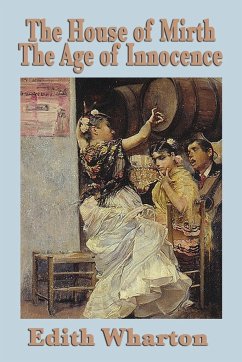
Like most Wharton novels, The House of Mirth examines the conflict between rigid social expectation and personal desire. Lily Bart is adept at playing society's games, which expect her to achieve an advantageous marriage. Yet, torn between her desire for luxurious living and a relationship based on mutual respect and love, she manages to sabotage all her possible chances for a wealthy marriage. The Age of Innocence is set in upper class New York City in the 1870s, and centers on an upper class couple's impending marriage, and the introduction of a woman plagued by scandal whose presence…mehr
Like most Wharton novels, The House of Mirth examines the conflict between rigid social expectation and personal desire. Lily Bart is adept at playing society's games, which expect her to achieve an advantageous marriage. Yet, torn between her desire for luxurious living and a relationship based on mutual respect and love, she manages to sabotage all her possible chances for a wealthy marriage. The Age of Innocence is set in upper class New York City in the 1870s, and centers on an upper class couple's impending marriage, and the introduction of a woman plagued by scandal whose presence threatens their happiness. Though the novel questions the assumptions and morals of 1870's New York society, it never devolves into an outright condemnation.
Edith Wharton (1862-1937) was one of the most accomplished and discerning literary figures of the early twentieth century, celebrated for her incisive portrayals of American society and the moral intricacies that underlie human ambition and desire. The first woman to win the Pulitzer Prize for Fiction, she authored enduring masterpieces such as The Age of Innocence, Ethan Frome, and The House of Mirth, blending psychological acuity with an architect's sense of structure and design. A cosmopolitan intellect shaped by both Old World refinement and New World dynamism, Wharton brought to her criticism the same elegance, authority, and moral clarity that define her fiction. In The Writing of Fiction, she offers not merely instruction, but a distilled philosophy of literature-born of a writer who lived deeply within the form.
Es gelten unsere Allgemeinen Geschäftsbedingungen: www.buecher.de/agb
Impressum
www.buecher.de ist ein Internetauftritt der buecher.de internetstores GmbH
Geschäftsführung: Monica Sawhney | Roland Kölbl | Günter Hilger
Sitz der Gesellschaft: Batheyer Straße 115 - 117, 58099 Hagen
Postanschrift: Bürgermeister-Wegele-Str. 12, 86167 Augsburg
Amtsgericht Hagen HRB 13257
Steuernummer: 321/5800/1497
USt-IdNr: DE450055826