
Andere Kunden interessierten sich auch für
 The Quiet Upgrade11,99 €
 Blamestorming21,99 €
 Life Upgrade44,99 €
 Respect the Code!12,99 €
 The Upgrade Mind11,99 €
 Upgrade Your Power24,99 €
 The Myth of Multitasking17,99 €



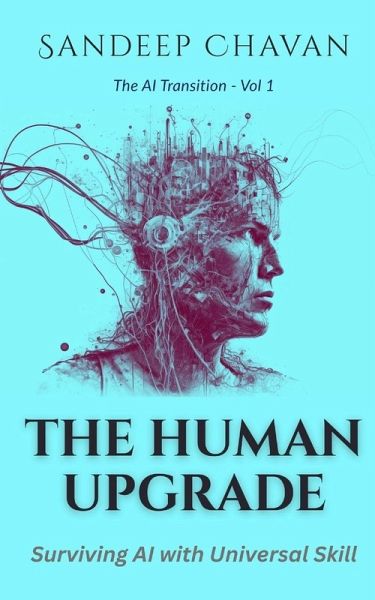
In an age where artificial intelligence writes, designs, diagnoses, predicts, and decides, a deeper question quietly emerges beneath the headlines and hype: what remains for the human mind to do? The Human Upgrade by Sandeep J. Chavan is not another book about machines, tools, or technological trends. It is a book about people-about what happens when automation erases routine, when once-reliable professions dissolve, and when education systems continue training individuals for a past that no longer exists. Across work, learning, and personal identity, this book confronts an uncomfortable truth: the most urgent upgrade required today is not technological, but human. From the Industrial Revolution to the AI-driven world, every major technological shift has rewritten the conditions of survival. Jobs disappear, skills lose value, and social structures reorganize themselves around new capabilities. This book follows that historical arc to show that technology itself has never been the true disruptor. Instead, disruption arises when human thinking, behavior, and institutions fail to evolve alongside the tools they create. Chavan reframes artificial intelligence not as an external threat, but as a consequence of long-standing human choices-our pursuit of efficiency, speed, and control, often without equal attention to adaptability, judgment, and responsibility. AI is not the cause of uncertainty; it exposes uncertainty that was already embedded within rigid systems. At the center of the book is the concept of Universal Skill-a timeless human capacity rooted in awareness, adaptability, emotional alignment, and consequence-based decision-making. Unlike technical skills or habits, which depend on stability, Universal Skill functions precisely when stability disappears. It allows individuals to navigate job loss, reinvent themselves without panic, collaborate with intelligent systems, and retain dignity in environments that no longer offer certainty. The Human Upgrade examines why "safe jobs" collapse first, why habits fail under uncertainty, and why education systems built on repetition struggle to prepare learners for fluid realities. It explores the changing meaning of work, the erosion of traditional career paths, and the growing gap between societies that adapt and those that resist change. Rather than predicting specific futures, the book focuses on patterns of response-how humans behave when familiar structures weaken. Beyond economics and employment, the book turns to a deeper question of identity. In a world where machines execute faster and more efficiently, what remains distinctly human? Empathy, ethical judgment, creativity, and responsibility emerge not as abstract ideals, but as practical survival advantages in complex, automated systems. Blending philosophy, psychology, and real-world observation, The Human Upgrade avoids technical jargon and fear-driven speculation. It offers neither utopian promises nor apocalyptic warnings. Instead, it provides clarity-helping readers understand why disruption feels personal, why anxiety is widespread, and how to remain grounded while navigating continuous change. This book is the first volume in The AI Transition series, which explores the human, social, and global consequences of artificial intelligence. This opening volume focuses on the individual, because no societal transformation succeeds unless people themselves learn how to adapt. The future will not be decided by machines alone. It will be shaped by humans who learn how to think, choose, and respond wisely when certainty disappears. The Human Upgrade is not about surviving the AI age. It is about evolving through it.