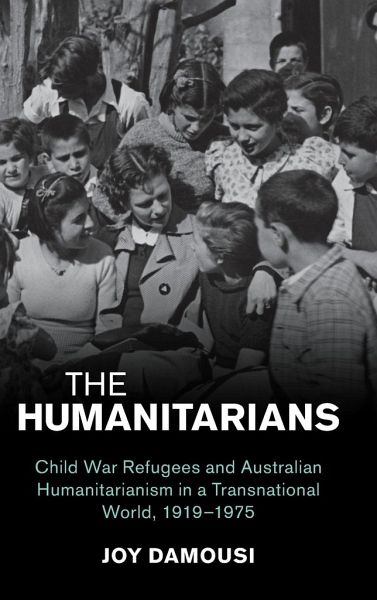
Spanning six decades from the formation of the Save the Children Fund in 1919 to humanitarian interventions during the Vietnam War, The Humanitarians maps the national and international humanitarian efforts undertaken by Australians on behalf of child refugees. In this longitudinal study, Joy Damousi explores the shifting forms of humanitarian activity related to war refugee children over the twentieth century, from child sponsorship, the establishment of orphanages, fundraising, to aid and development schemes and campaigns for inter-country adoption. Framed by conceptualisations of the…mehr
Spanning six decades from the formation of the Save the Children Fund in 1919 to humanitarian interventions during the Vietnam War, The Humanitarians maps the national and international humanitarian efforts undertaken by Australians on behalf of child refugees. In this longitudinal study, Joy Damousi explores the shifting forms of humanitarian activity related to war refugee children over the twentieth century, from child sponsorship, the establishment of orphanages, fundraising, to aid and development schemes and campaigns for inter-country adoption. Framed by conceptualisations of the history of emotions, and the limits and possibilities afforded by empathy and compassion, she considers the vital role of women and includes studies of unknown, but significant, women humanitarian workers and their often-traumatic experience of international humanitarian work. Through an examination of the intersection between racial politics and war refugees, Damousi advances our understanding of humanitarianism over the twentieth century as a deeply racialised and multi-layered practice.
Joy Damousi is Professor of History at the University of Melbourne. She has had a long-standing interest in Australian political history, beginning with her first book published twenty years ago on women in left-wing movements, Women Come Rally: Socialism, communism and gender in Australia 1890-1955 (1994). Since then she has written on various aspects of the politics and impact of war, migration and internationalism throughout the Cold War period. Her books include Living with the Aftermath: Trauma, Nostalgia and Grief in Post-war Australia (2001), Freud in the Antipodes: A Cultural History of Psychoanalysis in Australia (2005) and Colonial Voices: A Cultural History of English in Australia 1840-1940 (2010). She is co-editor of Diversity in Leadership: Australian Women, Past and Present (2014).
Inhaltsangabe
Introduction: The humanitarians: War refugee children, humanitarianism, and transnationalism; Part I. Saving: 1. Save the Children Fund in the Antipodes: Cecilia John, Meredith Atkinson and the paradox of child-saving politics; 2. The Australasian Orphanage at Antilyas: Near East Relief and American networks 1920s-1930; Part II. Evacuating: 3. Humanitarianism and child refugee sponsorship: The Spanish Civil War and Esme Odgers; 4. Campaigns to evacuate Jewish child refugees; 5. British child evacuees to Australia; 6. Aileen Fitzpatrick and reuniting Greek families separated by war; Part III. Assimilating and adopting: 7. Humanitarian rights: UN World Refugee Year and UNICEF in Australia; 8. Florence Grylls and Save the Children Fund: Humanitarianism in the assimilation era; 9. The campaign for Japanese-Australian children to enter Australia; 10. Humanitarian 'justice': Max Harris and the Australian Foster Parents Plan in Asia; 11. Humanitarian activism: The Vietnam War, Rosemary Taylor, Elaine Moir and Margaret Moses; Conclusion.
Es gelten unsere Allgemeinen Geschäftsbedingungen: www.buecher.de/agb
Impressum
www.buecher.de ist ein Internetauftritt der buecher.de internetstores GmbH
Geschäftsführung: Monica Sawhney | Roland Kölbl | Günter Hilger
Sitz der Gesellschaft: Batheyer Straße 115 - 117, 58099 Hagen
Postanschrift: Bürgermeister-Wegele-Str. 12, 86167 Augsburg
Amtsgericht Hagen HRB 13257
Steuernummer: 321/5800/1497
USt-IdNr: DE450055826