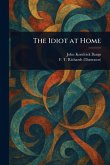
The Idiot is a novel by the 19th-century Russian author Fyodor Dostoevsky. The title is an ironic reference to the central character of the novel, Lev Nikolayevich Myshkin, a young prince whose goodness, open-hearted simplicity, and guilelessness lead many of the more worldly characters he encounters to mistakenly assume that he lacks intelligence and insight. In the character of Prince Myshkin, Dostoevsky set himself the task of depicting 'the positively good and beautiful man.' In The Idiot, the saintly Prince Myshkin returns to Russia from a Swiss sanatorium and finds himself a stranger in…mehr
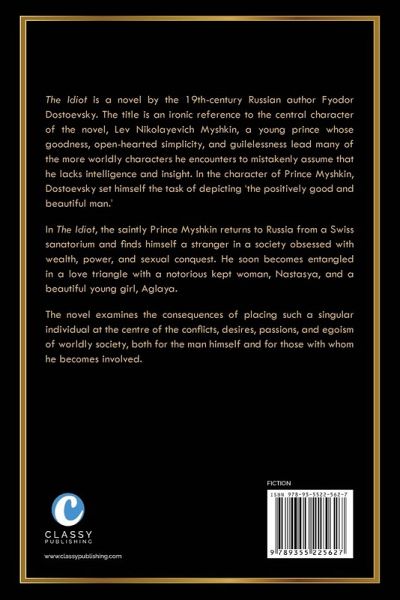
The Idiot is a novel by the 19th-century Russian author Fyodor Dostoevsky. The title is an ironic reference to the central character of the novel, Lev Nikolayevich Myshkin, a young prince whose goodness, open-hearted simplicity, and guilelessness lead many of the more worldly characters he encounters to mistakenly assume that he lacks intelligence and insight. In the character of Prince Myshkin, Dostoevsky set himself the task of depicting 'the positively good and beautiful man.' In The Idiot, the saintly Prince Myshkin returns to Russia from a Swiss sanatorium and finds himself a stranger in a society obsessed with wealth, power, and sexual conquest. He soon becomes entangled in a love triangle with a notorious kept woman, Nastasya, and a beautiful young girl, Aglaya. The novel examines the consequences of placing such a singular individual at the centre of the conflicts, desires, passions, and egoism of worldly society, both for the man himself and for those with whom he becomes involved.
Fyodor Dostoevsky (born in Russia, in 1821) is one of the world's most influential authors, but he lived nearly as many lives as he created on the page. He was a trained military engineer. A civil servant with a side hustle translating manuscripts. A political prisoner and death row inmate serving time in a Siberian prison camp. A reluctant soldier. A journalist. A husband. A gambler on a constant cold streak. It's this lived experience that brings such unmatched depth to his writing-from exile to acclaim, success to suffering, imagination to dark self-destruction. Like his greatest protagonists, the author himself was occasionally detestable and frequently brilliant, and it was through this hard wrought lens that he explored some of life's most urgent themes: faith and free will, self-interest and moral duty, individual responsibility, loneliness, and love. During the lean years, Dostoevsky searched for life's meaning with the same ferocity he chased a lucky break, and his most famous books-Crime and Punishment, The Idiot, The Brothers Karamazov, and Notes from Underground-established him as one of the first existentialists. These works went on to inspire an entire movement, and great minds from Nietzsche to Virginia Woolf to Murakami. When Dostoevsky died at the age of 59, at the height of his literary fame, he had created more than a dozen novels, novellas, and countless short works. Nearly 200 years later, these stories are just as relevant and relatable-in our TikTok feeds and neighborhood book clubs-as they were in the boisterous taverns and literary circles of Imperial Russia. And as the world gets more chaotic and clamoring each year, Dostoevsky's voice becomes clearer.
Es gelten unsere Allgemeinen Geschäftsbedingungen: www.buecher.de/agb
Impressum
www.buecher.de ist ein Internetauftritt der buecher.de internetstores GmbH
Geschäftsführung: Monica Sawhney | Roland Kölbl | Günter Hilger
Sitz der Gesellschaft: Batheyer Straße 115 - 117, 58099 Hagen
Postanschrift: Bürgermeister-Wegele-Str. 12, 86167 Augsburg
Amtsgericht Hagen HRB 13257
Steuernummer: 321/5800/1497
USt-IdNr: DE450055826