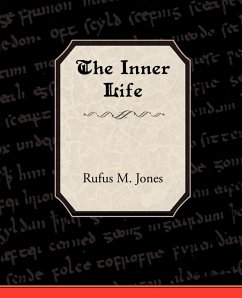
Rufus Jones (1863-1948) said in his introduciton, "There is no inner life that is not also an outer life. To withdraw from the stress and strain of practical action and from the complication of problems into the quiet cell of the inner life in order to build its domain undisturbed is the sure way to lose the inner life. The finest of all the mystical writers of the fourteenth century the author of Theologia Germanica knew this as fully as we of this psychologically trained generation know it. He intensely desired a rich inner life, but he saw that to be beautiful within he must live a radiant…mehr
Rufus Jones (1863-1948) said in his introduciton, "There is no inner life that is not also an outer life. To withdraw from the stress and strain of practical action and from the complication of problems into the quiet cell of the inner life in order to build its domain undisturbed is the sure way to lose the inner life. The finest of all the mystical writers of the fourteenth century the author of Theologia Germanica knew this as fully as we of this psychologically trained generation know it. He intensely desired a rich inner life, but he saw that to be beautiful within he must live a radiant and effective life in the world of men and events." He goes on to say, "Religion does not consist of inward thrills and private enjoyment of God it does not terminate in beatific vision. It is rather the joyous business of carrying the Life of God into the lives of men of being to the eternal God what a man's hand is to a man. There is no one exclusive way either to the supreme realities or to the loftiest experiences of life."
Rufus Matthew Jones was born on January 25, 1863, in South China, Maine, to Edwin Jones and Mary Gifford Hoxie Jones. He became one of the most significant American Quaker figures of the 20th century, known for his influential roles as a theologian, historian, philosopher, editor, and educator. After studying at Haverford College and later Harvard University, he taught philosophy and psychology at Haverford College for many years. A prolific writer, he authored over fifty books, primarily focusing on mysticism, Quaker history, and religious experience. His work often blended scholarly research with spiritual insight, offering a deeper understanding of inner religious life. As the founding editor of the American Friend, he shaped Quaker publications and thought. He was also instrumental in forming the American Friends Service Committee, which received the Nobel Peace Prize in 1947 on behalf of Quakers worldwide. Jones emphasized the importance of direct personal experience of God and advocated for a spirituality grounded in action and moral responsibility. His life was marked by efforts to unite intellectual pursuit with religious conviction. He died on June 16, 1948, in Haverford, Pennsylvania, leaving behind a legacy of spiritual and intellectual leadership.
Es gelten unsere Allgemeinen Geschäftsbedingungen: www.buecher.de/agb
Impressum
www.buecher.de ist ein Internetauftritt der buecher.de internetstores GmbH
Geschäftsführung: Monica Sawhney | Roland Kölbl | Günter Hilger
Sitz der Gesellschaft: Batheyer Straße 115 - 117, 58099 Hagen
Postanschrift: Bürgermeister-Wegele-Str. 12, 86167 Augsburg
Amtsgericht Hagen HRB 13257
Steuernummer: 321/5800/1497
USt-IdNr: DE450055826