S. Frederick Starr, Karen Dawisha
The International Politics of Eurasia
v. 1: The Influence of History
S. Frederick Starr, Karen Dawisha
The International Politics of Eurasia
v. 1: The Influence of History
- Broschiertes Buch
- Merkliste
- Auf die Merkliste
- Bewerten Bewerten
- Teilen
- Produkt teilen
- Produkterinnerung
- Produkterinnerung
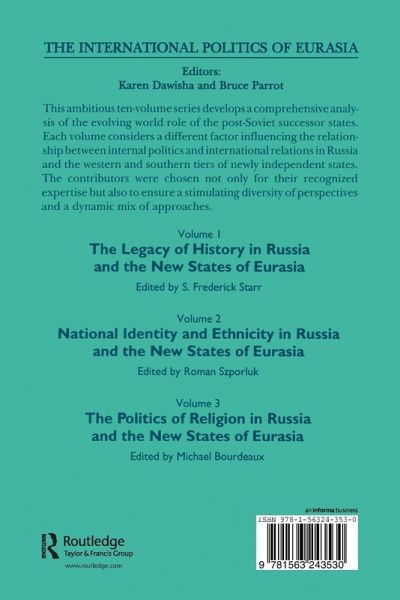
First Published in 1995. Routledge is an imprint of Taylor & Francis, an Informa company.
Andere Kunden interessierten sich auch für
S. Frederick StarrThe International Politics of Eurasia54,99 €
S. Frederick StarrThe International Politics of Eurasia36,99 €
S. Frederick StarrThe International Politics of Eurasia54,99 €
S. Frederick StarrThe International Politics of Eurasia53,99 €
S. Frederick StarrThe International Politics of Eurasia37,99 €
The International Politics of Eurasia27,99 €
The Politics of the Pandemic in Eastern Europe and Eurasia38,99 €-
-
-
First Published in 1995. Routledge is an imprint of Taylor & Francis, an Informa company.
Produktdetails
- Produktdetails
- Verlag: Routledge
- Seitenzahl: 328
- Erscheinungstermin: 30. September 1994
- Englisch
- Abmessung: 229mm x 152mm x 18mm
- Gewicht: 477g
- ISBN-13: 9781563243530
- ISBN-10: 1563243539
- Artikelnr.: 22310400
- Herstellerkennzeichnung
- Libri GmbH
- Europaallee 1
- 36244 Bad Hersfeld
- gpsr@libri.de
- Verlag: Routledge
- Seitenzahl: 328
- Erscheinungstermin: 30. September 1994
- Englisch
- Abmessung: 229mm x 152mm x 18mm
- Gewicht: 477g
- ISBN-13: 9781563243530
- ISBN-10: 1563243539
- Artikelnr.: 22310400
- Herstellerkennzeichnung
- Libri GmbH
- Europaallee 1
- 36244 Bad Hersfeld
- gpsr@libri.de
S. Frederick Starr is a historian and jazz musician. Educated at Yale, Cambridge University, and Princeton, he was the founding secretary of the Kennan Institute for Advanced Russian Studies at The Wilson Center in Washington and served for eleven years as president of Oberlin College in Ohio. In addition to his writings on Soviet and Russian affairs, he has taken an active role in Russian-American relations and served in various advisory capacities to the United States government. Most recently, he is the author of a major biography of the American composer Louis Moreau Gottschalk.
1. Introduction: The Legacy of History in Russia and the New States of
Eurasia I. Russia 2. On Certain Mythical Beliefs and Russian Behaviors 3.
The Yugoslav Question in the Foreign Policy of Russia at the Beginning of
the Twentieth Century 4. Struggle Over the Borderlands II. The Western
Newly Independent States, Map 5. National Identity and Foreign Policy in
the Baltic States 6. History as a Battleground: Russian-Ukrainian Relations
and Historical Consciousness in Contemporary Ukraine 7. Historical Debates
and Territorial Claims: Cossack Mythology in the Russian-Ukrainian Border
Dispute 8. Basic Factors in the Foreign Policy of Ukraine: The Impact of
the Soviet Experience III. The Southern Newly Independent States 9. Central
Asia's Foreign Relations: A Historical Survey 10. The Rediscovery ofUzbek
History and Its Foreign Policy Implications 11. Historical Memory and
Foreign Relations: The Armenian Perspective 12. Azerbaijan: A Borderland at
the Crossroads of History

Eurasia I. Russia 2. On Certain Mythical Beliefs and Russian Behaviors 3.
The Yugoslav Question in the Foreign Policy of Russia at the Beginning of
the Twentieth Century 4. Struggle Over the Borderlands II. The Western
Newly Independent States, Map 5. National Identity and Foreign Policy in
the Baltic States 6. History as a Battleground: Russian-Ukrainian Relations
and Historical Consciousness in Contemporary Ukraine 7. Historical Debates
and Territorial Claims: Cossack Mythology in the Russian-Ukrainian Border
Dispute 8. Basic Factors in the Foreign Policy of Ukraine: The Impact of
the Soviet Experience III. The Southern Newly Independent States 9. Central
Asia's Foreign Relations: A Historical Survey 10. The Rediscovery ofUzbek
History and Its Foreign Policy Implications 11. Historical Memory and
Foreign Relations: The Armenian Perspective 12. Azerbaijan: A Borderland at
the Crossroads of History
1. Introduction: The Legacy of History in Russia and the New States of
Eurasia I. Russia 2. On Certain Mythical Beliefs and Russian Behaviors 3.
The Yugoslav Question in the Foreign Policy of Russia at the Beginning of
the Twentieth Century 4. Struggle Over the Borderlands II. The Western
Newly Independent States, Map 5. National Identity and Foreign Policy in
the Baltic States 6. History as a Battleground: Russian-Ukrainian Relations
and Historical Consciousness in Contemporary Ukraine 7. Historical Debates
and Territorial Claims: Cossack Mythology in the Russian-Ukrainian Border
Dispute 8. Basic Factors in the Foreign Policy of Ukraine: The Impact of
the Soviet Experience III. The Southern Newly Independent States 9. Central
Asia's Foreign Relations: A Historical Survey 10. The Rediscovery ofUzbek
History and Its Foreign Policy Implications 11. Historical Memory and
Foreign Relations: The Armenian Perspective 12. Azerbaijan: A Borderland at
the Crossroads of History
Eurasia I. Russia 2. On Certain Mythical Beliefs and Russian Behaviors 3.
The Yugoslav Question in the Foreign Policy of Russia at the Beginning of
the Twentieth Century 4. Struggle Over the Borderlands II. The Western
Newly Independent States, Map 5. National Identity and Foreign Policy in
the Baltic States 6. History as a Battleground: Russian-Ukrainian Relations
and Historical Consciousness in Contemporary Ukraine 7. Historical Debates
and Territorial Claims: Cossack Mythology in the Russian-Ukrainian Border
Dispute 8. Basic Factors in the Foreign Policy of Ukraine: The Impact of
the Soviet Experience III. The Southern Newly Independent States 9. Central
Asia's Foreign Relations: A Historical Survey 10. The Rediscovery ofUzbek
History and Its Foreign Policy Implications 11. Historical Memory and
Foreign Relations: The Armenian Perspective 12. Azerbaijan: A Borderland at
the Crossroads of History