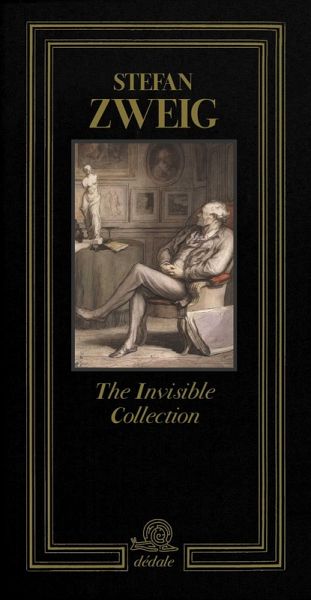
Stefan Zweig's The Invisible Collection still manages to strike the reader with its ability to masterfully sketch the contours of collecting obsession. Illustrated by paintings Daumier dedicated to collectors, this second book in the Dédale series is opened by Pedro Corrêa do Lago's preface, which is followed by Guillaume Glorieux's introduction. First published in 1925, Austrian writer Stefan Zweig's short story The Invisible Collection still manages to strike the reader with its ability to masterfully sketch the contours of collecting obsession. Deeply fascinated by the innovations that…mehr
Stefan Zweig's The Invisible Collection still manages to strike the reader with its ability to masterfully sketch the contours of collecting obsession. Illustrated by paintings Daumier dedicated to collectors, this second book in the Dédale series is opened by Pedro Corrêa do Lago's preface, which is followed by Guillaume Glorieux's introduction. First published in 1925, Austrian writer Stefan Zweig's short story The Invisible Collection still manages to strike the reader with its ability to masterfully sketch the contours of collecting obsession. Deeply fascinated by the innovations that enriched European thought in the 1920s, first and foremost psychoanalysis, which also echoes among these pages, Zweig constructs a story that, despite being deeply anchored in time and space, is still relevant and full of humanity. In addition to the engravings by Dürer and Rembrandt mentioned in the story, this second book in the Dédale series is illustrated by the paintings that the French painter Honoré Daumier. It is opened by a preface by Brazilian writer Pedro Corrêa do Lago, who shares with Zweig a collecting passion for letters and autograph manuscripts by well-known authors, which is followed by an introduction by Guillaume Glorieux, who focuses on the relationship between collection and wealth, as well as the importance of collecting and the joy of sharing.
Stefan Zweig was born in Vienna in 1881. After obtaining a degree in philosophy, he had the opportunity to travel extensively and live in a number of European cities. These experiences made him a cosmopolitan soul with a great interest in the wealth of innovations in European thought and culture. First and foremost among these was psychoanalysis, whose echoes are frequently found in his literary works. He debuted in his early twenties with a collection of poems. After that, his body of work developed in several directions, as if to reflect his universalist and humanist leanings: he wrote plays, novels and short stories, biographies, poems, many of them successful, including Amok, Decisive Moments in History and The Royal Game. Because of his anti-nationalist stances and Jewish origins, his life in Austria at the rise of Nazism became difficult: in 1933 his books were put on the list of those to be burned. The following year, he was subjected to a raid that compelled him to emigrate first to London, then, in 1940, to New York and finally, Brazil. On 23 February 1942, in the city of Petrópolis, disheartened by the vision of the destruction of the world and the ideals in which he believed, and plagued by fits of depression, he took his own life along with his second wife.
Es gelten unsere Allgemeinen Geschäftsbedingungen: www.buecher.de/agb
Impressum
www.buecher.de ist ein Internetauftritt der buecher.de internetstores GmbH
Geschäftsführung: Monica Sawhney | Roland Kölbl | Günter Hilger
Sitz der Gesellschaft: Batheyer Straße 115 - 117, 58099 Hagen
Postanschrift: Bürgermeister-Wegele-Str. 12, 86167 Augsburg
Amtsgericht Hagen HRB 13257
Steuernummer: 321/5800/1497
USt-IdNr: DE450055826